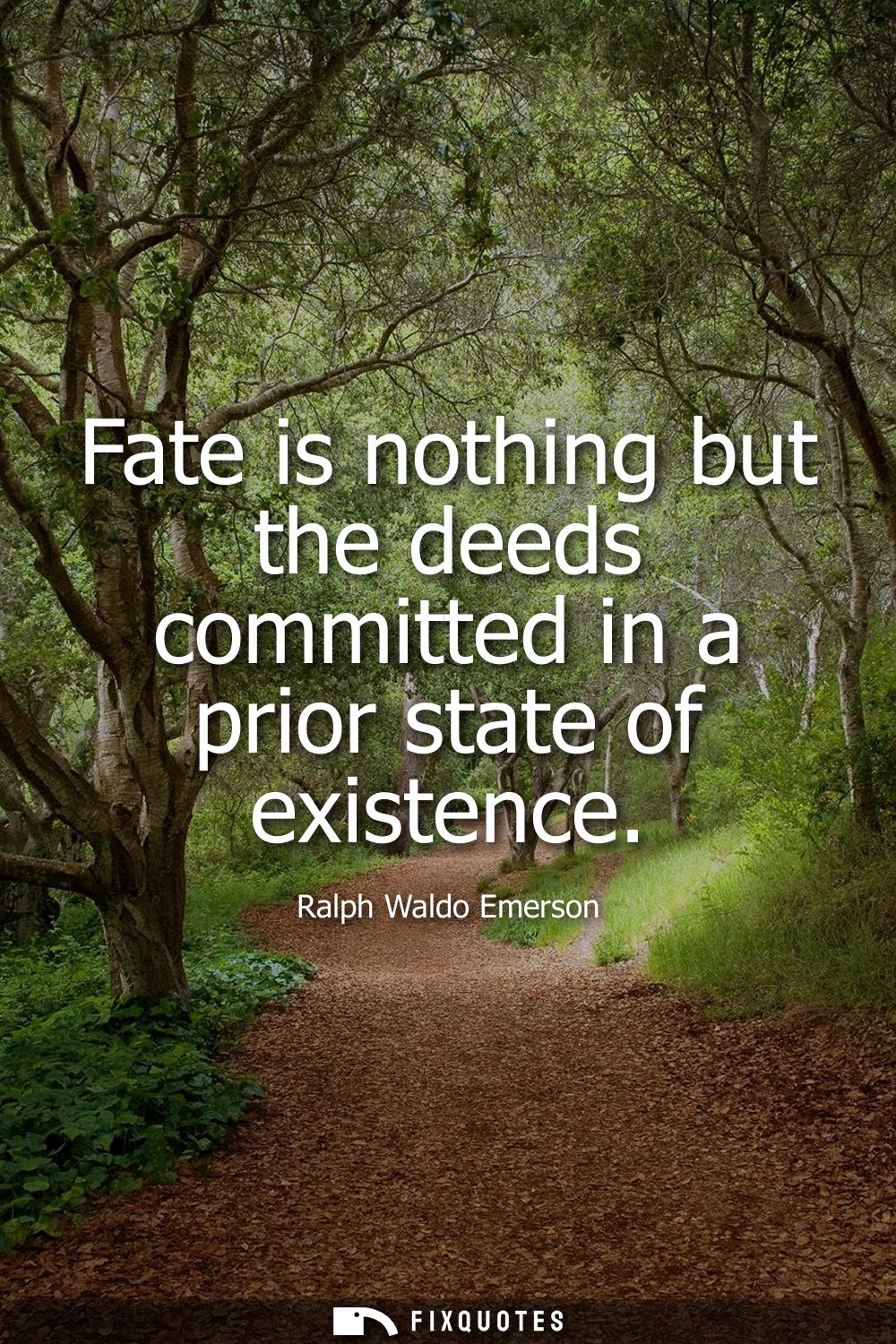
"Fate is nothing but the deeds committed in a prior state of existence"
About this Quote
The intent is less metaphysical than disciplinary. Emerson is writing in a 19th-century America drunk on possibility yet still haunted by inherited hierarchies, Puritan guilt, and the new secular temptation to treat life as pure chance. He wants a universe where consequences stick, where your circumstances aren’t a cosmic coin flip but a ledger. "Prior state of existence" borrows the aroma of reincarnation without fully committing to Eastern doctrine; it’s a strategic ambiguity that lets him smuggle in karmic logic while staying legible to Christian-trained readers. You don’t need literal past lives for the idea to land. Your "prior state" can be yesterday’s habit, your family’s history, your nation’s sins.
Subtext: stop romanticizing powerlessness. Emerson’s self-reliance often gets marketed as inspirational wallpaper, but here it’s sterner. Fate becomes the long shadow of action, a way of saying: you are not trapped by destiny; you are trapped by patterns you (or your predecessors) set in motion. It works because it flatters and accuses at once, granting agency even as it denies excuses.
Quote Details
| Topic | Free Will & Fate |
|---|---|
| Source | Help us find the source |
| Cite |
Citation Formats
APA Style (7th ed.)
Emerson, Ralph Waldo. (2026, January 18). Fate is nothing but the deeds committed in a prior state of existence. FixQuotes. https://fixquotes.com/quotes/fate-is-nothing-but-the-deeds-committed-in-a-14168/
Chicago Style
Emerson, Ralph Waldo. "Fate is nothing but the deeds committed in a prior state of existence." FixQuotes. January 18, 2026. https://fixquotes.com/quotes/fate-is-nothing-but-the-deeds-committed-in-a-14168/.
MLA Style (9th ed.)
"Fate is nothing but the deeds committed in a prior state of existence." FixQuotes, 18 Jan. 2026, https://fixquotes.com/quotes/fate-is-nothing-but-the-deeds-committed-in-a-14168/. Accessed 24 Mar. 2026.