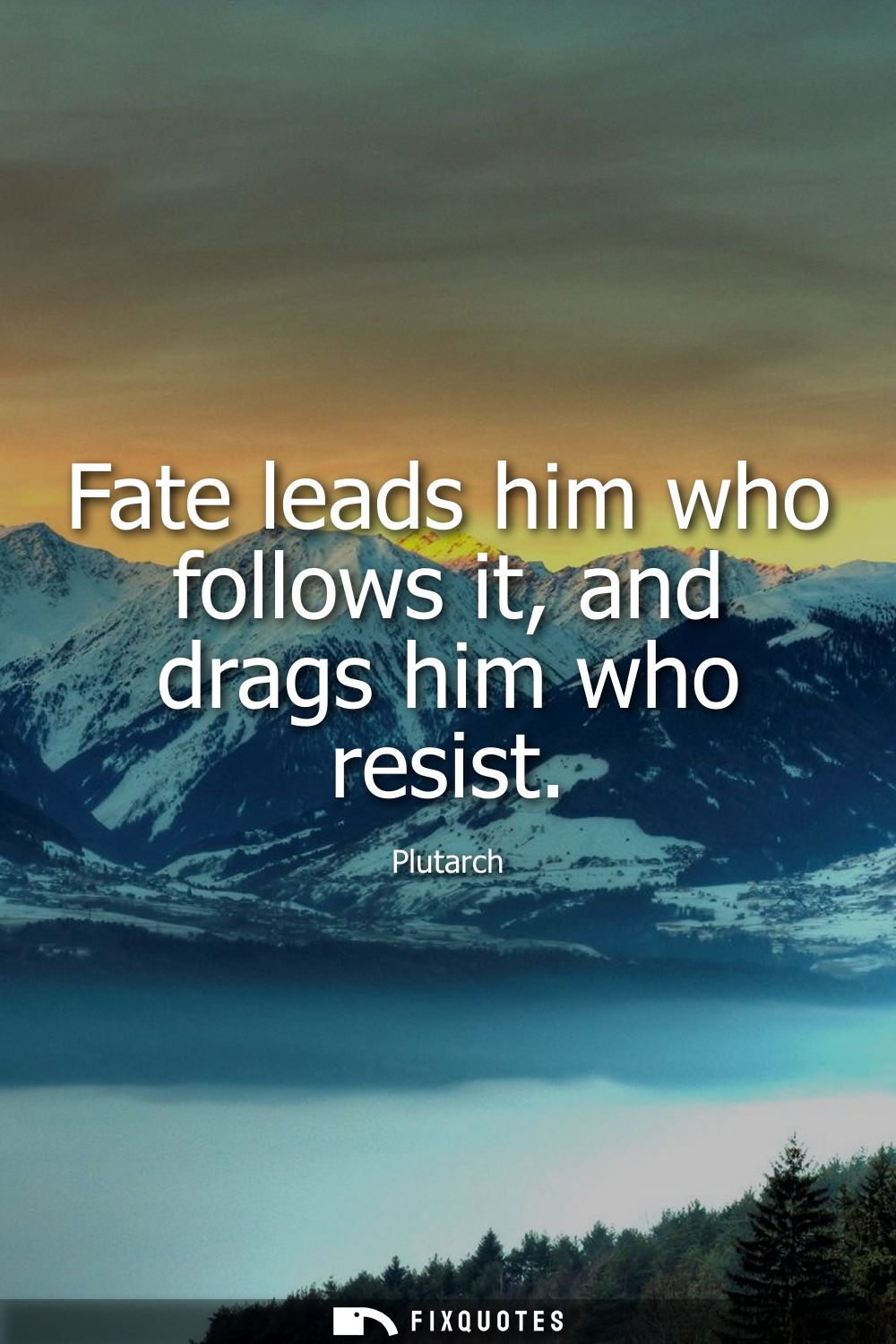
"Fate leads him who follows it, and drags him who resist"
About this Quote
Plutarch’s line lands like a proverb, but it’s really an argument about dignity under pressure. “Fate” here isn’t a mystical puppet-master so much as the sum of forces bigger than any one person: political upheaval, illness, aging, imperial power, the limits of character. You can pretend you’re steering, Plutarch implies, but history and circumstance are steering too. The question isn’t whether you’ll be moved, it’s whether you’ll walk with the motion or be hauled by it.
The craft is in the physical verbs. “Leads” preserves the subject’s posture; “drags” humiliates. Same destination, radically different self-conception. That’s classic Greco-Roman moral psychology: virtue is less about controlling events than about controlling your response to them. The quote also flatters the reader into choosing the nobler role. No one wants to be the one getting dragged.
Context matters: Plutarch lived under the Roman Empire, writing biography and moral essays in a world where individual agency was real but sharply bounded. You could cultivate your soul, serve your city, educate your children; you couldn’t vote Caesar out. Stoic and Platonic currents run beneath the sentence: alignment with necessity becomes a form of freedom, not because it changes reality, but because it changes the kind of person reality is acting upon.
The subtext is a warning against performative defiance. Resistance can be brave, but it can also be vanity that mistakes friction for control. Plutarch isn’t canceling choice; he’s narrowing it to the one choice that always remains: cooperation with what cannot be negotiated, so you can save your strength for what can.
The craft is in the physical verbs. “Leads” preserves the subject’s posture; “drags” humiliates. Same destination, radically different self-conception. That’s classic Greco-Roman moral psychology: virtue is less about controlling events than about controlling your response to them. The quote also flatters the reader into choosing the nobler role. No one wants to be the one getting dragged.
Context matters: Plutarch lived under the Roman Empire, writing biography and moral essays in a world where individual agency was real but sharply bounded. You could cultivate your soul, serve your city, educate your children; you couldn’t vote Caesar out. Stoic and Platonic currents run beneath the sentence: alignment with necessity becomes a form of freedom, not because it changes reality, but because it changes the kind of person reality is acting upon.
The subtext is a warning against performative defiance. Resistance can be brave, but it can also be vanity that mistakes friction for control. Plutarch isn’t canceling choice; he’s narrowing it to the one choice that always remains: cooperation with what cannot be negotiated, so you can save your strength for what can.
Quote Details
| Topic | Free Will & Fate |
|---|---|
| Source | Later attribution: The Corpse Lodging (EJ Henry, 2015) modern compilationISBN: 9781910333020 · ID: YSHLCgAAQBAJ
Evidence:
‘Fate leads him who follows it, and drags him who resist.’ Plutarch (46-120), Greek essayist, and biographer Having suffered terrible trauma as a hostage of Somali pirates, Ed Donovan is relieved to be welcomed into the isolated but ... |
| Cite |
Citation Formats
APA Style (7th ed.)
Plutarch. (2026, February 11). Fate leads him who follows it, and drags him who resist. FixQuotes. https://fixquotes.com/quotes/fate-leads-him-who-follows-it-and-drags-him-who-27142/
Chicago Style
Plutarch. "Fate leads him who follows it, and drags him who resist." FixQuotes. February 11, 2026. https://fixquotes.com/quotes/fate-leads-him-who-follows-it-and-drags-him-who-27142/.
MLA Style (9th ed.)
"Fate leads him who follows it, and drags him who resist." FixQuotes, 11 Feb. 2026, https://fixquotes.com/quotes/fate-leads-him-who-follows-it-and-drags-him-who-27142/. Accessed 21 Mar. 2026.
More Quotes by Plutarch
Add to List