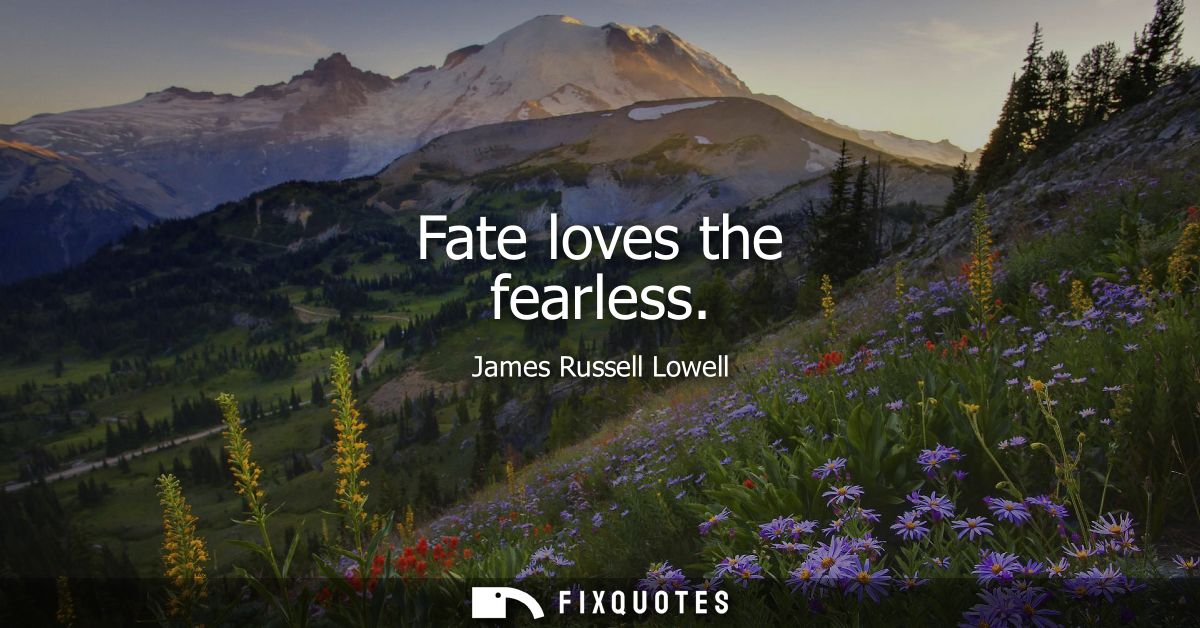
"Fate loves the fearless!"
About this Quote
"Fate loves the fearless" flatters you into bravery by pretending the universe has a crush. Lowell compresses an entire moral worldview into five clean words: history (or providence, or luck) is not neutral machinery but a selective force with preferences. The line works because it turns courage into a kind of social skill, not just a private virtue. Be bold, and the world leans your way.
As a poet shaped by the 19th century's appetite for moral uplift, Lowell is trafficking in a familiar cultural engine: the belief that character can bend circumstance. That idea was useful in an era of reform movements and national convulsions, when "fate" could be read as God, nation, or the verdict of history itself. The aphorism offers a secular-sounding providence: you don't need a sermon, just nerve.
The subtext is slightly more cunning than a motivational poster. It doesn't claim fearlessness makes you invulnerable; it suggests fearlessness makes you legible to opportunity. Fate "loves" the fearless because the fearless act, and action creates narrative. In public life, narrative is power: people follow the one who moves first, institutions reward the one who decides, and even randomness gets retroactively framed as destiny when someone has the audacity to claim it.
There's irony tucked inside the romance. Fate isn't a lover; it's indifferent. The line dares you to behave as if it isn't, because that posture can manufacture the very breaks you later call fate.
As a poet shaped by the 19th century's appetite for moral uplift, Lowell is trafficking in a familiar cultural engine: the belief that character can bend circumstance. That idea was useful in an era of reform movements and national convulsions, when "fate" could be read as God, nation, or the verdict of history itself. The aphorism offers a secular-sounding providence: you don't need a sermon, just nerve.
The subtext is slightly more cunning than a motivational poster. It doesn't claim fearlessness makes you invulnerable; it suggests fearlessness makes you legible to opportunity. Fate "loves" the fearless because the fearless act, and action creates narrative. In public life, narrative is power: people follow the one who moves first, institutions reward the one who decides, and even randomness gets retroactively framed as destiny when someone has the audacity to claim it.
There's irony tucked inside the romance. Fate isn't a lover; it's indifferent. The line dares you to behave as if it isn't, because that posture can manufacture the very breaks you later call fate.
Quote Details
| Topic | Free Will & Fate |
|---|---|
| Source | Help us find the source |
| Cite |
Citation Formats
APA Style (7th ed.)
Lowell, James Russell. (2026, February 20). Fate loves the fearless! FixQuotes. https://fixquotes.com/quotes/fate-loves-the-fearless-26767/
Chicago Style
Lowell, James Russell. "Fate loves the fearless!" FixQuotes. February 20, 2026. https://fixquotes.com/quotes/fate-loves-the-fearless-26767/.
MLA Style (9th ed.)
"Fate loves the fearless!" FixQuotes, 20 Feb. 2026, https://fixquotes.com/quotes/fate-loves-the-fearless-26767/. Accessed 7 Mar. 2026.
More Quotes by James
Add to List