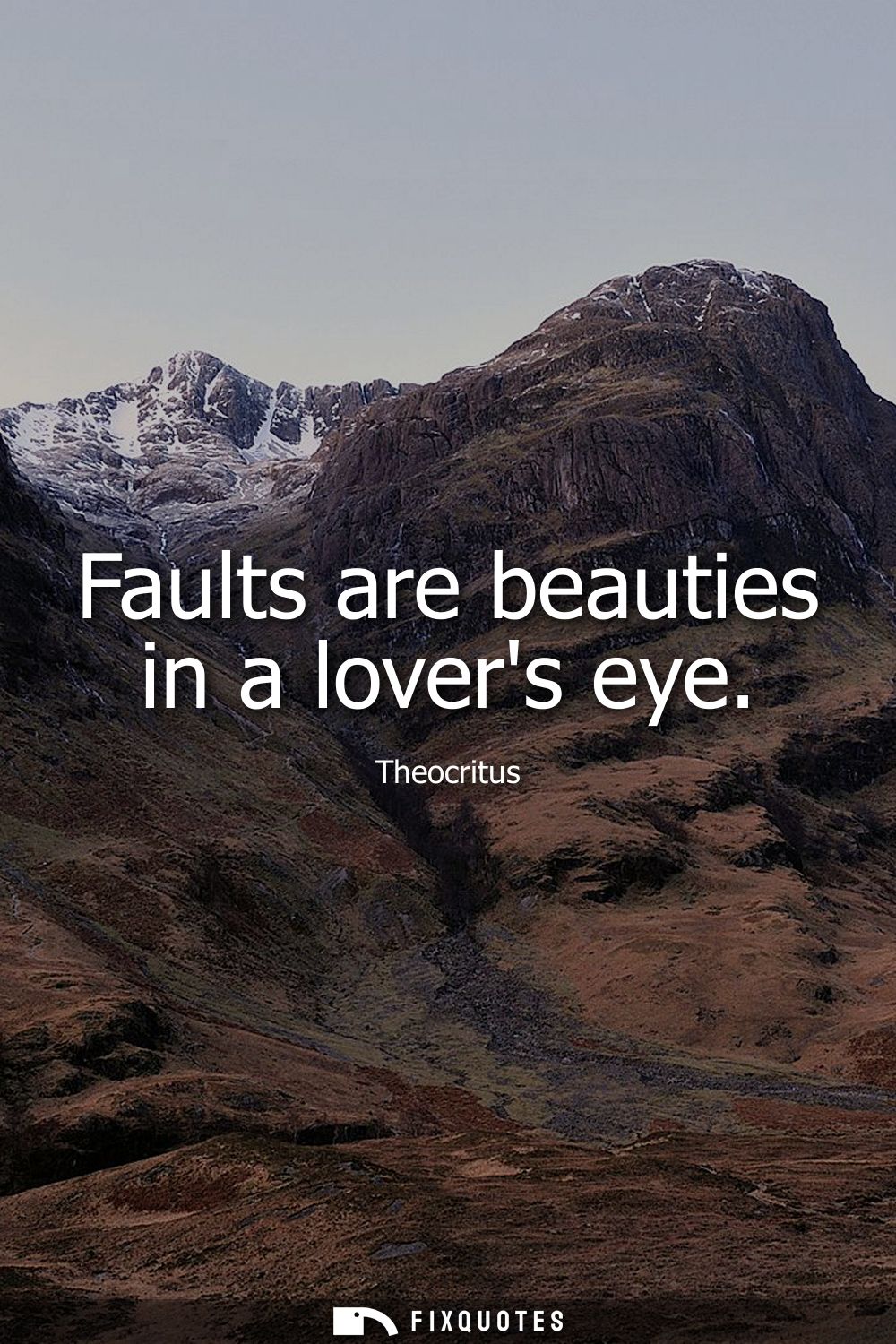
"Faults are beauties in a lover's eye"
About this Quote
Desire doesn’t just soften the world; it edits it. Theocritus’s line, "Faults are beauties in a lover’s eye", is a neat reversal of moral accounting: what should count against someone gets reclassified as charm the moment affection takes the wheel. It works because it’s not offering a sentimental excuse for love so much as exposing love’s most persuasive trick - its ability to aestheticize the inconvenient. A stutter becomes “endearing.” Jealousy becomes “passion.” Moodiness becomes “depth.” The phrase “lover’s eye” is doing the heavy lifting: love isn’t presented as a truth-serum but as a lens, a private filter that can turn defects into features.
Theocritus, writing in the Hellenistic world and famous for pastoral poetry, is keenly aware of performance - of how people curate themselves and each other in small communities where everyone sees everything. In that setting, the line feels less like a Hallmark blessing and more like a quietly amused diagnosis. Lovers aren’t merely blind; they’re imaginative, collaborators in a story that makes the beloved legible as exceptional.
The subtext has bite: if faults can be recast as beauties, then “beauty” itself is unstable, contingent, and socially negotiated. The quote flatters love while also warning about it. Romantic devotion can be generous, even humane - it grants complexity where the crowd would render a verdict. It can also be a kind of complicity, turning red flags into decor. Theocritus captures both in a single, deceptively gentle sentence.
Theocritus, writing in the Hellenistic world and famous for pastoral poetry, is keenly aware of performance - of how people curate themselves and each other in small communities where everyone sees everything. In that setting, the line feels less like a Hallmark blessing and more like a quietly amused diagnosis. Lovers aren’t merely blind; they’re imaginative, collaborators in a story that makes the beloved legible as exceptional.
The subtext has bite: if faults can be recast as beauties, then “beauty” itself is unstable, contingent, and socially negotiated. The quote flatters love while also warning about it. Romantic devotion can be generous, even humane - it grants complexity where the crowd would render a verdict. It can also be a kind of complicity, turning red flags into decor. Theocritus captures both in a single, deceptively gentle sentence.
Quote Details
| Topic | Love |
|---|
More Quotes by Theocritus
Add to List