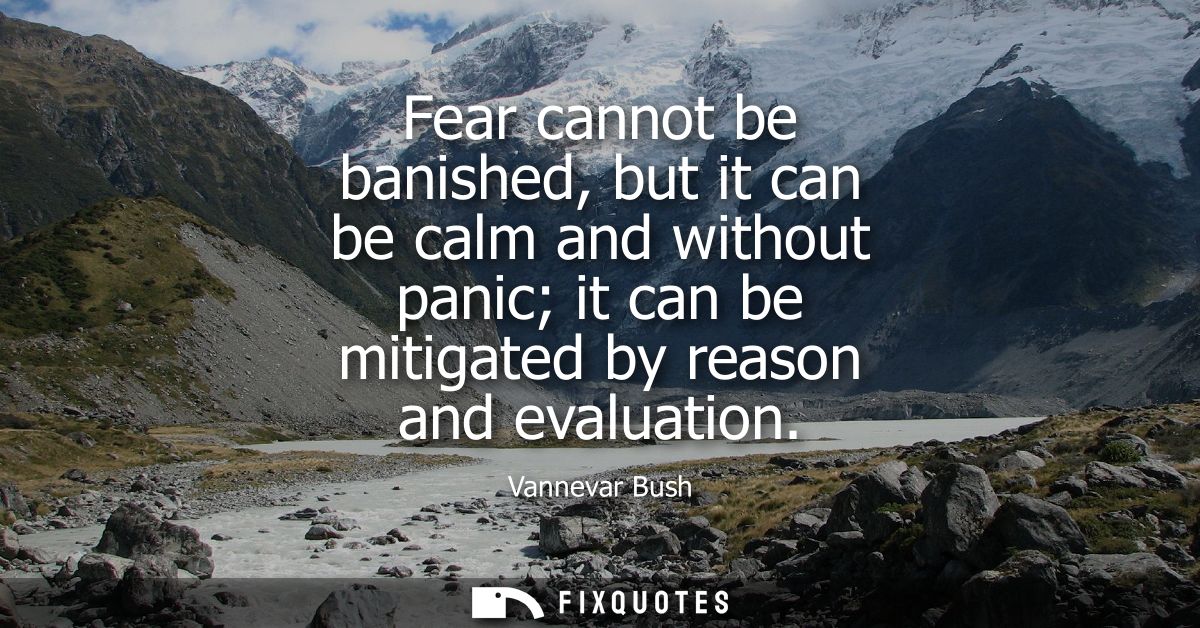
"Fear cannot be banished, but it can be calm and without panic; it can be mitigated by reason and evaluation"
About this Quote
The subtext is technocratic, and historically loaded. Bush helped architect the midcentury American research apparatus and advised presidents through a period when “fear” wasn’t abstract: world war, nuclear weapons, the beginning of Cold War paranoia. In that atmosphere, panic wasn’t merely personal weakness; it was political fuel. It justified bad policy, scapegoating, secrecy, and the kind of stampede thinking that treats worst-case scenarios as certainties. By insisting on “reason and evaluation,” Bush is arguing for a civic ethic: decisions should be made like experiments, with hypotheses, evidence, and an honest accounting of uncertainty.
The rhetoric works because it’s modest. He doesn’t promise comfort, only stability. That restraint reads as a rebuttal to propaganda and to the seductive narrative that safety comes from absolute certainty. Bush’s line is a reminder that fear can coexist with clarity - and that maturity, individual or national, is measured by what you do while afraid.
Quote Details
| Topic | Fear |
|---|---|
| Source | Help us find the source |
| Cite |
Citation Formats
APA Style (7th ed.)
Bush, Vannevar. (2026, January 15). Fear cannot be banished, but it can be calm and without panic; it can be mitigated by reason and evaluation. FixQuotes. https://fixquotes.com/quotes/fear-cannot-be-banished-but-it-can-be-calm-and-168644/
Chicago Style
Bush, Vannevar. "Fear cannot be banished, but it can be calm and without panic; it can be mitigated by reason and evaluation." FixQuotes. January 15, 2026. https://fixquotes.com/quotes/fear-cannot-be-banished-but-it-can-be-calm-and-168644/.
MLA Style (9th ed.)
"Fear cannot be banished, but it can be calm and without panic; it can be mitigated by reason and evaluation." FixQuotes, 15 Jan. 2026, https://fixquotes.com/quotes/fear-cannot-be-banished-but-it-can-be-calm-and-168644/. Accessed 9 Mar. 2026.