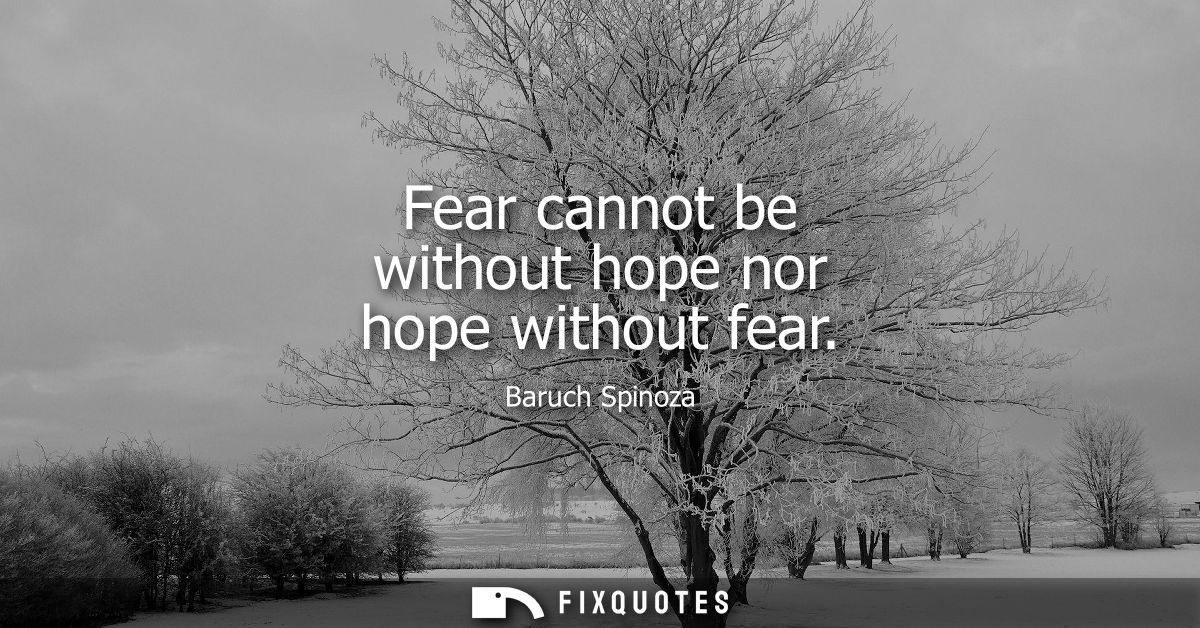
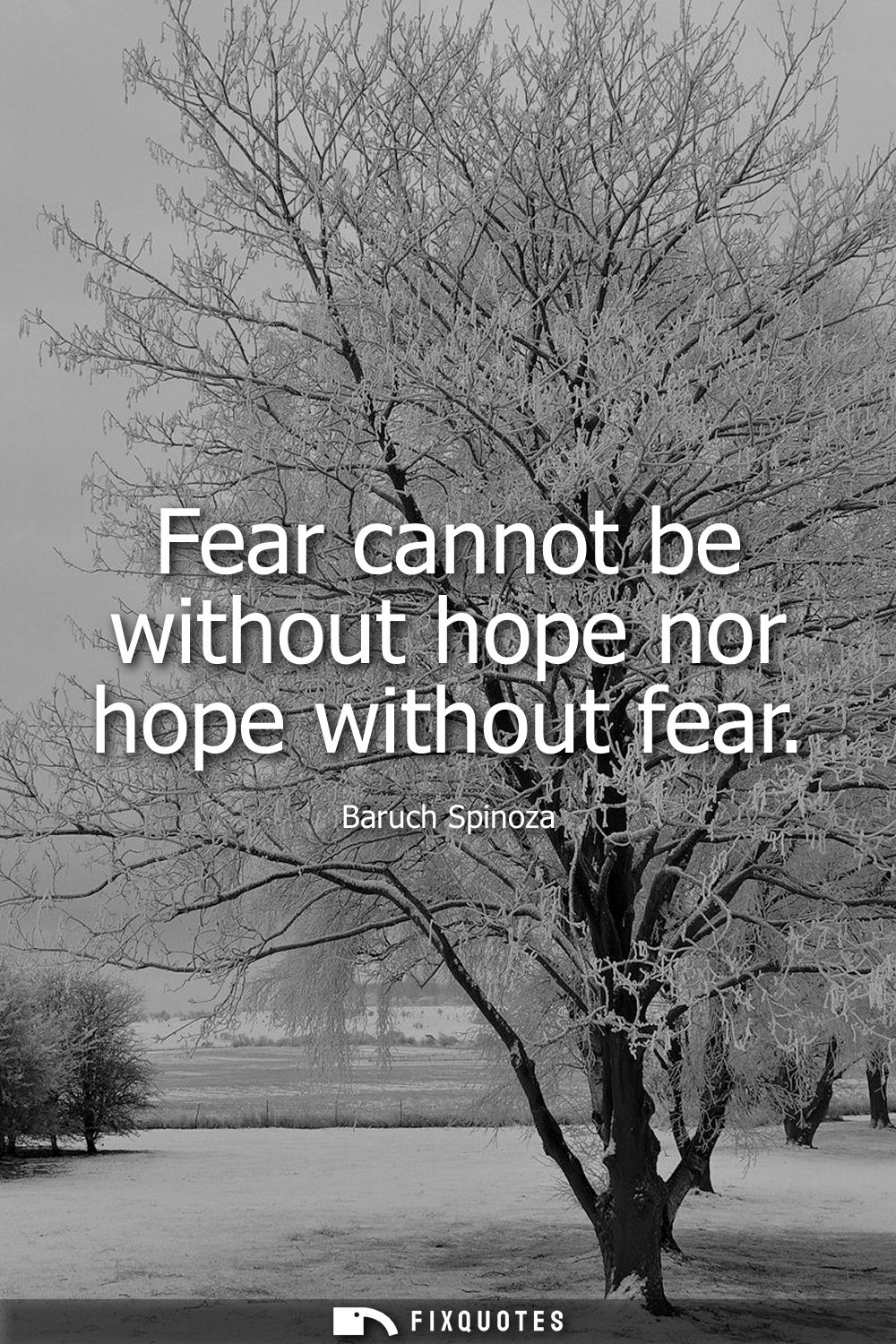
"Fear cannot be without hope nor hope without fear"
About this Quote
Spinoza refuses the comforting myth that fear is simply the absence of hope, and vice versa. He treats them as entangled energies, two faces of the same anticipatory coin: you fear because you can still imagine a better outcome slipping away; you hope because you can still imagine a worse one being avoided. In that sense, the line isn’t a bleak paradox so much as a diagnostic tool. It names the way the mind manufactures stakes.
The subtext is almost clinical. Spinoza, writing in a 17th-century Europe jittery with religious conflict and political volatility, is suspicious of emotions that make us governable. Hope and fear are not noble opposites; they are paired levers that pull us into dependence on uncertain futures. That’s why the quote lands with such austerity: it strips both emotions of their moral costumes and reads them as mechanisms. Hope is not purity. Fear is not cowardice. Both are fluctuations tied to uncertainty, and uncertainty is where institutions, prophets, and demagogues do their best work.
The intent is to shift the reader from moralizing to understanding. If you can see that your fear contains a hope (something you still want preserved), you can ask what you’re actually attached to. If you can see that your hope contains a fear (something you dread continuing), you can examine what you’re trying to escape. Spinoza’s larger project is freedom through clarity: not the fantasy of being unafraid, but the harder achievement of being less manipulable by the emotional weather of “maybe.”
The subtext is almost clinical. Spinoza, writing in a 17th-century Europe jittery with religious conflict and political volatility, is suspicious of emotions that make us governable. Hope and fear are not noble opposites; they are paired levers that pull us into dependence on uncertain futures. That’s why the quote lands with such austerity: it strips both emotions of their moral costumes and reads them as mechanisms. Hope is not purity. Fear is not cowardice. Both are fluctuations tied to uncertainty, and uncertainty is where institutions, prophets, and demagogues do their best work.
The intent is to shift the reader from moralizing to understanding. If you can see that your fear contains a hope (something you still want preserved), you can ask what you’re actually attached to. If you can see that your hope contains a fear (something you dread continuing), you can examine what you’re trying to escape. Spinoza’s larger project is freedom through clarity: not the fantasy of being unafraid, but the harder achievement of being less manipulable by the emotional weather of “maybe.”
Quote Details
| Topic | Wisdom |
|---|---|
| Source | Help us find the source |
| Cite |
Citation Formats
APA Style (7th ed.)
Spinoza, Baruch. (2026, January 16). Fear cannot be without hope nor hope without fear. FixQuotes. https://fixquotes.com/quotes/fear-cannot-be-without-hope-nor-hope-without-fear-125635/
Chicago Style
Spinoza, Baruch. "Fear cannot be without hope nor hope without fear." FixQuotes. January 16, 2026. https://fixquotes.com/quotes/fear-cannot-be-without-hope-nor-hope-without-fear-125635/.
MLA Style (9th ed.)
"Fear cannot be without hope nor hope without fear." FixQuotes, 16 Jan. 2026, https://fixquotes.com/quotes/fear-cannot-be-without-hope-nor-hope-without-fear-125635/. Accessed 25 Mar. 2026.
More Quotes by Baruch
Add to List