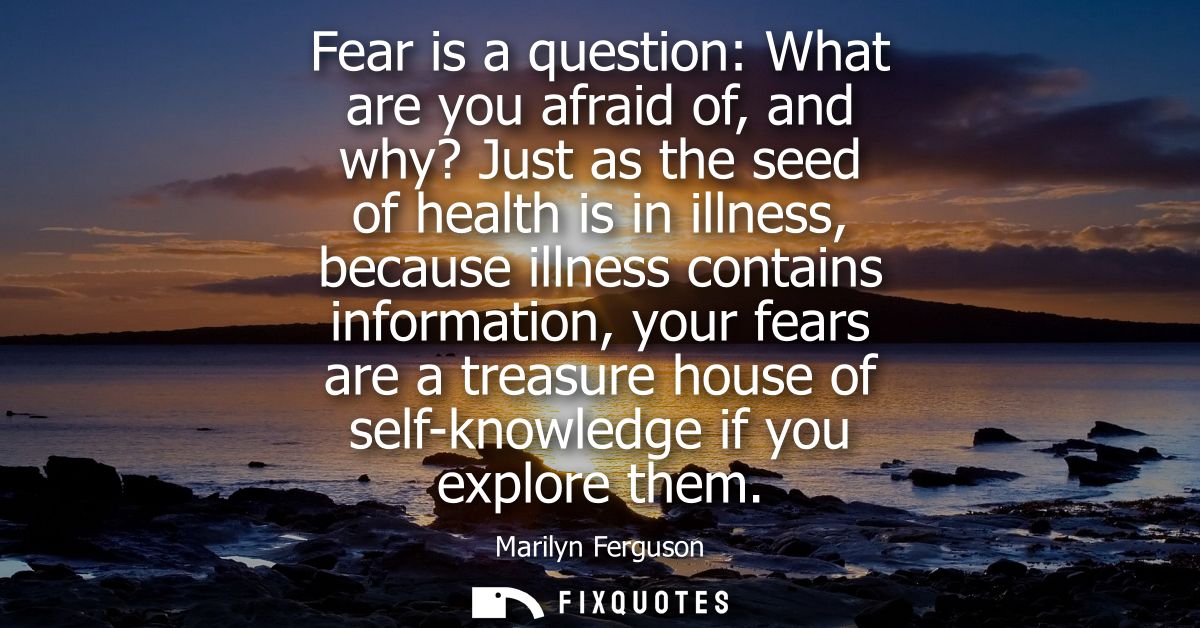
"Fear is a question: What are you afraid of, and why? Just as the seed of health is in illness, because illness contains information, your fears are a treasure house of self-knowledge if you explore them"
About this Quote
Ferguson treats fear less like a siren and more like a survey form: not an order to flee, but an invitation to interrogate. The first move is rhetorical judo. By calling fear a question, she flips the usual power dynamic. Fear typically interrogates us (What if you fail? What if they leave?), but Ferguson insists we can interrogate it back. That shift matters because it restores agency without pretending fear is optional.
Her second gambit borrows from a holistic, late-20th-century self-help ethos: illness as information, not merely malfunction. The metaphor is intentionally provocative. Seed-of-health-in-illness reframes breakdown as data. It’s a rebuke to the cultural habit of treating discomfort as a glitch to be silenced, medicated, or outpaced. In Ferguson’s worldview, the symptom is a signal; the panic is a clue. You don’t just “manage” fear; you mine it.
The subtext is a quiet argument against shame. If fear is a “treasure house,” then being afraid isn’t evidence of weakness; it’s proof you’re close to something meaningful: an unresolved story, a boundary you haven’t defended, a desire you haven’t admitted, a risk you actually want. That’s why the line works: it dignifies the messy interior life while still demanding work from the reader. Explore them. Don’t romanticize them.
Contextually, Ferguson’s language echoes the Human Potential movement and a moment when psychology, spirituality, and systems-thinking were being blended for a general audience. It’s optimistic, but not naive: the treasure isn’t comfort. It’s self-knowledge earned by looking directly at what you’d rather avoid.
Her second gambit borrows from a holistic, late-20th-century self-help ethos: illness as information, not merely malfunction. The metaphor is intentionally provocative. Seed-of-health-in-illness reframes breakdown as data. It’s a rebuke to the cultural habit of treating discomfort as a glitch to be silenced, medicated, or outpaced. In Ferguson’s worldview, the symptom is a signal; the panic is a clue. You don’t just “manage” fear; you mine it.
The subtext is a quiet argument against shame. If fear is a “treasure house,” then being afraid isn’t evidence of weakness; it’s proof you’re close to something meaningful: an unresolved story, a boundary you haven’t defended, a desire you haven’t admitted, a risk you actually want. That’s why the line works: it dignifies the messy interior life while still demanding work from the reader. Explore them. Don’t romanticize them.
Contextually, Ferguson’s language echoes the Human Potential movement and a moment when psychology, spirituality, and systems-thinking were being blended for a general audience. It’s optimistic, but not naive: the treasure isn’t comfort. It’s self-knowledge earned by looking directly at what you’d rather avoid.
Quote Details
| Topic | Fear |
|---|
More Quotes by Marilyn
Add to List