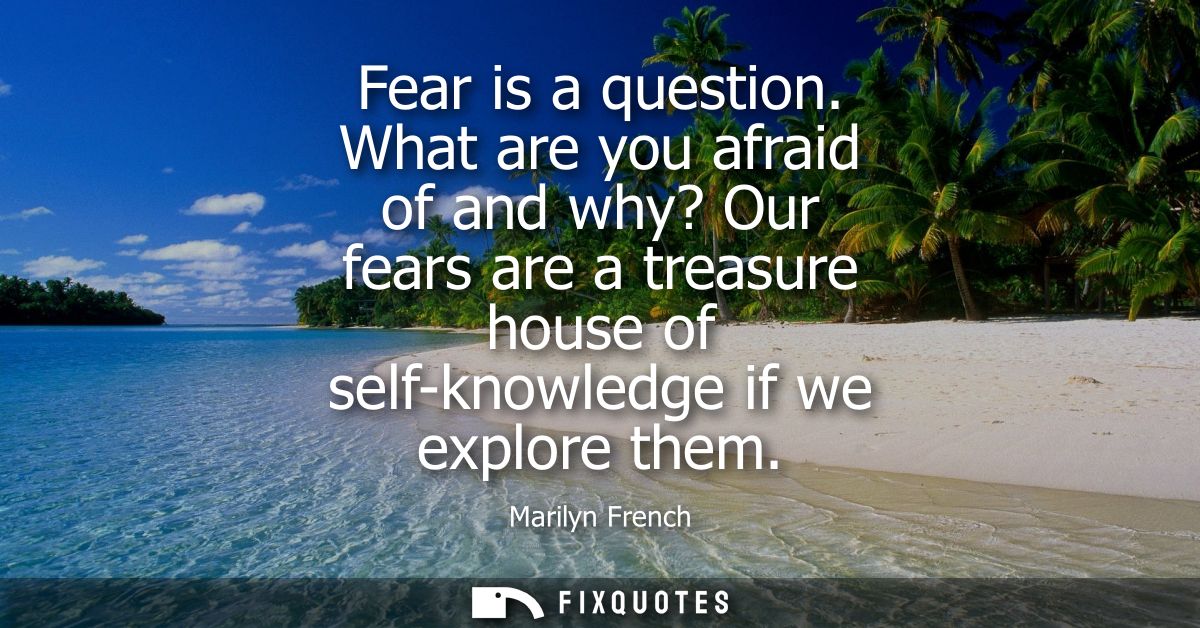
"Fear is a question. What are you afraid of and why? Our fears are a treasure house of self-knowledge if we explore them"
About this Quote
The paired prompts - “What are you afraid of and why?” - insist that fear has an object and a logic, even when it feels irrational. That insistence matters in French’s cultural context: late-20th-century feminism, where “personal” emotions were increasingly understood as political data. If you’re afraid to speak in a meeting, to walk home alone, to outshine a partner, to age, to be disliked, French nudges you to notice the systems hiding inside those feelings: sexism, violence, economic precarity, the social tax on female ambition. Fear becomes a diagnostic tool for the rules you’ve been trained to follow.
“Treasure house” is the sly, almost seductively optimistic metaphor. She’s not romanticizing suffering; she’s reframing the payoff. Exploration isn’t self-help fluff here, it’s a strategy of liberation: name the fear, trace its origin, and you expose the scaffolding that holds it up. The subtext is blunt: ignorance protects the status quo, while curiosity is a form of resistance. French’s line works because it offers a bargain that feels both bracing and doable: you don’t have to be fearless; you just have to be investigative.
Quote Details
| Topic | Fear |
|---|---|
| Source | Help us find the source |
| Cite |
Citation Formats
APA Style (7th ed.)
French, Marilyn. (2026, January 17). Fear is a question. What are you afraid of and why? Our fears are a treasure house of self-knowledge if we explore them. FixQuotes. https://fixquotes.com/quotes/fear-is-a-question-what-are-you-afraid-of-and-why-63913/
Chicago Style
French, Marilyn. "Fear is a question. What are you afraid of and why? Our fears are a treasure house of self-knowledge if we explore them." FixQuotes. January 17, 2026. https://fixquotes.com/quotes/fear-is-a-question-what-are-you-afraid-of-and-why-63913/.
MLA Style (9th ed.)
"Fear is a question. What are you afraid of and why? Our fears are a treasure house of self-knowledge if we explore them." FixQuotes, 17 Jan. 2026, https://fixquotes.com/quotes/fear-is-a-question-what-are-you-afraid-of-and-why-63913/. Accessed 30 Mar. 2026.