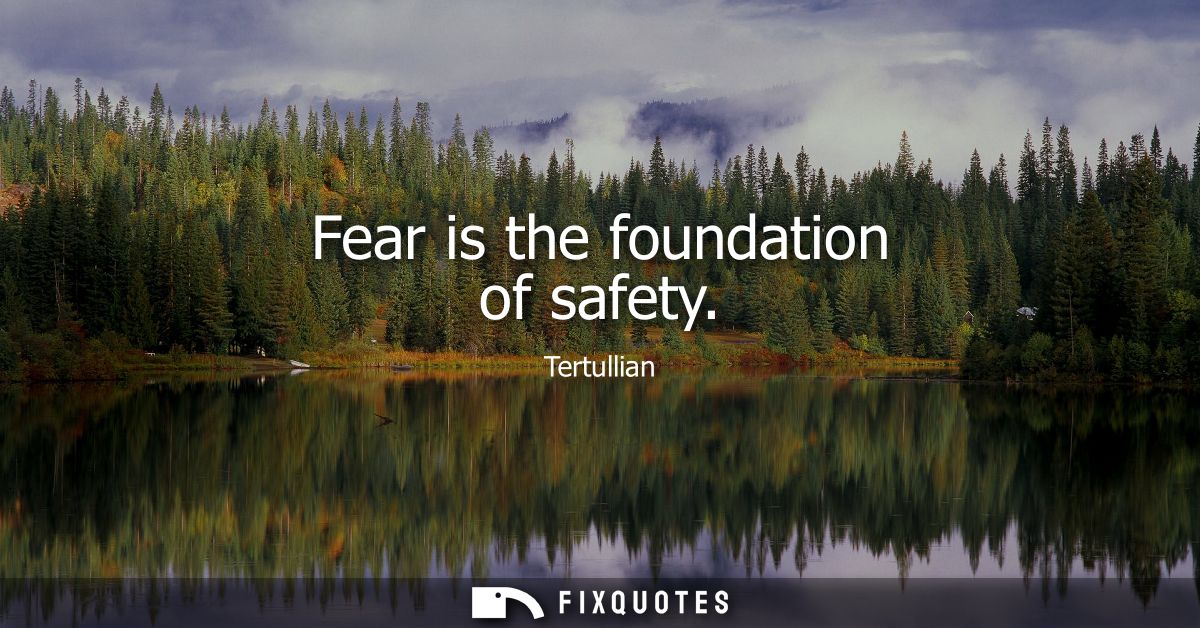
"Fear is the foundation of safety"
About this Quote
Safety, for Tertullian, isn’t the warm glow of protection; it’s a structure built on dread. Coming out of the second and third centuries, when Christianity was still a suspect minority under Roman rule, he writes like someone who’s watched power operate up close: not through persuasion but through the management of fear. “Foundation” is doing the heavy lifting here. Fear isn’t an occasional tool or regrettable side effect; it’s the base layer on which order is poured and set.
The line carries a double edge. On the surface, it’s almost practical: people behave when consequences feel real. Parents know it, emperors weaponize it, churches can sanctify it. But Tertullian’s sharper intent is diagnostic, not celebratory. He’s implying that what we call “safety” is often just obedience with better branding. If a society needs fear to keep itself upright, the society is confessing its own fragility.
Subtext: security is never neutral. The promise of protection can be a moral alibi for coercion, surveillance, punishment, and exclusion. Fear trains bodies before it convinces minds; it shrinks the range of “acceptable” behavior until compliance feels like common sense.
Read in Tertullian’s wider project - rigorous, combative, suspicious of Roman spectacle and civic piety - the quote also sounds like a warning to believers. Don’t mistake enforced calm for justice. If safety depends on fear, it can be withdrawn the moment fear stops working, and it can be aimed at anyone once the machinery is built.
The line carries a double edge. On the surface, it’s almost practical: people behave when consequences feel real. Parents know it, emperors weaponize it, churches can sanctify it. But Tertullian’s sharper intent is diagnostic, not celebratory. He’s implying that what we call “safety” is often just obedience with better branding. If a society needs fear to keep itself upright, the society is confessing its own fragility.
Subtext: security is never neutral. The promise of protection can be a moral alibi for coercion, surveillance, punishment, and exclusion. Fear trains bodies before it convinces minds; it shrinks the range of “acceptable” behavior until compliance feels like common sense.
Read in Tertullian’s wider project - rigorous, combative, suspicious of Roman spectacle and civic piety - the quote also sounds like a warning to believers. Don’t mistake enforced calm for justice. If safety depends on fear, it can be withdrawn the moment fear stops working, and it can be aimed at anyone once the machinery is built.
Quote Details
| Topic | Wisdom |
|---|
More Quotes by Tertullian
Add to List