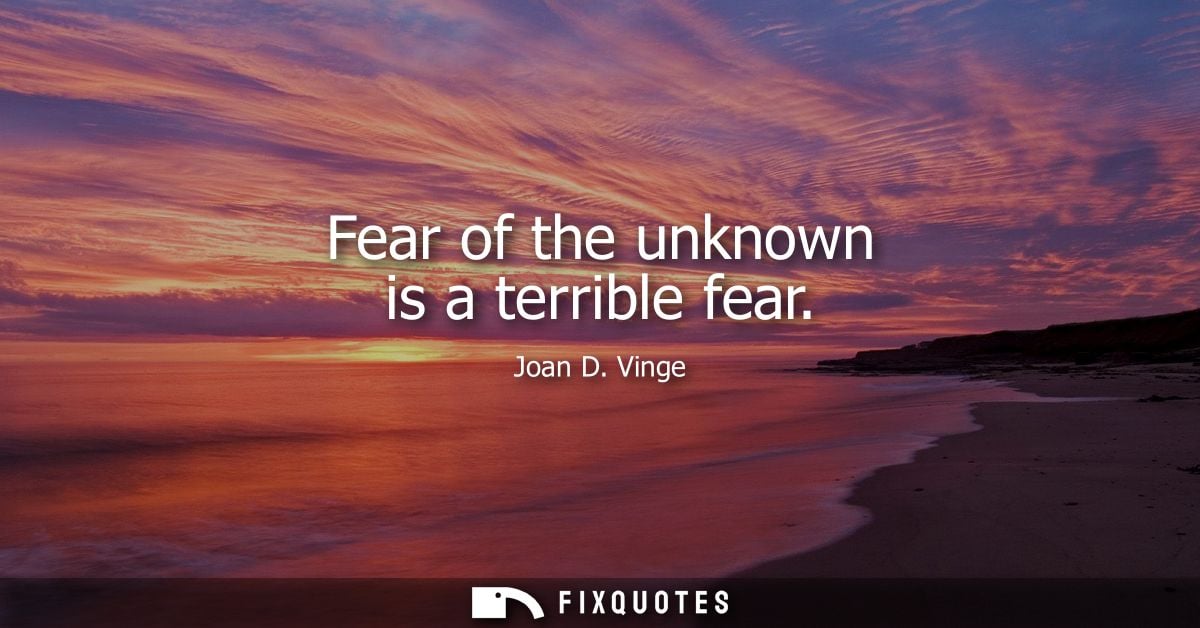
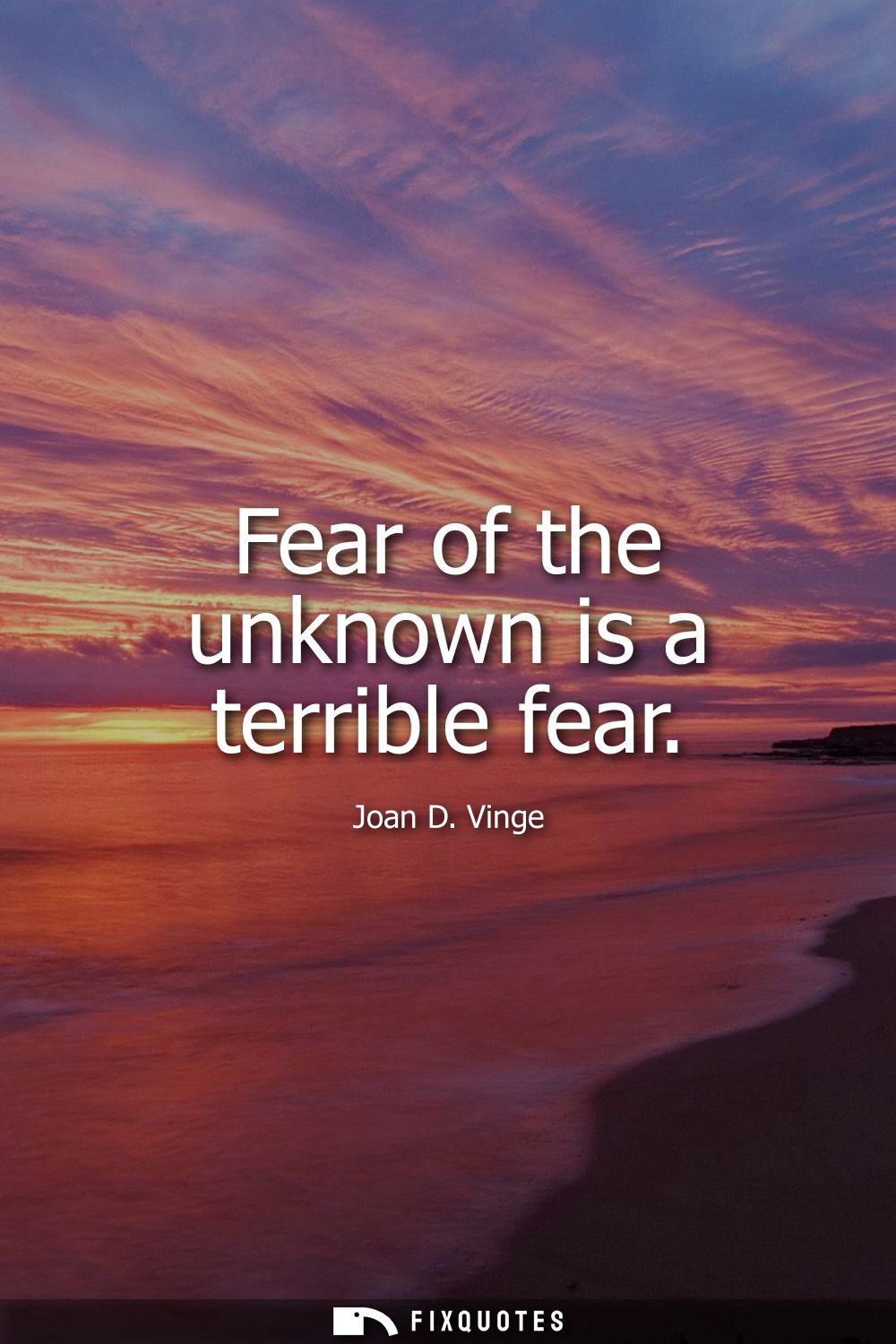
"Fear of the unknown is a terrible fear"
About this Quote
“Fear of the unknown is a terrible fear” reads like a tautology on purpose: Vinge doubles down on “fear” to stress how self-feeding the emotion is. It’s not just that the unknown scares us; it’s that the act of fearing turns the unknown into a kind of psychological hall of mirrors. You’re not responding to a thing so much as to your own projections, and that’s what makes it “terrible” in the older sense of the word: not merely unpleasant, but overpowering, disordering.
As a science fiction writer, Vinge is working in a genre built on the unknown: alien intelligences, unfamiliar bodies, strange social systems, futures that don’t flatter our assumptions. The line carries an implicit critique of how humans meet novelty. We like to imagine ourselves as curious explorers, but our default setting is often defensive imagination - we populate blank space with monsters because monsters are easier than complexity. That’s the subtext: the unknown isn’t inherently hostile; our narrative reflex makes it hostile.
The sentence also functions as a quiet argument for empathy and inquiry. In Vinge’s worlds, survival often depends less on firepower than on interpretation: reading signals, tolerating ambiguity, resisting the urge to simplify. The quote’s plainness is its rhetorical trick. No ornate metaphor, no moralizing. Just a compact warning: the most dangerous threat may not be what you don’t know, but what fear persuades you to believe about it.
As a science fiction writer, Vinge is working in a genre built on the unknown: alien intelligences, unfamiliar bodies, strange social systems, futures that don’t flatter our assumptions. The line carries an implicit critique of how humans meet novelty. We like to imagine ourselves as curious explorers, but our default setting is often defensive imagination - we populate blank space with monsters because monsters are easier than complexity. That’s the subtext: the unknown isn’t inherently hostile; our narrative reflex makes it hostile.
The sentence also functions as a quiet argument for empathy and inquiry. In Vinge’s worlds, survival often depends less on firepower than on interpretation: reading signals, tolerating ambiguity, resisting the urge to simplify. The quote’s plainness is its rhetorical trick. No ornate metaphor, no moralizing. Just a compact warning: the most dangerous threat may not be what you don’t know, but what fear persuades you to believe about it.
Quote Details
| Topic | Fear |
|---|
More Quotes by Joan
Add to List