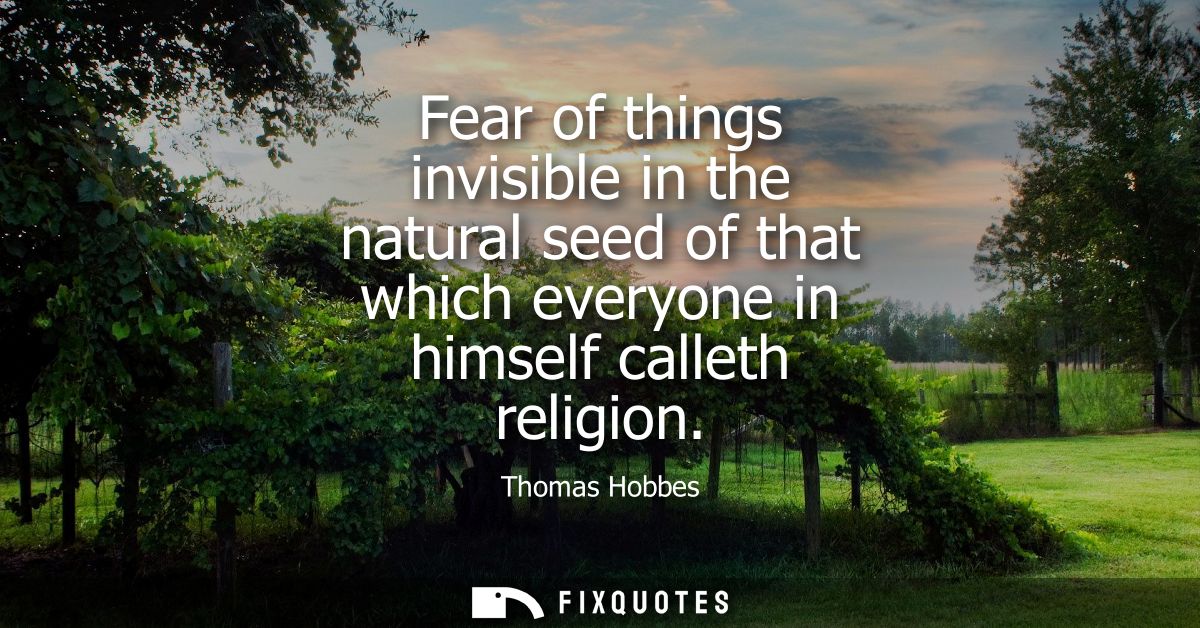
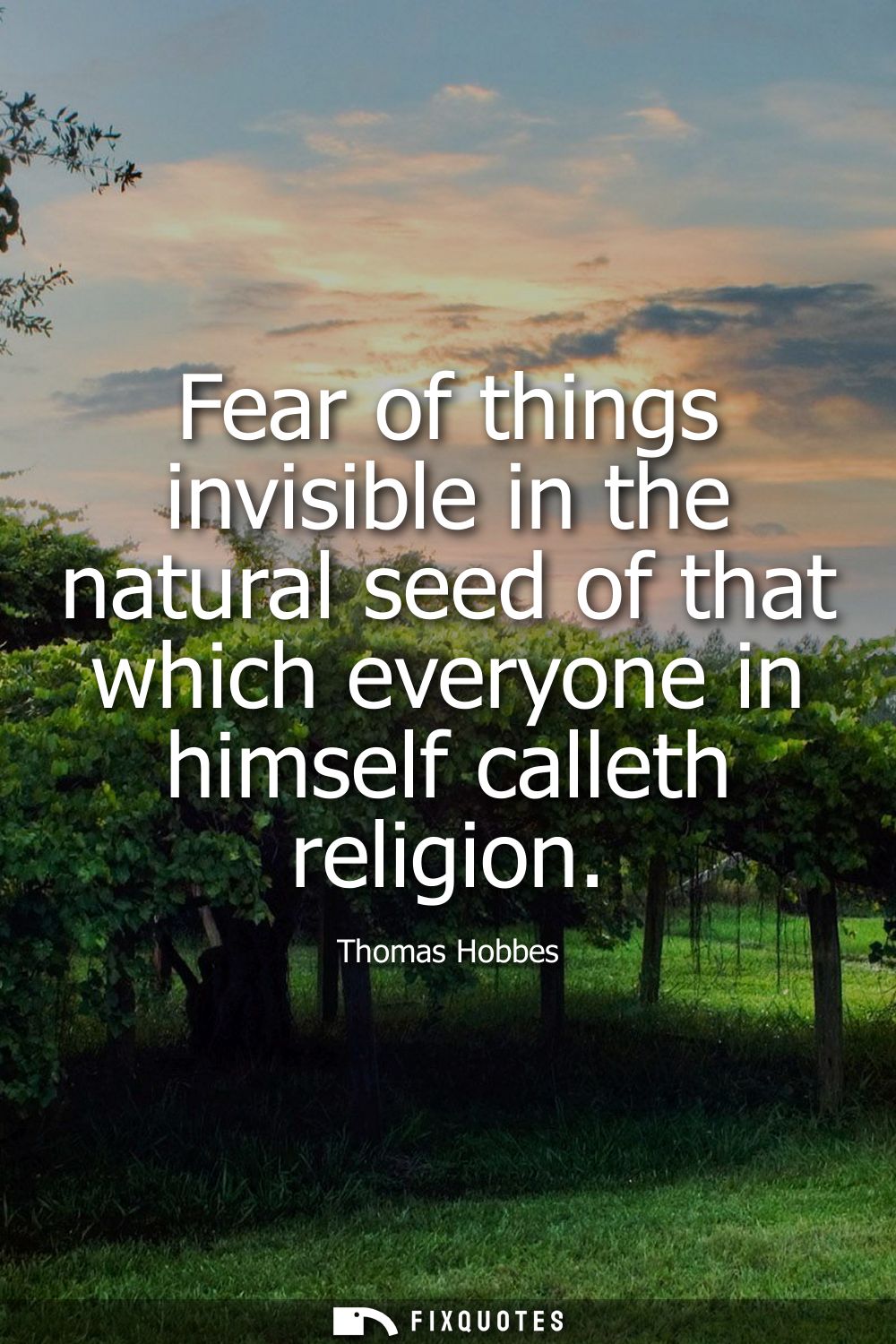
"Fear of things invisible in the natural seed of that which everyone in himself calleth religion"
About this Quote
The subtext is political as much as metaphysical. Writing in the long shadow of England’s civil wars, Hobbes treats “things invisible” as a volatile resource: invisible causes breed invisible authorities, and invisible authorities compete with the state. Fear becomes a technology that priests and factions can cultivate, turning private anxiety into public obedience or public revolt. That’s why he frames religion as something “everyone in himself calleth” it: the emphasis is on interior naming, not external truth. Religion is a label we attach to a felt condition.
The sentence’s archaic cadence also functions as rhetorical containment. Hobbes sounds almost scriptural while stripping scripture of its privileged status. He mimics the tone of holy language to smuggle in a secular diagnosis: the origin of religion is not God reaching down, but humans looking up and flinching. In Hobbes’s world, the point isn’t to sneer at belief; it’s to explain how fear becomes a competing sovereignty, and why a stable commonwealth must manage it.
Quote Details
| Topic | Faith |
|---|---|
| Source | Help us find the source |
| Cite |
Citation Formats
APA Style (7th ed.)
Hobbes, Thomas. (2026, January 18). Fear of things invisible in the natural seed of that which everyone in himself calleth religion. FixQuotes. https://fixquotes.com/quotes/fear-of-things-invisible-in-the-natural-seed-of-2058/
Chicago Style
Hobbes, Thomas. "Fear of things invisible in the natural seed of that which everyone in himself calleth religion." FixQuotes. January 18, 2026. https://fixquotes.com/quotes/fear-of-things-invisible-in-the-natural-seed-of-2058/.
MLA Style (9th ed.)
"Fear of things invisible in the natural seed of that which everyone in himself calleth religion." FixQuotes, 18 Jan. 2026, https://fixquotes.com/quotes/fear-of-things-invisible-in-the-natural-seed-of-2058/. Accessed 7 Apr. 2026.