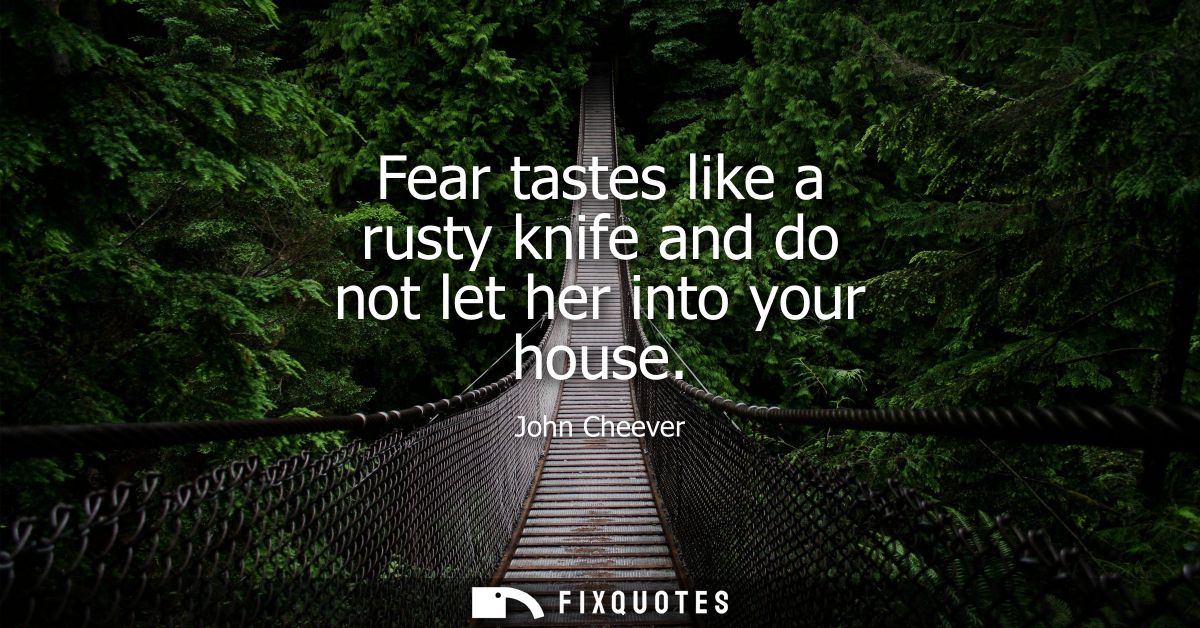
"Fear tastes like a rusty knife, and do not let her into your house"
About this Quote
Fear, in Cheever's hands, isn’t a vague mood; it’s a contaminant with a sharp edge. “Tastes like a rusty knife” is an almost perversely intimate image: fear isn’t just felt, it’s ingested. The mouth is where comfort enters - food, drink, kisses - and Cheever puts danger there, turning the body against itself. “Rusty” matters as much as “knife.” Rust implies neglect, old wounds, the tetanus of memory. This isn’t clean, cinematic terror; it’s the grimy, lingering anxiety that comes from living too long with the wrong thought, the wrong suspicion, the wrong private story.
Then the quote pivots into warning: “do not let her into your house.” Personifying fear as “her” makes it seductive, familiar, capable of knocking politely. Cheever’s suburban worlds run on the idea that the house is sanctuary and performance space at once: a place to keep appearances, to keep chaos outside, to pretend a life is orderly. Fear is the guest that ruins the party by moving in. Once admitted, it reorganizes the furniture, edits your conversations, chooses your routes through the day.
The subtext is almost puritanical in its discipline: don’t romanticize your dread, don’t host it, don’t confuse it for insight. Cheever knew how easily respectable lives curdle from the inside - alcoholism, desire, shame, the quiet terror of not measuring up. The line reads like a hard-won rule from someone who has watched fear pretend to be prudence, then take the keys.
Then the quote pivots into warning: “do not let her into your house.” Personifying fear as “her” makes it seductive, familiar, capable of knocking politely. Cheever’s suburban worlds run on the idea that the house is sanctuary and performance space at once: a place to keep appearances, to keep chaos outside, to pretend a life is orderly. Fear is the guest that ruins the party by moving in. Once admitted, it reorganizes the furniture, edits your conversations, chooses your routes through the day.
The subtext is almost puritanical in its discipline: don’t romanticize your dread, don’t host it, don’t confuse it for insight. Cheever knew how easily respectable lives curdle from the inside - alcoholism, desire, shame, the quiet terror of not measuring up. The line reads like a hard-won rule from someone who has watched fear pretend to be prudence, then take the keys.
Quote Details
| Topic | Fear |
|---|---|
| Source | Verified source: The Wapshot Chronicle (John Cheever, 1957)
Evidence: Fear tastes like a rusty knife and do not let her into your house. Courage tastes of blood. Stand up straight. Admire the world. Relish the love of a gentle woman. Trust in the Lord. (Chapter 36 (end). Page varies by edition (e.g., p. 349 in a 2011 Harper Perennial/HarperCollins reprint).). This line appears as part of the father’s closing letter/advice near the end of John Cheever’s first novel. The wording you provided (“into your house”) matches the novel’s text; some secondary sources paraphrase it as “into your home,” but the primary-text wording is as above. First publication is the novel’s original publication in 1957. Other candidates (1) Words of Wisdom (William Safire, Leonard Safir, 1990) compilation95.0% ... Fear tastes like a rusty knife and do not let her into your house . Courage tastes of blood . Stand up straight .... |
| Cite |
Citation Formats
APA Style (7th ed.)
Cheever, John. (2026, February 23). Fear tastes like a rusty knife, and do not let her into your house. FixQuotes. https://fixquotes.com/quotes/fear-tastes-like-a-rusty-knife-and-do-not-let-her-79658/
Chicago Style
Cheever, John. "Fear tastes like a rusty knife, and do not let her into your house." FixQuotes. February 23, 2026. https://fixquotes.com/quotes/fear-tastes-like-a-rusty-knife-and-do-not-let-her-79658/.
MLA Style (9th ed.)
"Fear tastes like a rusty knife, and do not let her into your house." FixQuotes, 23 Feb. 2026, https://fixquotes.com/quotes/fear-tastes-like-a-rusty-knife-and-do-not-let-her-79658/. Accessed 11 Mar. 2026.
More Quotes by John
Add to List