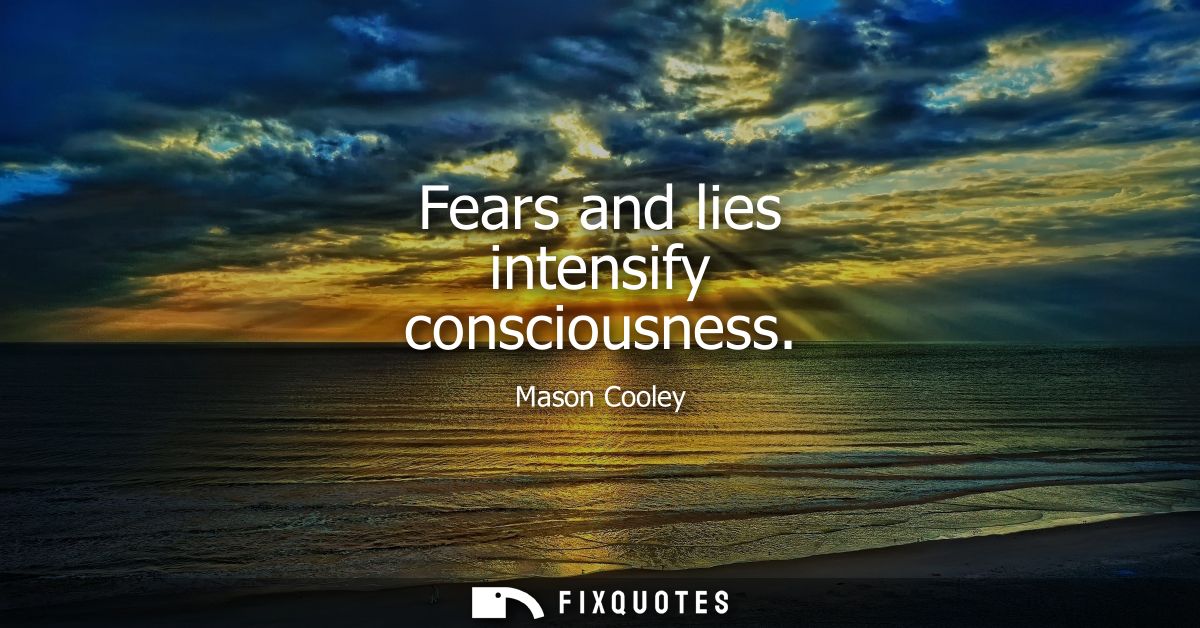
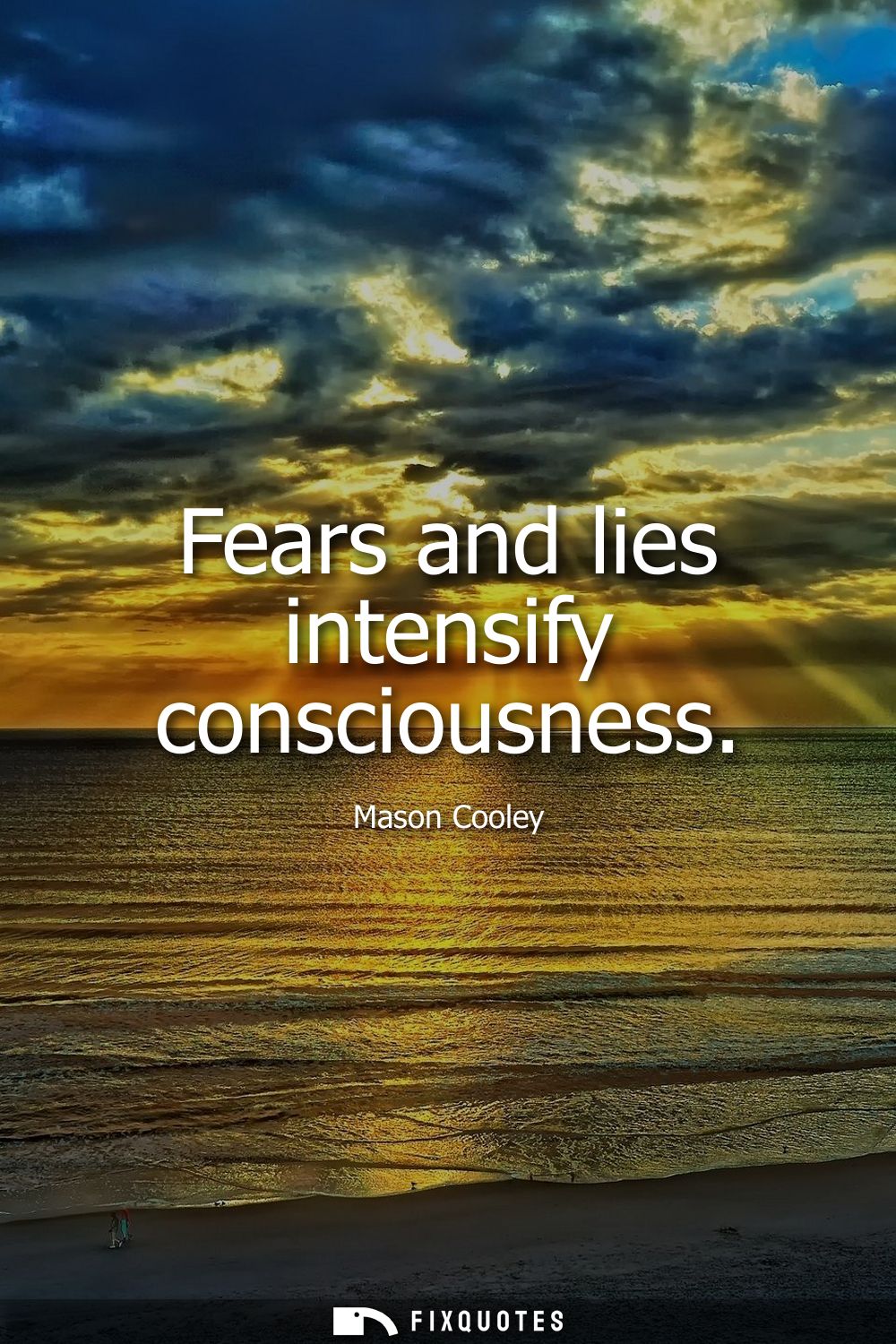
"Fears and lies intensify consciousness"
About this Quote
“Fears and lies intensify consciousness” is a coolly unsettling proposition: not that fear and deceit enlighten us, but that they sharpen us the way a knife sharpens by scraping against stone. Cooley, a master of aphorism, likes his insights small enough to pocket and sharp enough to cut. The line works because it refuses moral comfort. It doesn’t tell you to overcome fear or to tell the truth. It observes the mechanics: threat and fabrication turn the mind hypervigilant.
The intent feels diagnostic. Fear forces attention; it narrows perception onto exits, tells, risks. Consciousness under fear is not expansive, it’s bright and cramped. Lies do something similar but from the inside out. To lie is to run two parallel stories at once: the world as it is and the world you’re selling. That doubling recruits memory, timing, and constant self-monitoring. The liar becomes intensely aware of faces, pauses, and the fragile seams of narrative. In that sense, deceit is a crude form of mindfulness - awareness yoked to control.
The subtext is bleaker: we often become most awake when we’re least free. Anxiety and dishonesty produce an alertness that can look like insight, even feel like intelligence, while actually being a survival posture. Cooley wrote in a 20th-century America steeped in advertising, Cold War paranoia, and the professionalization of public persona. In such a culture, consciousness isn’t always awakened by truth or beauty; it’s activated by menace and performance. The aphorism lands because it implicates both the individual psyche and the social order: fear polices, lies organize, and wakefulness becomes a byproduct of pressure rather than clarity.
The intent feels diagnostic. Fear forces attention; it narrows perception onto exits, tells, risks. Consciousness under fear is not expansive, it’s bright and cramped. Lies do something similar but from the inside out. To lie is to run two parallel stories at once: the world as it is and the world you’re selling. That doubling recruits memory, timing, and constant self-monitoring. The liar becomes intensely aware of faces, pauses, and the fragile seams of narrative. In that sense, deceit is a crude form of mindfulness - awareness yoked to control.
The subtext is bleaker: we often become most awake when we’re least free. Anxiety and dishonesty produce an alertness that can look like insight, even feel like intelligence, while actually being a survival posture. Cooley wrote in a 20th-century America steeped in advertising, Cold War paranoia, and the professionalization of public persona. In such a culture, consciousness isn’t always awakened by truth or beauty; it’s activated by menace and performance. The aphorism lands because it implicates both the individual psyche and the social order: fear polices, lies organize, and wakefulness becomes a byproduct of pressure rather than clarity.
Quote Details
| Topic | Deep |
|---|---|
| Source | Help us find the source |
| Cite |
Citation Formats
APA Style (7th ed.)
Cooley, Mason. (2026, January 15). Fears and lies intensify consciousness. FixQuotes. https://fixquotes.com/quotes/fears-and-lies-intensify-consciousness-165467/
Chicago Style
Cooley, Mason. "Fears and lies intensify consciousness." FixQuotes. January 15, 2026. https://fixquotes.com/quotes/fears-and-lies-intensify-consciousness-165467/.
MLA Style (9th ed.)
"Fears and lies intensify consciousness." FixQuotes, 15 Jan. 2026, https://fixquotes.com/quotes/fears-and-lies-intensify-consciousness-165467/. Accessed 12 Feb. 2026.
More Quotes by Mason
Add to List