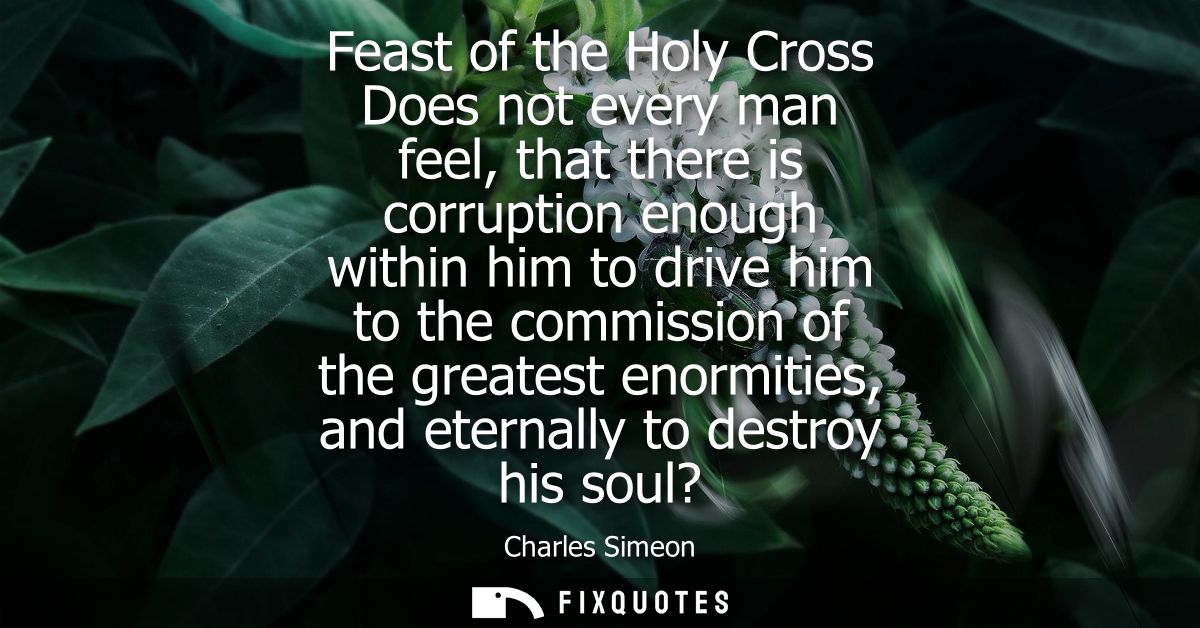
"Feast of the Holy Cross: Does not every man feel, that there is corruption enough within him to drive him to the commission of the greatest enormities, and eternally to destroy his soul?"
About this Quote
The phrasing does heavy work. “Does not every man feel” appeals to interior experience rather than argument, as if conscience is a universal instrument calibrated to the same grim reading. “Corruption enough” is strikingly economic, almost quantitative; it suggests a reservoir, not a slip. Then Simeon leaps from inward tendency to outward catastrophe (“commission”) and finally to ultimate consequence (“eternally… destroy his soul”). The escalation is deliberate: it collapses the comforting gap between “I have dark thoughts” and “I would never do that,” insisting the distance is thinner than we imagine.
Context matters: Simeon was a flagship figure of Anglican evangelicalism, preaching in a culture that prized decorum and moral respectability. On the Feast of the Holy Cross, he leverages the calendar’s focus on crucifixion to puncture polite religion. The subtext is pastoral and tactical: shame the audience out of complacency, then make grace feel not optional but necessary. The Cross, in that frame, isn’t sentimental. It’s the only antidote proportionate to what’s already festering in the self.
Quote Details
| Topic | Faith |
|---|---|
| Source | Help us find the source |
| Cite |
Citation Formats
APA Style (7th ed.)
Simeon, Charles. (2026, February 16). Feast of the Holy Cross: Does not every man feel, that there is corruption enough within him to drive him to the commission of the greatest enormities, and eternally to destroy his soul? FixQuotes. https://fixquotes.com/quotes/feast-of-the-holy-cross-does-not-every-man-feel-119923/
Chicago Style
Simeon, Charles. "Feast of the Holy Cross: Does not every man feel, that there is corruption enough within him to drive him to the commission of the greatest enormities, and eternally to destroy his soul?" FixQuotes. February 16, 2026. https://fixquotes.com/quotes/feast-of-the-holy-cross-does-not-every-man-feel-119923/.
MLA Style (9th ed.)
"Feast of the Holy Cross: Does not every man feel, that there is corruption enough within him to drive him to the commission of the greatest enormities, and eternally to destroy his soul?" FixQuotes, 16 Feb. 2026, https://fixquotes.com/quotes/feast-of-the-holy-cross-does-not-every-man-feel-119923/. Accessed 15 Mar. 2026.