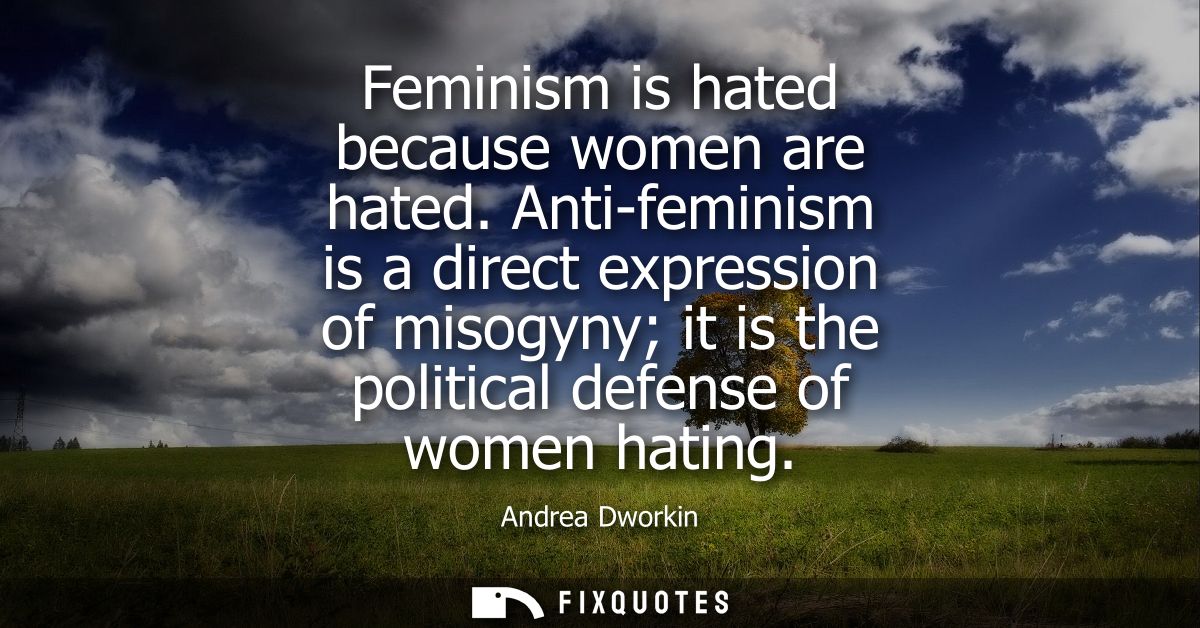
"Feminism is hated because women are hated. Anti-feminism is a direct expression of misogyny; it is the political defense of women hating"
About this Quote
The subtext is accusatory and strategic. By framing anti feminism as "the political defense of women hating", she reframes backlash as a power project rather than a misunderstanding. It is a refusal to grant the opposition moral complexity. That is why the sentence lands with such blunt force and why it infuriates: it denies the comforting idea that misogyny is just a few bad men and instead treats it as a public philosophy with talking points.
Context matters. Dworkin wrote in the wake of second wave feminism, during a period when fights over pornography, domestic violence, and sexual coercion were moving from private suffering to public argument. She came out of an era that specialized in dismissing women s testimony as hysteria, then branding feminist anger as the real extremism. Her phrasing anticipates that recoil and turns it into evidence.
As a piece of political language, it works because it is uncompromisingly diagnostic: hatred is not a side effect of feminism, she argues, but the thing feminism reveals.
Quote Details
| Topic | Equality |
|---|---|
| Source | Evidence: Feminism is a much-hated political philosophy. This is true all along the male-defined, recognizable political spectrum from far Right to far Left. Feminism is hated because women are hated. Antifeminism is a direct expression of misogyny; it is the political defense of woman hating. (Chapter 6 (“Antifeminism”); often cited as pp. 230–231 (some editions)). This is a primary-source passage from Andrea Dworkin’s own writing in Right-Wing Women, in the chapter titled “Antifeminism.” The quote is frequently reposted online with minor wording/punctuation changes (e.g., “Anti-feminism” vs “Antifeminism,” and “women hating” vs “woman hating”). For page-level verification: a scanned copy circulating online shows it at the start of Chapter 6 (“Antifeminism”), and secondary reference pages commonly cite pp. 230–231, but page numbering can differ by edition/printing. The earliest publication of the book is 1983, so this line cannot be earlier than 1983 unless an earlier appearance in a separate Dworkin essay/speech is found (I did not locate a verifiable earlier primary publication during this search). Other candidates (1) Quotationary - The A-Z Book of Quotations (Nasser Amiri, 2024) compilation96.1% ... Feminism is hated because women are hated. Anti-feminism is a direct expression of misogyny; it is the political ... |
| Cite |
Citation Formats
APA Style (7th ed.)
Dworkin, Andrea. (2026, February 10). Feminism is hated because women are hated. Anti-feminism is a direct expression of misogyny; it is the political defense of women hating. FixQuotes. https://fixquotes.com/quotes/feminism-is-hated-because-women-are-hated-43848/
Chicago Style
Dworkin, Andrea. "Feminism is hated because women are hated. Anti-feminism is a direct expression of misogyny; it is the political defense of women hating." FixQuotes. February 10, 2026. https://fixquotes.com/quotes/feminism-is-hated-because-women-are-hated-43848/.
MLA Style (9th ed.)
"Feminism is hated because women are hated. Anti-feminism is a direct expression of misogyny; it is the political defense of women hating." FixQuotes, 10 Feb. 2026, https://fixquotes.com/quotes/feminism-is-hated-because-women-are-hated-43848/. Accessed 5 Apr. 2026.