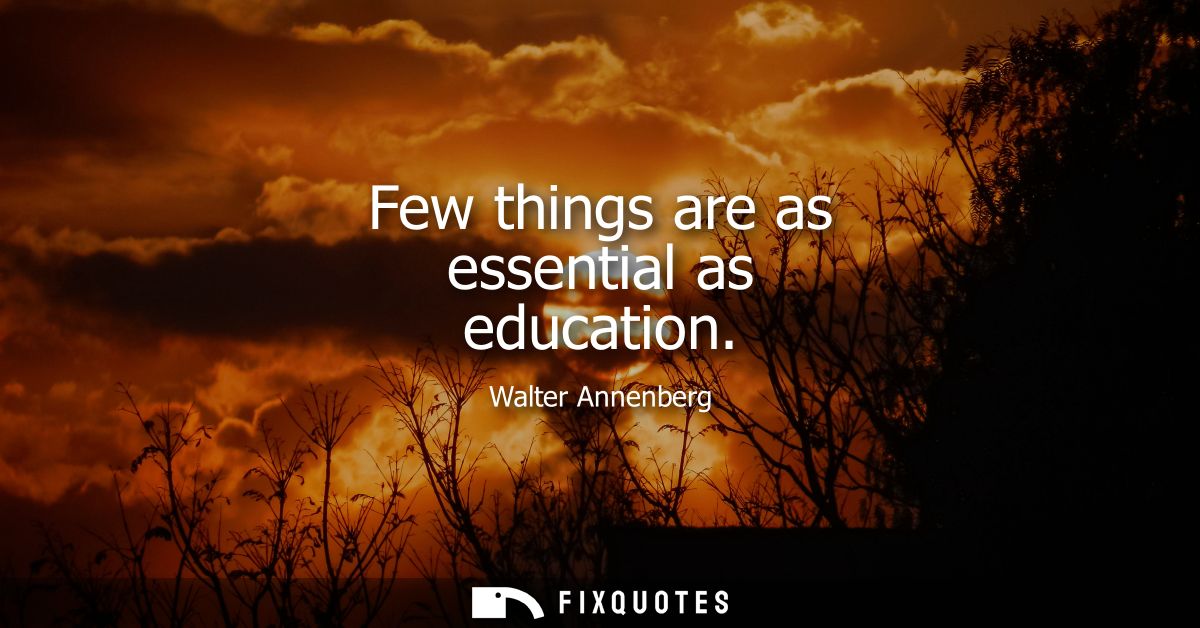
"Few things are as essential as education"
About this Quote
Spoken like a man who made his fortune in media and then spent a good chunk of it trying to shape the country through classrooms. Annenberg's line is deceptively simple, almost bland on the surface, but it's doing classic establishment work: turning a contested public project into a near-natural law. "Few things" suggests consensus without having to argue for it; "essential" smuggles education into the category of clean water and oxygen, something you don't debate so much as fund.
The subtext sits in what he doesn't specify. Education for whom, by whom, to what end? For a businessman-philanthropist, education is both moral credential and social technology. It promises mobility while quietly protecting the system that makes mobility feel necessary. Annenberg's era matters: mid-century mass schooling, Cold War anxiety about scientific and civic competence, and rising worries about inequality and urban decline. In that context, calling education "essential" reads less like a personal value and more like a stabilizing prescription for a country that feared falling behind and coming apart.
It also reflects the worldview of someone who understood narrative power. Annenberg built influence by distributing information; philanthropy let him launder that influence into public trust. The phrase works because it is hard to oppose and easy to repeat, a tidy civic mantra that frames education as the one investment that can justify nearly any reform agenda, from workforce readiness to democracy-saving. The genius, and the risk, is that the line makes education sound like a single thing, when in practice it's a battleground over resources, ideology, and who gets to count as "educated."
The subtext sits in what he doesn't specify. Education for whom, by whom, to what end? For a businessman-philanthropist, education is both moral credential and social technology. It promises mobility while quietly protecting the system that makes mobility feel necessary. Annenberg's era matters: mid-century mass schooling, Cold War anxiety about scientific and civic competence, and rising worries about inequality and urban decline. In that context, calling education "essential" reads less like a personal value and more like a stabilizing prescription for a country that feared falling behind and coming apart.
It also reflects the worldview of someone who understood narrative power. Annenberg built influence by distributing information; philanthropy let him launder that influence into public trust. The phrase works because it is hard to oppose and easy to repeat, a tidy civic mantra that frames education as the one investment that can justify nearly any reform agenda, from workforce readiness to democracy-saving. The genius, and the risk, is that the line makes education sound like a single thing, when in practice it's a battleground over resources, ideology, and who gets to count as "educated."
Quote Details
| Topic | Learning |
|---|
More Quotes by Walter
Add to List