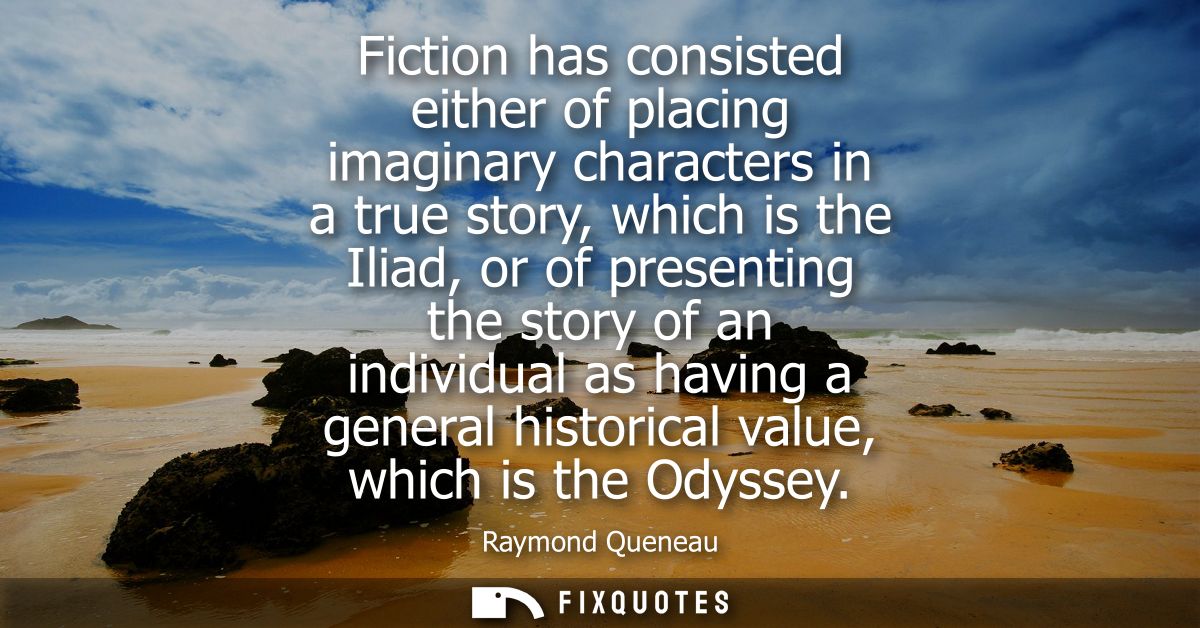
"Fiction has consisted either of placing imaginary characters in a true story, which is the Iliad, or of presenting the story of an individual as having a general historical value, which is the Odyssey"
About this Quote
The wit is in the faux-casual classification, as if literature were a filing cabinet and Homer a bureaucrat. Queneau, a poet and Oulipo-adjacent formalist who loved constraints, is also smuggling in a manifesto: stories are not born from boundless inspiration but from shrewd structural decisions about scale. Do you make history intimate, or make intimacy historical?
The subtext bites at mid-century literary prestige. After modernism’s obsession with the individual psyche and the novel’s appetite for “serious” historical witness, Queneau suggests the game has always been the same: fiction earns authority by borrowing it. Either it piggybacks on “true story” gravity, or it retrofits a solitary journey with civic meaning.
Context matters: writing in a Europe still negotiating propaganda, trauma, and the credibility of narratives, Queneau’s dichotomy reads like a warning. Fiction isn’t the opposite of truth; it’s a technology for distributing truth-effects. The line flatters no one - least of all the novelist who believes their work stands outside the old Homeric bargain.
Quote Details
| Topic | Writing |
|---|---|
| Source | Help us find the source |
| Cite |
Citation Formats
APA Style (7th ed.)
Queneau, Raymond. (2026, January 16). Fiction has consisted either of placing imaginary characters in a true story, which is the Iliad, or of presenting the story of an individual as having a general historical value, which is the Odyssey. FixQuotes. https://fixquotes.com/quotes/fiction-has-consisted-either-of-placing-imaginary-90553/
Chicago Style
Queneau, Raymond. "Fiction has consisted either of placing imaginary characters in a true story, which is the Iliad, or of presenting the story of an individual as having a general historical value, which is the Odyssey." FixQuotes. January 16, 2026. https://fixquotes.com/quotes/fiction-has-consisted-either-of-placing-imaginary-90553/.
MLA Style (9th ed.)
"Fiction has consisted either of placing imaginary characters in a true story, which is the Iliad, or of presenting the story of an individual as having a general historical value, which is the Odyssey." FixQuotes, 16 Jan. 2026, https://fixquotes.com/quotes/fiction-has-consisted-either-of-placing-imaginary-90553/. Accessed 12 Feb. 2026.