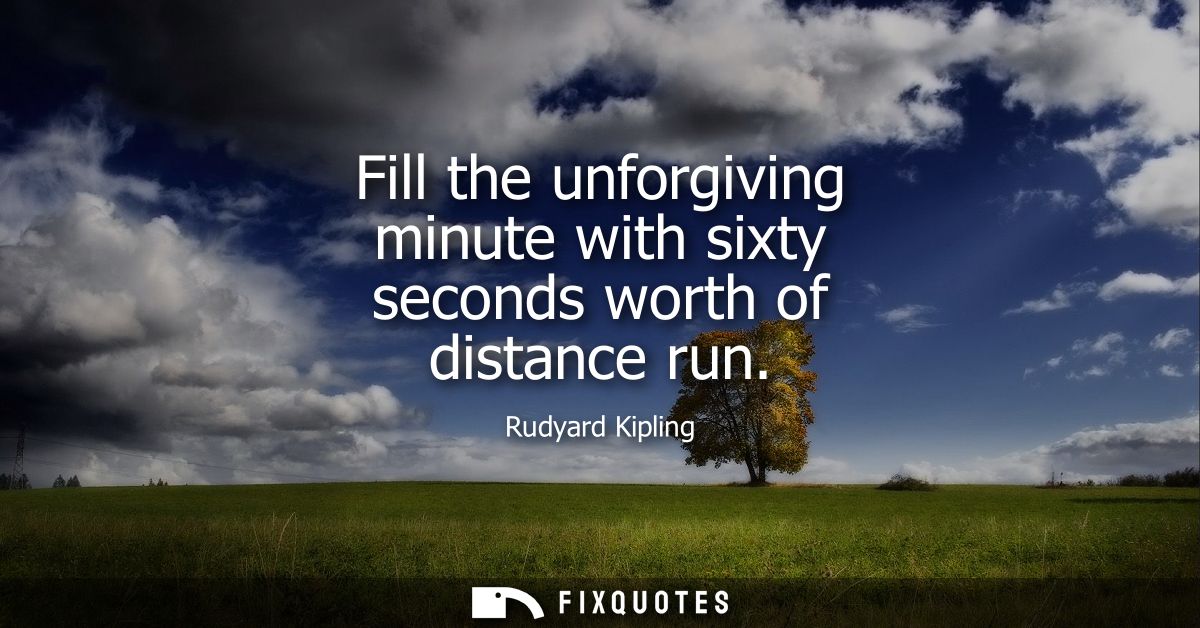
"Fill the unforgiving minute with sixty seconds' worth of distance run"
About this Quote
The phrase "sixty seconds worth of distance run" is deliberately physical. Not "achievement", not "progress", not even "work" - distance. Something measurable, body-based, undeniable. It’s the rhetoric of training, not reflection: you don’t think your way out of panic, you move. The line’s music reinforces the command. The repeated s-sounds ("sixty seconds") and the clipped concreteness of numbers make the sentence feel like cadence, the kind you can march to. Kipling’s intent is motivational, but not in a soft way. It’s a code for self-mastery: treat every slice of time as a unit to be conquered.
Context sharpens the subtext. This comes from "If-" (1910), a poem steeped in Victorian stoicism and the values of a British imperial class that prized restraint, grit, and usefulness. The advice is empowering, and also disciplinary: a worldview where worth is proven by output, where even a minute must be "filled" or it accuses you. The line still lands today because our own unforgiving minutes are now app timers and inboxes - and we keep trying to outrun them.
Quote Details
| Topic | Time |
|---|---|
| Source | Poem If by Rudyard Kipling; published 1910 in the collection Rewards and Fairies; contains the line “Fill the unforgiving minute with sixty seconds' worth of distance run.” |
| Cite |
Citation Formats
APA Style (7th ed.)
Kipling, Rudyard. (2026, February 20). Fill the unforgiving minute with sixty seconds' worth of distance run. FixQuotes. https://fixquotes.com/quotes/fill-the-unforgiving-minute-with-sixty-seconds-15616/
Chicago Style
Kipling, Rudyard. "Fill the unforgiving minute with sixty seconds' worth of distance run." FixQuotes. February 20, 2026. https://fixquotes.com/quotes/fill-the-unforgiving-minute-with-sixty-seconds-15616/.
MLA Style (9th ed.)
"Fill the unforgiving minute with sixty seconds' worth of distance run." FixQuotes, 20 Feb. 2026, https://fixquotes.com/quotes/fill-the-unforgiving-minute-with-sixty-seconds-15616/. Accessed 27 Mar. 2026.