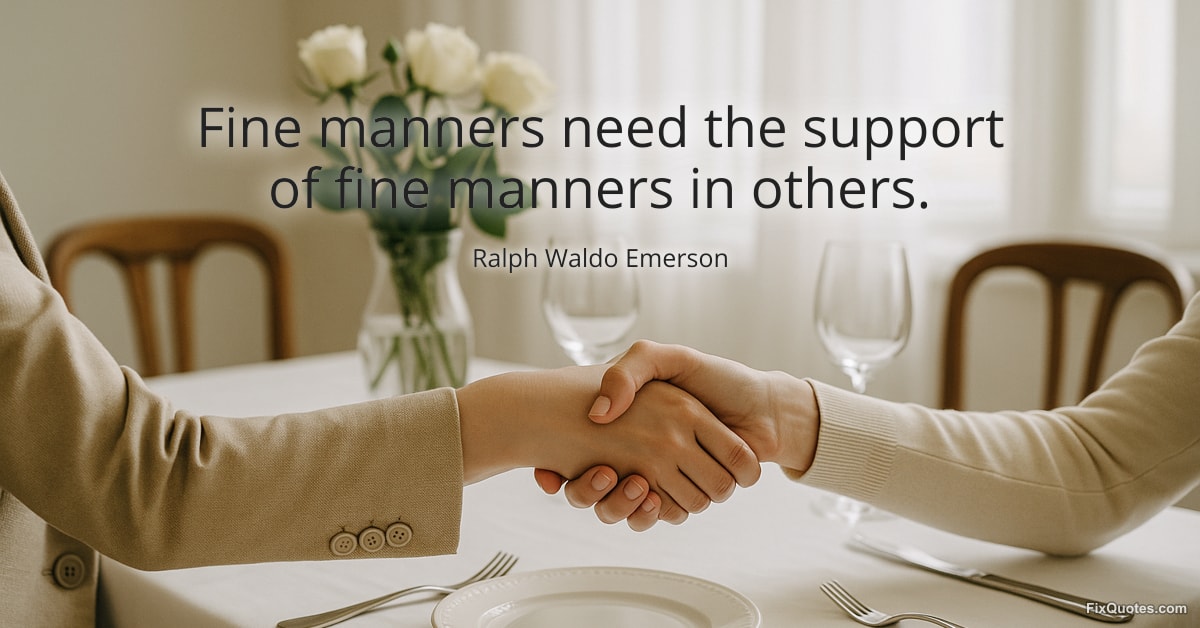
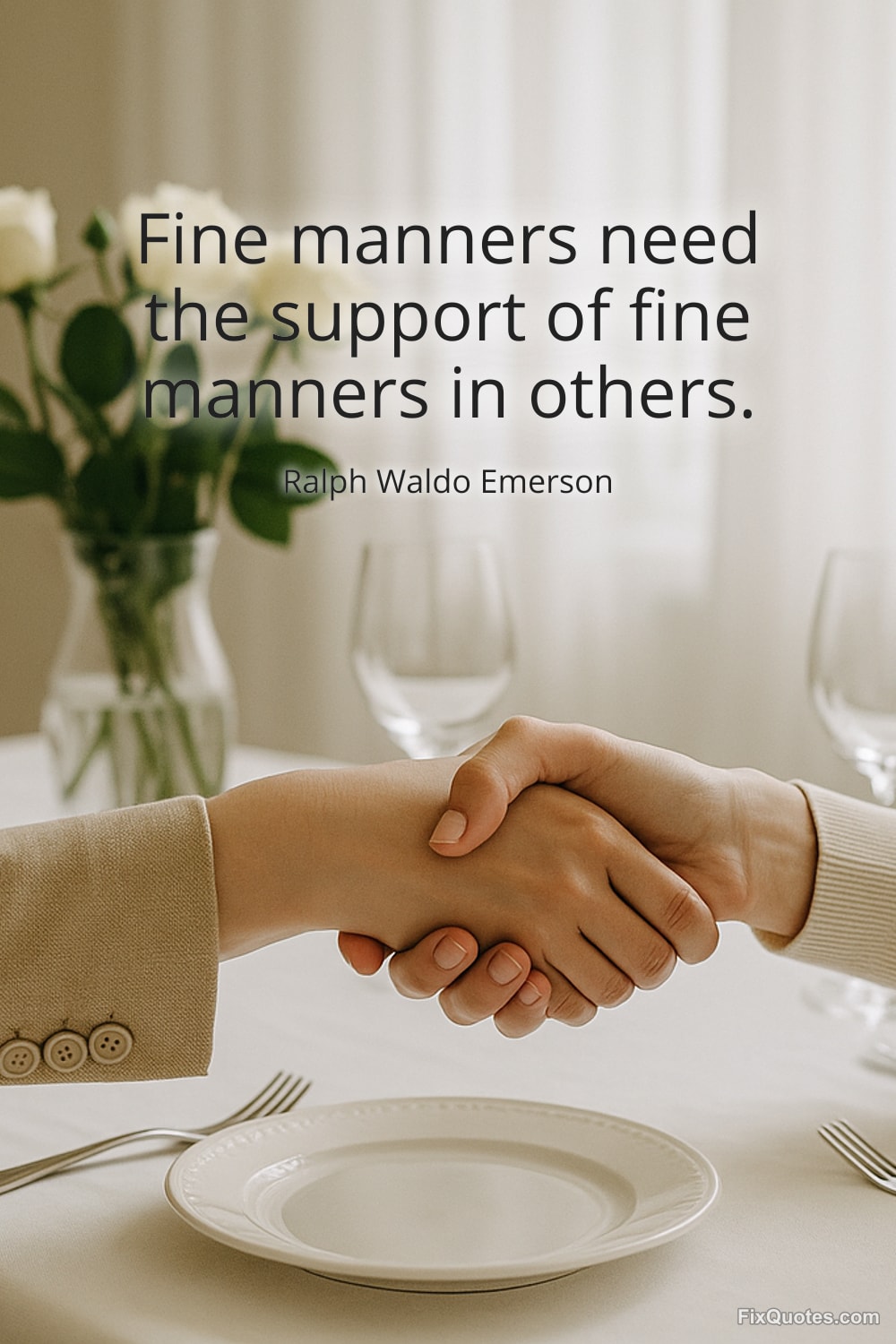
"Fine manners need the support of fine manners in others"
About this Quote
Emerson’s line lands like a polite rebuke with teeth: good behavior isn’t a private virtue, it’s a social ecosystem. “Fine manners” sound ornamental until you read the sentence’s quiet conditionals. Manners, for Emerson, aren’t just about self-control or etiquette as personal branding; they’re a form of mutual recognition. The twist is that they’re fragile. Courtesy needs an audience willing to play along, not because it craves applause, but because manners are a shared language. If the other side refuses the grammar, your sentences collapse.
That subtext fits Emerson’s larger preoccupation with the tension between the sovereign self and the crowd. He’s often read as the patron saint of self-reliance, yet here he concedes a stubborn fact: even the most principled individual can be dragged into coarseness by a coarse environment. Manners become less like a moral halo and more like a social contract. You can’t keep shaking hands in good faith if the room is full of clenched fists.
Context matters: Emerson writes from a 19th-century America anxious about democratization, mobility, and the erosion of old status signals. In that world, “manners” are a proxy for trust across difference - a way to keep public life from turning into pure competition. The line also carries a warning aimed at the smugly refined: if you want civility, you can’t treat it as a one-way performance. Fine manners aren’t a badge; they’re a bargain, constantly renegotiated in the smallest exchanges.
That subtext fits Emerson’s larger preoccupation with the tension between the sovereign self and the crowd. He’s often read as the patron saint of self-reliance, yet here he concedes a stubborn fact: even the most principled individual can be dragged into coarseness by a coarse environment. Manners become less like a moral halo and more like a social contract. You can’t keep shaking hands in good faith if the room is full of clenched fists.
Context matters: Emerson writes from a 19th-century America anxious about democratization, mobility, and the erosion of old status signals. In that world, “manners” are a proxy for trust across difference - a way to keep public life from turning into pure competition. The line also carries a warning aimed at the smugly refined: if you want civility, you can’t treat it as a one-way performance. Fine manners aren’t a badge; they’re a bargain, constantly renegotiated in the smallest exchanges.
Quote Details
| Topic | Respect |
|---|---|
| Source | Unverified source: The Conduct of Life (Ralph Waldo Emerson, 1860)
Evidence: Essay/Chapter: “Behavior” (spelled “Behaviour” in this edition); exact page not verified in-image due to access limits. The sentence appears verbatim at the start of the essay "Behavior" in Emerson’s essay collection The Conduct of Life. The Library of Congress catalog record confirms an 1860 Lon... Other candidates (2) Ralph Waldo Emerson (Ralph Waldo Emerson) compilation98.0% ails adorned behavior fine manners need the support of fine manners in others an The Collected Works of Ralph Waldo Emerson (Ralph Waldo Emerson, 2022) compilation95.0% Ralph Waldo Emerson. Fine manners need the support of fine manners in others . A scholar may be a well - bred man , o... |
| Featured | This quote was our Quote of the Day on October 17, 2025 |
| Cite |
Citation Formats
APA Style (7th ed.)
Emerson, Ralph Waldo. (2026, January 12). Fine manners need the support of fine manners in others. FixQuotes. https://fixquotes.com/quotes/fine-manners-need-the-support-of-fine-manners-in-33753/
Chicago Style
Emerson, Ralph Waldo. "Fine manners need the support of fine manners in others." FixQuotes. January 12, 2026. https://fixquotes.com/quotes/fine-manners-need-the-support-of-fine-manners-in-33753/.
MLA Style (9th ed.)
"Fine manners need the support of fine manners in others." FixQuotes, 12 Jan. 2026, https://fixquotes.com/quotes/fine-manners-need-the-support-of-fine-manners-in-33753/. Accessed 15 Mar. 2026.
More Quotes by Ralph
Add to List