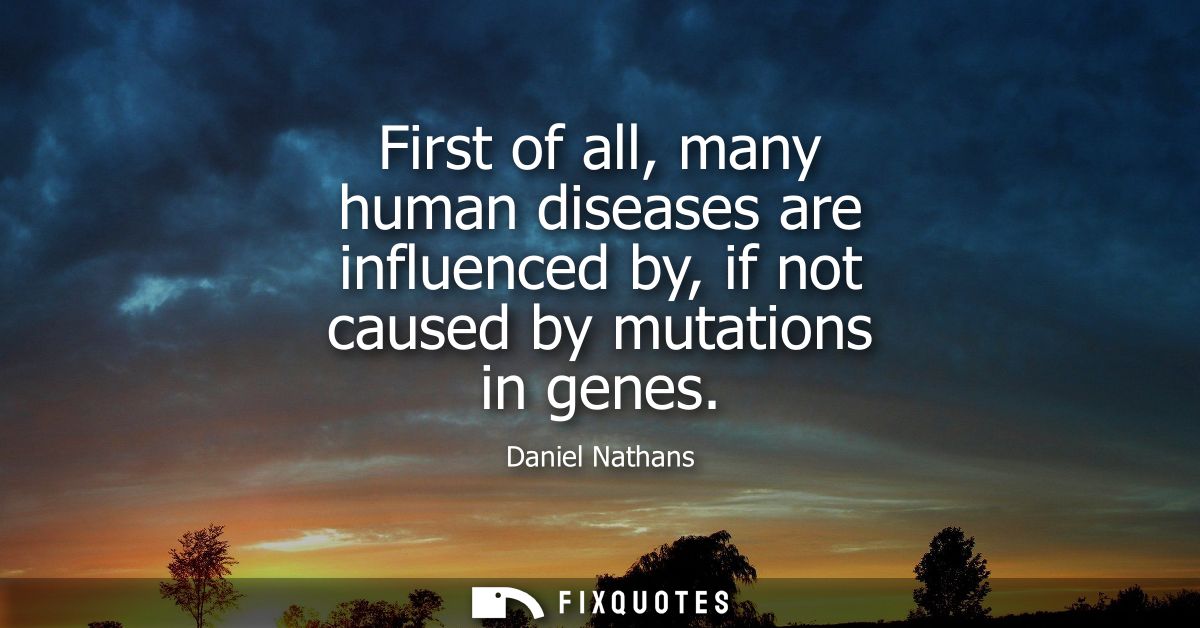
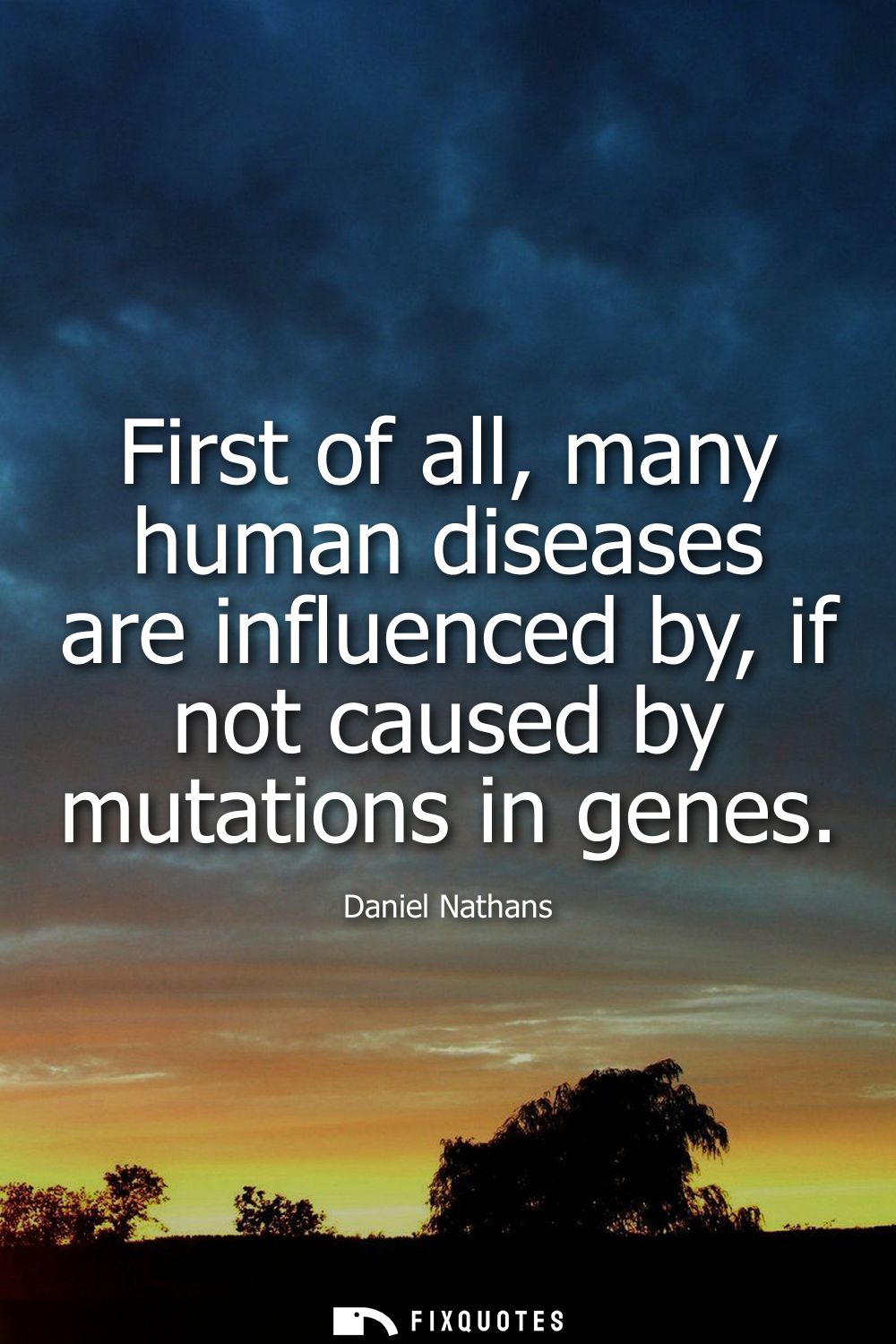
"First of all, many human diseases are influenced by, if not caused by mutations in genes"
About this Quote
The phrasing is careful in a way that reveals its politics. “Influenced by, if not caused by” is a rhetorical hedge that doubles as a power move: it concedes complexity while tightening the noose around causality. Nathans anticipates pushback from clinicians, environmentalists, and anyone wary of genetic determinism. He acknowledges multifactorial reality, then nudges the audience toward a stronger claim: genes aren’t just background conditions; they can be prime movers.
“Mutations” does heavy lifting here. It frames disease not as moral failing, fate, or vague “bad luck,” but as a material glitch in information. That reframing underwrites an entire research agenda: map the genome, find the errors, build interventions. Subtextually, it’s also a rebuttal to the comforting idea that most illness is purely lifestyle or environment - a reminder that even the most disciplined body can be betrayed at the molecular level.
In context, this is the rhetoric of molecular biology’s ascendancy: an insistence that understanding life means reading, and sometimes editing, its code.
Quote Details
| Topic | Science |
|---|---|
| Source | Help us find the source |
| Cite |
Citation Formats
APA Style (7th ed.)
Nathans, Daniel. (2026, January 17). First of all, many human diseases are influenced by, if not caused by mutations in genes. FixQuotes. https://fixquotes.com/quotes/first-of-all-many-human-diseases-are-influenced-44481/
Chicago Style
Nathans, Daniel. "First of all, many human diseases are influenced by, if not caused by mutations in genes." FixQuotes. January 17, 2026. https://fixquotes.com/quotes/first-of-all-many-human-diseases-are-influenced-44481/.
MLA Style (9th ed.)
"First of all, many human diseases are influenced by, if not caused by mutations in genes." FixQuotes, 17 Jan. 2026, https://fixquotes.com/quotes/first-of-all-many-human-diseases-are-influenced-44481/. Accessed 4 Apr. 2026.