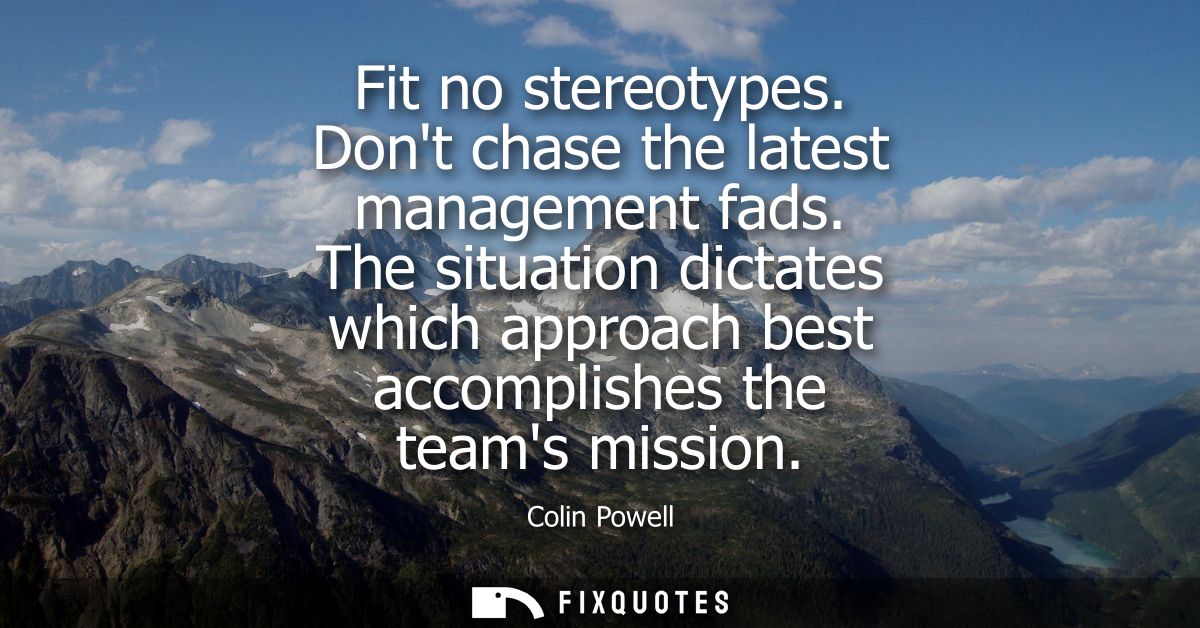
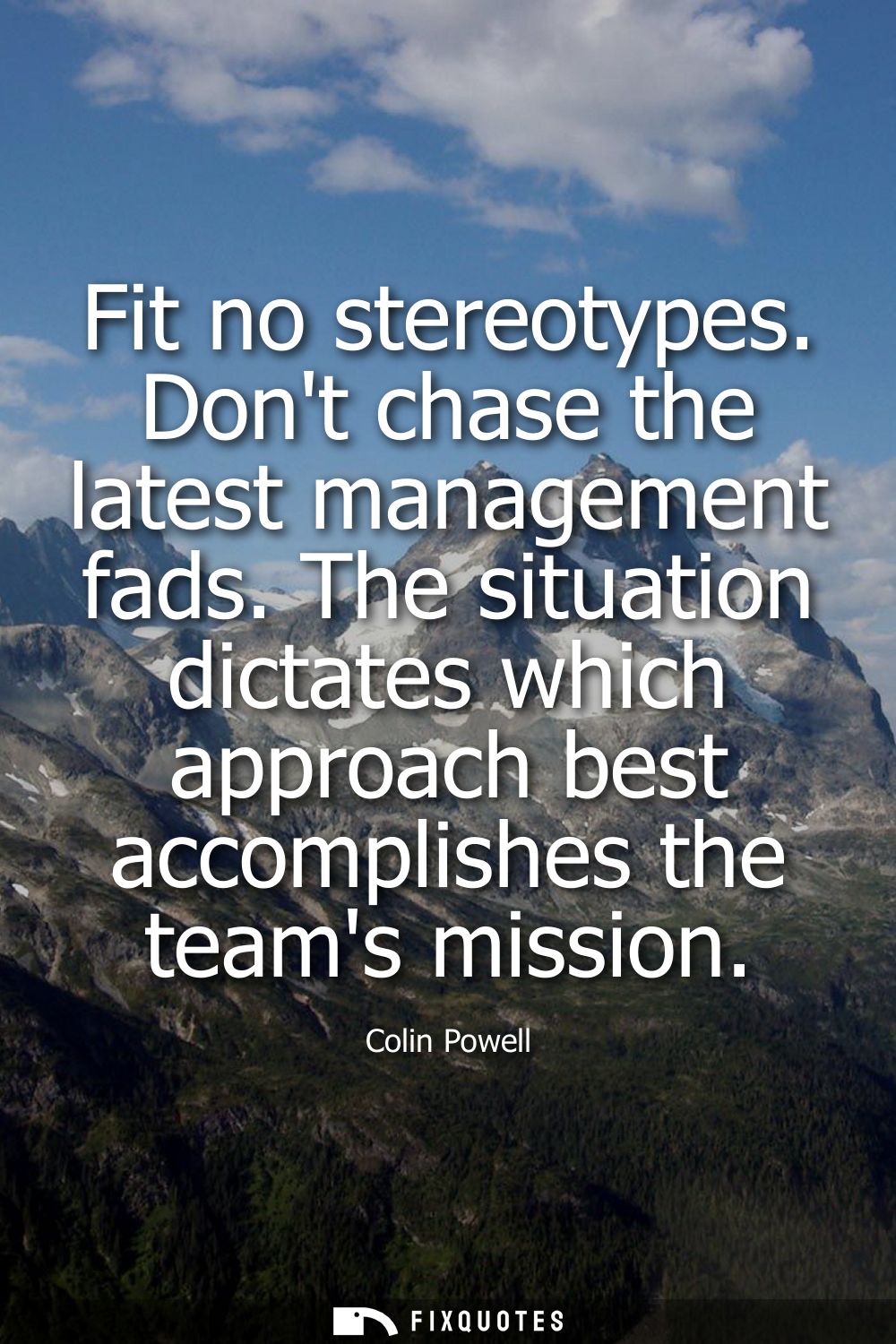
"Fit no stereotypes. Don't chase the latest management fads. The situation dictates which approach best accomplishes the team's mission!"
About this Quote
“Don’t chase the latest management fads” is the statesman’s side-eye at the corporate-imported promises that wash through government and the military: one more framework, one more acronym, one more reorg that will magically produce clarity. Powell is pointing to a structural temptation: when stakes are high and ambiguity is constant, leaders reach for packaged certainty. Fads offer the feeling of control without the burden of judgment.
Then he lands the real thesis: “The situation dictates.” That’s contingency thinking framed as moral discipline. It’s not relativism; it’s mission-first pragmatism. The subtext is accountability: if you hide behind a style (“I’m just a tough leader”) or a trend (“the system made me do it”), you dodge responsibility for outcomes. Powell insists leadership is diagnostic work - reading terrain, people, timing, politics - and choosing the approach that serves the mission, not your identity.
In Powell’s context, this isn’t TED Talk flexibility; it’s forged in institutions where doctrine can save lives but dogma can cost them. He’s arguing for adaptive authority: principled about ends, unromantic about means, and suspicious of anyone selling a single template for human complexity.
Quote Details
| Topic | Decision-Making |
|---|---|
| Source | Help us find the source |
| Cite |
Citation Formats
APA Style (7th ed.)
Powell, Colin. (2026, February 19). Fit no stereotypes. Don't chase the latest management fads. The situation dictates which approach best accomplishes the team's mission! FixQuotes. https://fixquotes.com/quotes/fit-no-stereotypes-dont-chase-the-latest-30649/
Chicago Style
Powell, Colin. "Fit no stereotypes. Don't chase the latest management fads. The situation dictates which approach best accomplishes the team's mission!" FixQuotes. February 19, 2026. https://fixquotes.com/quotes/fit-no-stereotypes-dont-chase-the-latest-30649/.
MLA Style (9th ed.)
"Fit no stereotypes. Don't chase the latest management fads. The situation dictates which approach best accomplishes the team's mission!" FixQuotes, 19 Feb. 2026, https://fixquotes.com/quotes/fit-no-stereotypes-dont-chase-the-latest-30649/. Accessed 16 Mar. 2026.