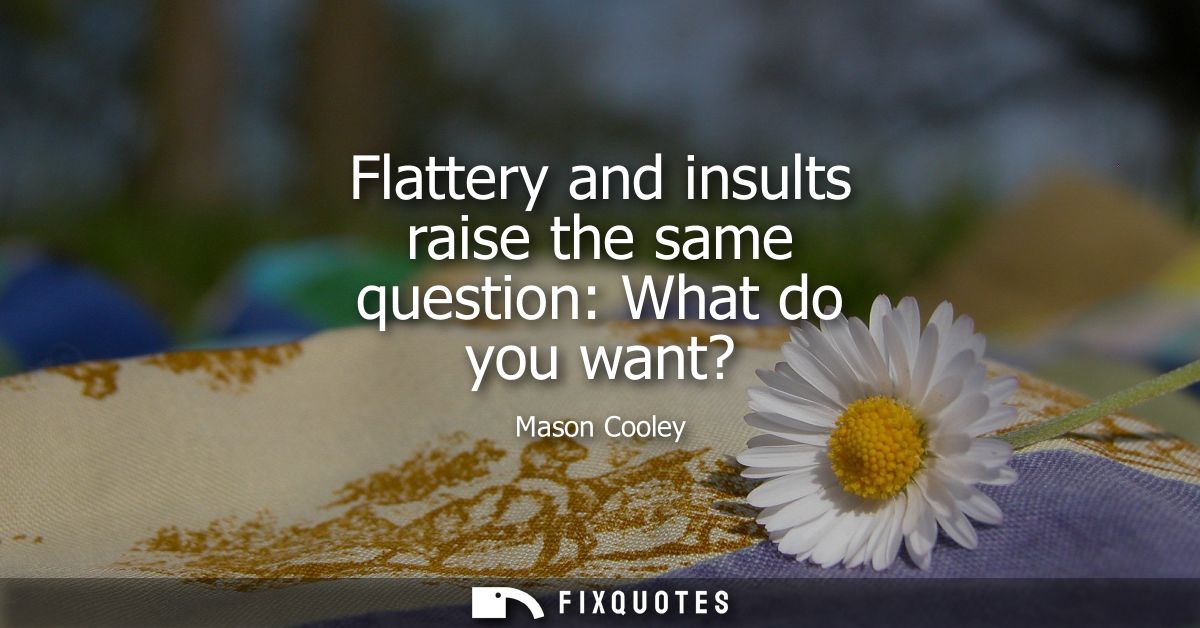
"Flattery and insults raise the same question: What do you want?"
About this Quote
Cooley’s line treats praise and abuse as sibling tactics, not moral opposites. The sting is in the symmetry: flattery and insults both masquerade as judgments, but he frames them as bids. They’re attempts to move you, to make you grant attention, agreement, access, obedience. By collapsing the distance between the compliment and the slap, Cooley quietly punctures our favorite fantasy about speech - that it’s primarily about truth. Most talk is leverage.
The genius is the question he plants behind every charged remark: What do you want? It’s not “Are you right?” or “Are you being fair?” It’s motive-hunting, almost clinical, and it puts the listener back in control. If you can identify the ask, you can refuse it. If you can’t, you’re likely already paying.
Subtextually, Cooley is warning that emotional language is often transactional. Flattery is a soft bribe; an insult can be a shove that corrals you into defending yourself, proving yourself, performing. Both presume a vulnerability: vanity, shame, belonging. The line also hints at a darker truth about power. Insults aren’t always spontaneous anger; they can be domination disguised as candor. Flattery isn’t always kindness; it can be extraction disguised as admiration.
In a media environment built on engagement, Cooley’s aphorism feels less like a witty observation than a survival tool. The most useful response to either extreme isn’t gratitude or outrage - it’s interrogation.
The genius is the question he plants behind every charged remark: What do you want? It’s not “Are you right?” or “Are you being fair?” It’s motive-hunting, almost clinical, and it puts the listener back in control. If you can identify the ask, you can refuse it. If you can’t, you’re likely already paying.
Subtextually, Cooley is warning that emotional language is often transactional. Flattery is a soft bribe; an insult can be a shove that corrals you into defending yourself, proving yourself, performing. Both presume a vulnerability: vanity, shame, belonging. The line also hints at a darker truth about power. Insults aren’t always spontaneous anger; they can be domination disguised as candor. Flattery isn’t always kindness; it can be extraction disguised as admiration.
In a media environment built on engagement, Cooley’s aphorism feels less like a witty observation than a survival tool. The most useful response to either extreme isn’t gratitude or outrage - it’s interrogation.
Quote Details
| Topic | Witty One-Liners |
|---|---|
| Source | Later attribution: Quotationary - The A-Z Book of Quotations (Nasser Amiri, 2024) modern compilationISBN: 9780722354841 · ID: M0NZEQAAQBAJ
Evidence:
... Flattery and insults raise the same question: What do you want? He who can lick can bite. Mason Cooley French proverb Knavery and flattery are blood relations. Abraham Lincoln Nothing is so great an example of bad manners as flattery ... |
| Cite |
Citation Formats
APA Style (7th ed.)
Cooley, Mason. (2026, February 21). Flattery and insults raise the same question: What do you want? FixQuotes. https://fixquotes.com/quotes/flattery-and-insults-raise-the-same-question-what-127812/
Chicago Style
Cooley, Mason. "Flattery and insults raise the same question: What do you want?" FixQuotes. February 21, 2026. https://fixquotes.com/quotes/flattery-and-insults-raise-the-same-question-what-127812/.
MLA Style (9th ed.)
"Flattery and insults raise the same question: What do you want?" FixQuotes, 21 Feb. 2026, https://fixquotes.com/quotes/flattery-and-insults-raise-the-same-question-what-127812/. Accessed 31 Mar. 2026.
More Quotes by Mason
Add to List