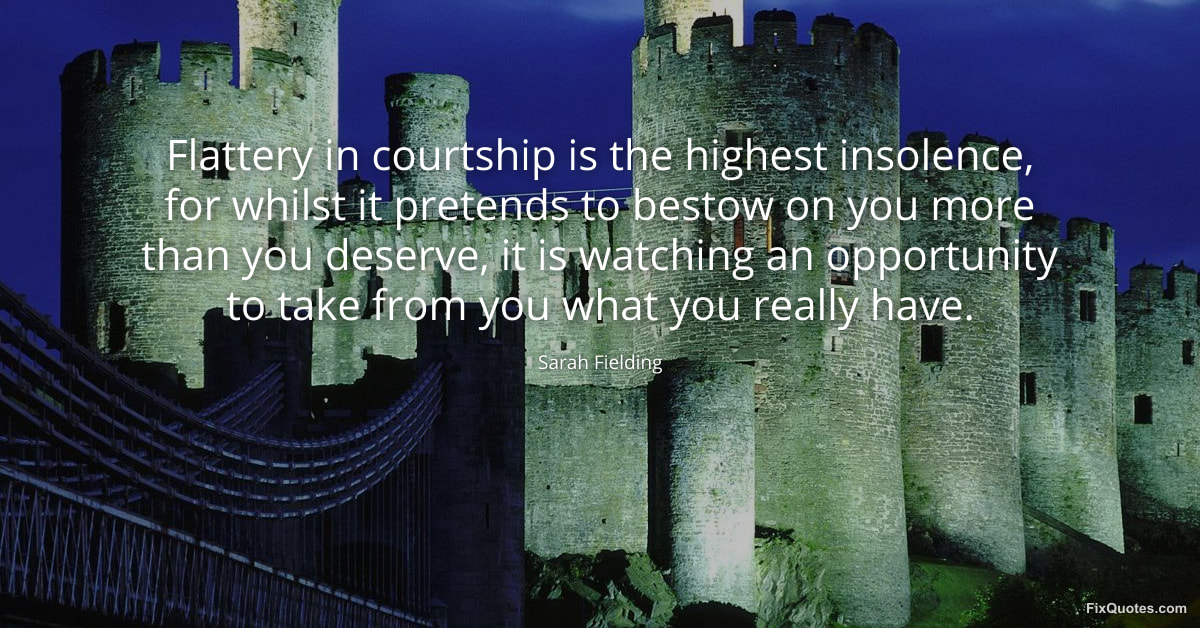
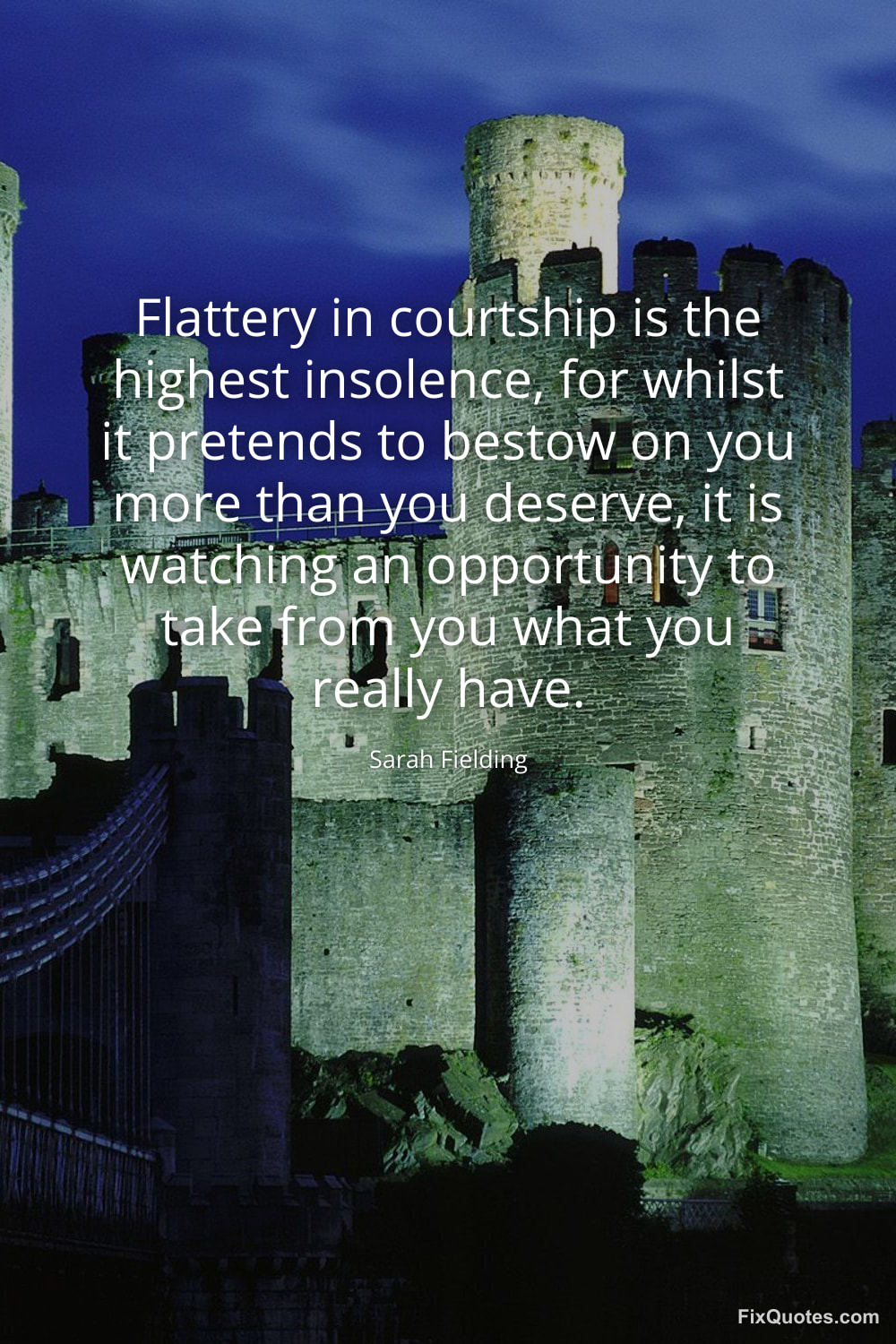
"Flattery in courtship is the highest insolence, for whilst it pretends to bestow on you more than you deserve, it is watching an opportunity to take from you what you really have"
About this Quote
The sentence works because it stages a bait-and-switch in real time. "Pretends to bestow on you more than you deserve" describes the sugar rush: a lover offers a version of you that feels better than the one you inhabit. That "more than you deserve" isn’t moralizing so much as diagnostic: flattery relies on a tiny private insecurity (what if I’m not enough?) and temporarily patches it with excess admiration. Then comes the trapdoor: it "is watching an opportunity". Courtship becomes surveillance, attentiveness weaponized. The goal isn’t to honor your worth; it’s to identify what can be extracted - consent, reputation, autonomy, money, time.
Context matters. As an 18th-century novelist writing in a culture where women’s social and economic futures could hinge on marriage, Fielding treats romantic rhetoric as a power technology. Her warning isn’t anti-love; it’s pro-literacy. Learn to hear the difference between genuine regard and praise that demands repayment, because the cost of believing the wrong language could be "what you really have."
Quote Details
| Topic | Romantic |
|---|---|
| Source | Help us find the source |
| Cite |
Citation Formats
APA Style (7th ed.)
Fielding, Sarah. (2026, January 15). Flattery in courtship is the highest insolence, for whilst it pretends to bestow on you more than you deserve, it is watching an opportunity to take from you what you really have. FixQuotes. https://fixquotes.com/quotes/flattery-in-courtship-is-the-highest-insolence-163037/
Chicago Style
Fielding, Sarah. "Flattery in courtship is the highest insolence, for whilst it pretends to bestow on you more than you deserve, it is watching an opportunity to take from you what you really have." FixQuotes. January 15, 2026. https://fixquotes.com/quotes/flattery-in-courtship-is-the-highest-insolence-163037/.
MLA Style (9th ed.)
"Flattery in courtship is the highest insolence, for whilst it pretends to bestow on you more than you deserve, it is watching an opportunity to take from you what you really have." FixQuotes, 15 Jan. 2026, https://fixquotes.com/quotes/flattery-in-courtship-is-the-highest-insolence-163037/. Accessed 31 Mar. 2026.