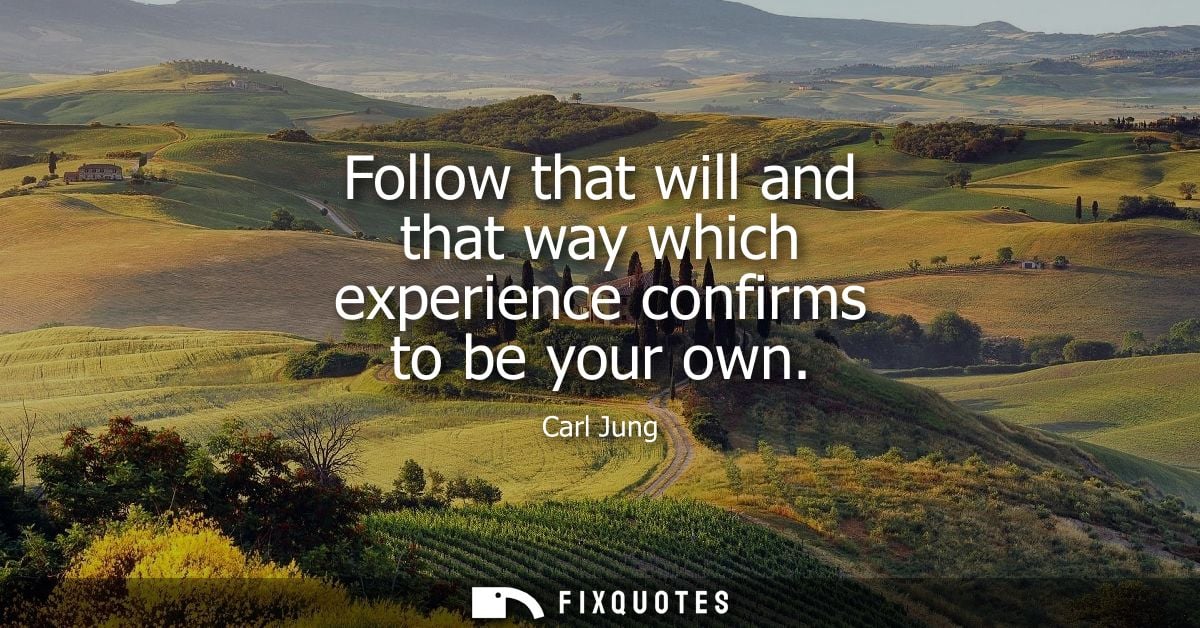
"Follow that will and that way which experience confirms to be your own"
About this Quote
Jung’s line is a manifesto for self-authorship, but it’s also a warning label. “Follow” sounds like motivational poster language until you notice what’s doing the legitimizing: not desire, not ideology, not even reason, but experience. He’s not asking you to discover a “true self” in some pristine inner chamber; he’s asking you to trust the version of you that survives contact with reality.
The phrasing does quiet psychological work. “That will and that way” splits the self into two forces: the drive (will) and the method (way). Jung implies you can’t just want authentically; you have to move through the world in a pattern that repeatedly proves itself. “Confirms” is clinical, almost empirical, as if your life is a long-term study and the data keeps pointing to the same conclusion: this path fits you, that one doesn’t. It’s an identity built by recurrence, not revelation.
The subtext is classic Jung: individuation as an earned, sometimes painful alignment between conscious intention and the deeper currents of the psyche. It’s also a rebuke to borrowed lives - the roles prescribed by family, class, religion, or the fashionable moral program of the moment. Jung knew how easily people confuse social approval with inner direction; neurosis, in his framework, often blooms where a person’s lived experience is repeatedly overruled by what they “should” be.
Context matters: writing in a modern age full of mass politics, mass culture, and mass psychology, Jung offers a counter-pressure. Not rebellion for its own sake, but fidelity to the only authority he thinks can’t be faked for long: the evidence of your own life.
The phrasing does quiet psychological work. “That will and that way” splits the self into two forces: the drive (will) and the method (way). Jung implies you can’t just want authentically; you have to move through the world in a pattern that repeatedly proves itself. “Confirms” is clinical, almost empirical, as if your life is a long-term study and the data keeps pointing to the same conclusion: this path fits you, that one doesn’t. It’s an identity built by recurrence, not revelation.
The subtext is classic Jung: individuation as an earned, sometimes painful alignment between conscious intention and the deeper currents of the psyche. It’s also a rebuke to borrowed lives - the roles prescribed by family, class, religion, or the fashionable moral program of the moment. Jung knew how easily people confuse social approval with inner direction; neurosis, in his framework, often blooms where a person’s lived experience is repeatedly overruled by what they “should” be.
Context matters: writing in a modern age full of mass politics, mass culture, and mass psychology, Jung offers a counter-pressure. Not rebellion for its own sake, but fidelity to the only authority he thinks can’t be faked for long: the evidence of your own life.
Quote Details
| Topic | Wisdom |
|---|---|
| Source | Help us find the source |
| Cite |
Citation Formats
APA Style (7th ed.)
Jung, Carl. (2026, January 17). Follow that will and that way which experience confirms to be your own. FixQuotes. https://fixquotes.com/quotes/follow-that-will-and-that-way-which-experience-30376/
Chicago Style
Jung, Carl. "Follow that will and that way which experience confirms to be your own." FixQuotes. January 17, 2026. https://fixquotes.com/quotes/follow-that-will-and-that-way-which-experience-30376/.
MLA Style (9th ed.)
"Follow that will and that way which experience confirms to be your own." FixQuotes, 17 Jan. 2026, https://fixquotes.com/quotes/follow-that-will-and-that-way-which-experience-30376/. Accessed 12 Feb. 2026.
More Quotes by Carl
Add to List