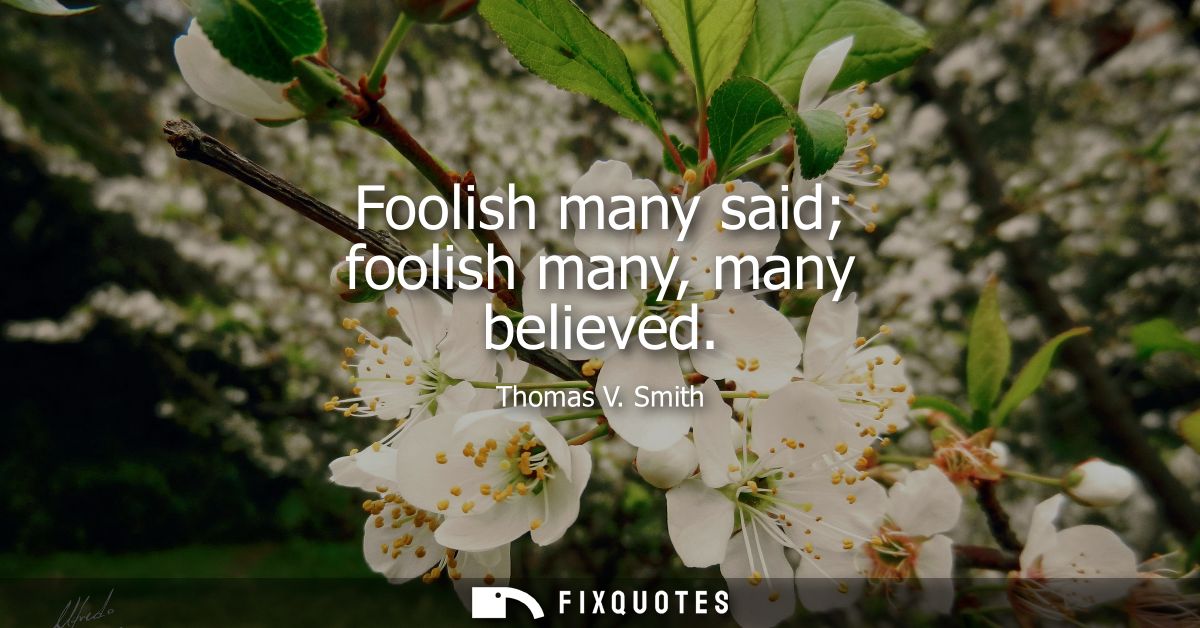
"Foolish many said; foolish many, many believed"
About this Quote
"Foolish many said; foolish many, many believed" lands like a clipped verdict on the life cycle of bad ideas: first they get mocked, then they get adopted. The structure does the heavy lifting. Smith’s semicolon isn’t just punctuation; it’s a hinge that turns sneering commentary into social reality. The repetition of "foolish many" works like a chant, exposing how crowds manufacture legitimacy through sheer volume. It’s not one person being wrong; it’s the comfort of being wrong together.
The sly sting is that the sentence refuses to identify the “foolish” claim itself. That omission is the point. It makes the line portable across eras: political myths, financial manias, moral panics, viral misinformation. Smith isn’t litigating a single delusion; he’s diagnosing a habit of mind, the way ridicule can coexist with credulity in the same public, sometimes in the same person. People can call something stupid at breakfast and forward it by lunch.
There’s also a faint moral irony in the cadence. The first clause implies a knowing minority looking down on the masses; the second suggests that judgment didn’t prevent contagion. Skepticism, in this framing, is often performative: a social pose that doesn’t reliably translate into resistance. Smith’s intent feels less like scolding individuals than indicting the crowd’s metabolic process: nonsense enters, gets laughed at, and still becomes belief once it finds enough mouths to repeat it.
The sly sting is that the sentence refuses to identify the “foolish” claim itself. That omission is the point. It makes the line portable across eras: political myths, financial manias, moral panics, viral misinformation. Smith isn’t litigating a single delusion; he’s diagnosing a habit of mind, the way ridicule can coexist with credulity in the same public, sometimes in the same person. People can call something stupid at breakfast and forward it by lunch.
There’s also a faint moral irony in the cadence. The first clause implies a knowing minority looking down on the masses; the second suggests that judgment didn’t prevent contagion. Skepticism, in this framing, is often performative: a social pose that doesn’t reliably translate into resistance. Smith’s intent feels less like scolding individuals than indicting the crowd’s metabolic process: nonsense enters, gets laughed at, and still becomes belief once it finds enough mouths to repeat it.
Quote Details
| Topic | Wisdom |
|---|---|
| Source | Help us find the source |
| Cite |
Citation Formats
APA Style (7th ed.)
Smith, Thomas V. (2026, January 15). Foolish many said; foolish many, many believed. FixQuotes. https://fixquotes.com/quotes/foolish-many-said-foolish-many-many-believed-169134/
Chicago Style
Smith, Thomas V. "Foolish many said; foolish many, many believed." FixQuotes. January 15, 2026. https://fixquotes.com/quotes/foolish-many-said-foolish-many-many-believed-169134/.
MLA Style (9th ed.)
"Foolish many said; foolish many, many believed." FixQuotes, 15 Jan. 2026, https://fixquotes.com/quotes/foolish-many-said-foolish-many-many-believed-169134/. Accessed 5 Apr. 2026.
More Quotes by Thomas
Add to List