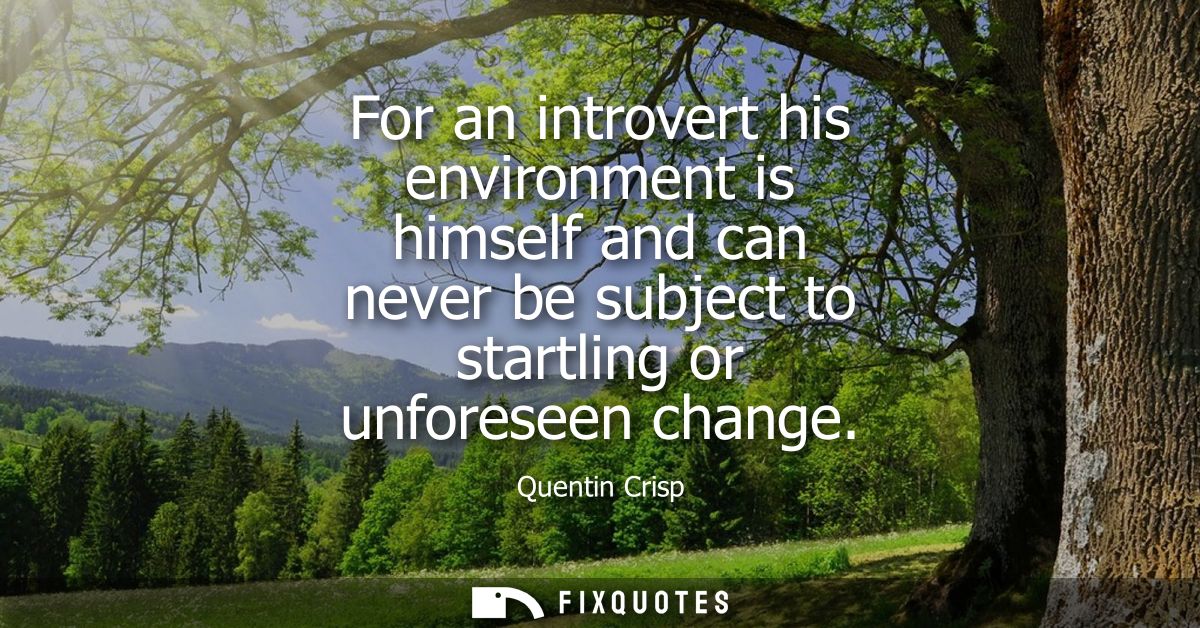
"For an introvert, his environment is himself and can never be subject to startling or unforeseen change"
About this Quote
The intent is double-edged. On the surface, it dignifies the introvert as someone insulated from chaos, almost elegantly self-sufficient. Underneath, it’s Crisp reframing marginalization as mastery. A gay, openly flamboyant man in mid-century Britain didn’t get the luxury of feeling “safe” in public space; the street could be a tribunal. So he relocates “environment” to the only place hostile crowds can’t legislate: the inner life. That move is both protective and provocatively aloof, a refusal to grant the outside world interpretive authority.
The phrasing matters. “Can never” is absolutist, deliberately overstated in that Crisp way, the performance of certainty as armor. “Startling or unforeseen change” suggests that what unsettles most people is novelty. Crisp’s implication is that the introvert already lives with the most complex, unstable terrain imaginable: the self. If you’ve learned to inhabit that, external drama looks less like fate and more like bad staging.
Context sharpens the irony: Crisp, a public character famous for being seen, praises invisibility as power. It’s a paradox that reads like lived experience rather than theory.
Quote Details
| Topic | Deep |
|---|---|
| Source | Help us find the source |
| Cite |
Citation Formats
APA Style (7th ed.)
Crisp, Quentin. (2026, February 20). For an introvert, his environment is himself and can never be subject to startling or unforeseen change. FixQuotes. https://fixquotes.com/quotes/for-an-introvert-his-environment-is-himself-and-6443/
Chicago Style
Crisp, Quentin. "For an introvert, his environment is himself and can never be subject to startling or unforeseen change." FixQuotes. February 20, 2026. https://fixquotes.com/quotes/for-an-introvert-his-environment-is-himself-and-6443/.
MLA Style (9th ed.)
"For an introvert, his environment is himself and can never be subject to startling or unforeseen change." FixQuotes, 20 Feb. 2026, https://fixquotes.com/quotes/for-an-introvert-his-environment-is-himself-and-6443/. Accessed 25 Mar. 2026.