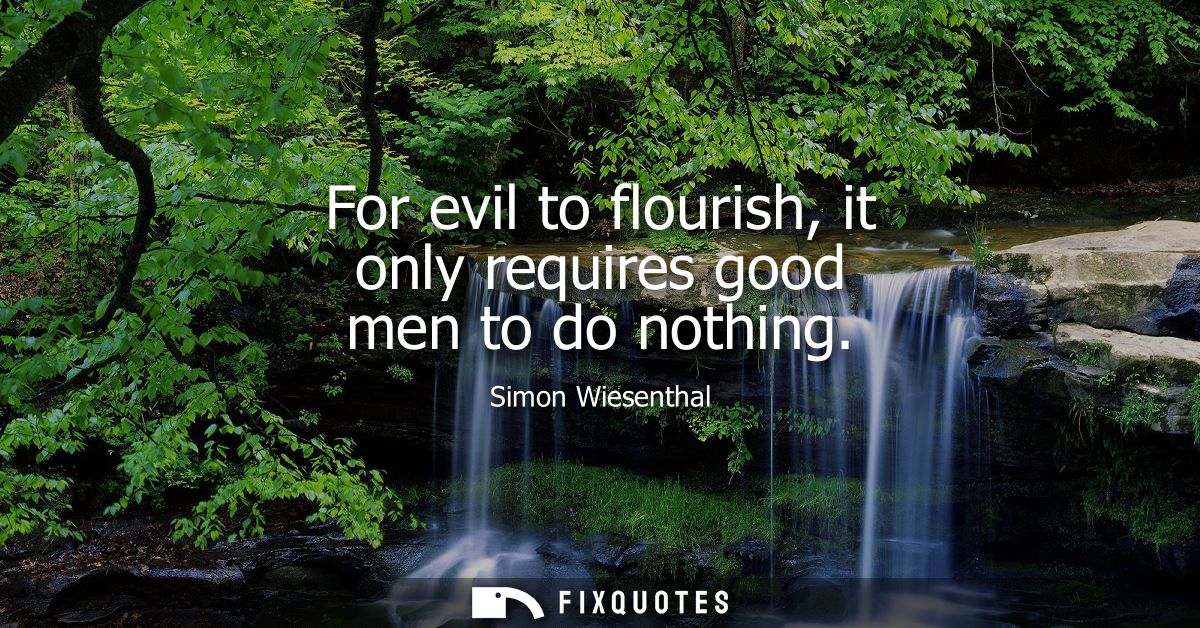
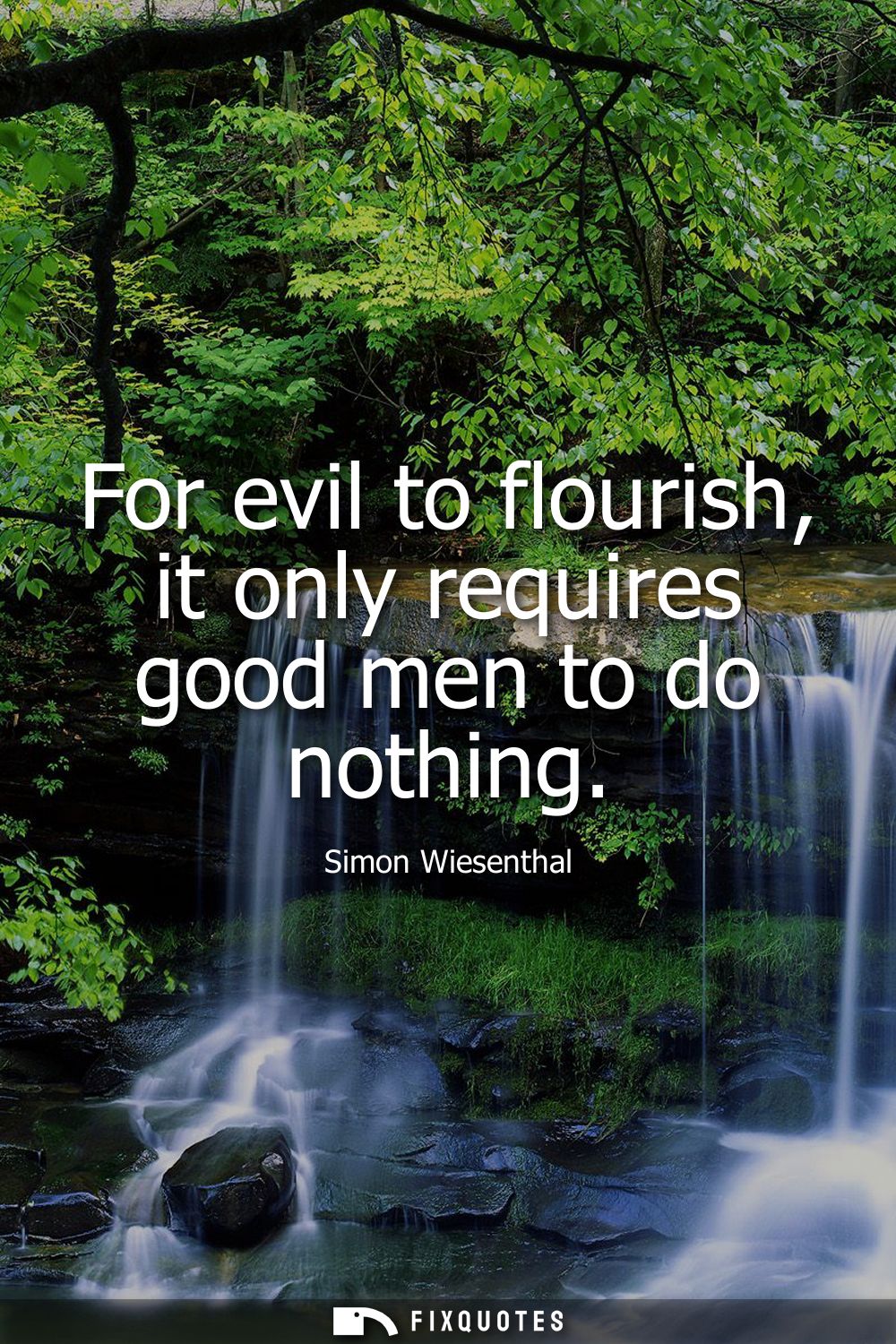
"For evil to flourish, it only requires good men to do nothing"
About this Quote
A line like this doesn’t flatter “good men”; it indicts them. Wiesenthal’s point isn’t that villains are unusually strong. It’s that they’re opportunistic, and their best accomplice is the respectable bystander who treats cruelty as someone else’s problem. The phrasing is engineered to sting: “only requires” shrinks evil’s needs down to something terrifyingly ordinary, while “do nothing” turns passivity into a choice with consequences. The subtext is moral bookkeeping: if you benefit from stability, community, citizenship, you’re already in the story. Neutrality isn’t outside the conflict; it’s an invisible hand on the scales.
Coming from Wiesenthal, a Holocaust survivor who dedicated his life to tracking Nazi war criminals, this isn’t abstract sermonizing. It’s a verdict formed in the aftermath of a society where mass murder depended not just on ideologues and bureaucrats, but on neighbors who looked away, institutions that stalled, and “decent” people who waited for someone else to object first. The quote’s specific intent is to collapse the comfortable distance between atrocity and everyday life. It reframes responsibility from heroic intervention to basic refusal: refusing to normalize, to excuse, to stay silent.
Its cultural power lies in how it weaponizes shame without demanding sainthood. It asks for motion, not purity. In an era of algorithmic outrage and fatigued spectatorship, the line still bites: the easiest way to sustain harm is to turn conscience into a private feeling instead of a public act.
Coming from Wiesenthal, a Holocaust survivor who dedicated his life to tracking Nazi war criminals, this isn’t abstract sermonizing. It’s a verdict formed in the aftermath of a society where mass murder depended not just on ideologues and bureaucrats, but on neighbors who looked away, institutions that stalled, and “decent” people who waited for someone else to object first. The quote’s specific intent is to collapse the comfortable distance between atrocity and everyday life. It reframes responsibility from heroic intervention to basic refusal: refusing to normalize, to excuse, to stay silent.
Its cultural power lies in how it weaponizes shame without demanding sainthood. It asks for motion, not purity. In an era of algorithmic outrage and fatigued spectatorship, the line still bites: the easiest way to sustain harm is to turn conscience into a private feeling instead of a public act.
Quote Details
| Topic | Justice |
|---|---|
| Source | Help us find the source |
| Cite |
Citation Formats
APA Style (7th ed.)
Wiesenthal, Simon. (2026, January 14). For evil to flourish, it only requires good men to do nothing. FixQuotes. https://fixquotes.com/quotes/for-evil-to-flourish-it-only-requires-good-men-to-63186/
Chicago Style
Wiesenthal, Simon. "For evil to flourish, it only requires good men to do nothing." FixQuotes. January 14, 2026. https://fixquotes.com/quotes/for-evil-to-flourish-it-only-requires-good-men-to-63186/.
MLA Style (9th ed.)
"For evil to flourish, it only requires good men to do nothing." FixQuotes, 14 Jan. 2026, https://fixquotes.com/quotes/for-evil-to-flourish-it-only-requires-good-men-to-63186/. Accessed 14 Mar. 2026.
More Quotes by Simon
Add to List