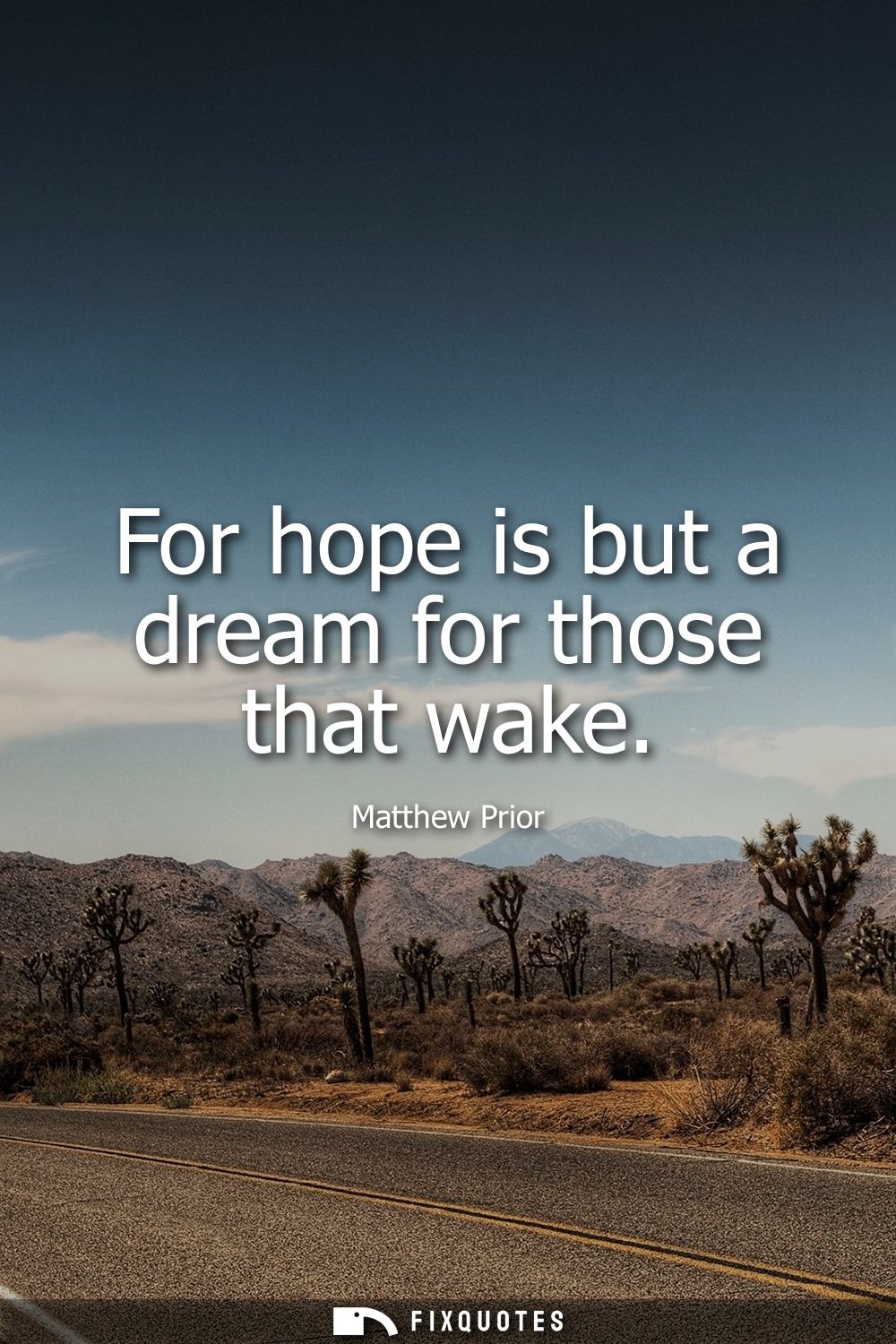
"For hope is but a dream for those that wake"
About this Quote
Hope gets demoted here from virtue to nighttime illusion: something you can afford only while you are asleep. Prior’s line turns on a neat, almost cruel inversion. We tend to treat waking as clarity and moral seriousness; he treats it as the moment the lights come on and the set collapses. “But” does the heavy lifting, snapping the reader out of any sentimental expectation. Hope isn’t a steady flame. It’s a dream - vivid, persuasive, and fundamentally unbinding from the constraints of daylight.
The subtext is less nihilistic than it first appears. Prior is writing in an era that prized poise, polish, and a certain skepticism about grand feeling: Restoration and early Augustan culture learned to distrust raptures that couldn’t survive daylight. In that world, “waking” signals social realism: bills, rank, reputation, political volatility, the hard math of desire versus consequence. The line implies that to be fully awake - socially, politically, psychologically - is to see how little leverage hope actually has.
It works because it flatters and indicts at once. If you recognize yourself among “those that wake,” you’re being cast as shrewd, unseduced, adult. You’re also being told you’ve paid for that adulthood with a particular kind of inner poverty: the inability to let possibility feel real. Prior doesn’t argue; he compresses a worldview into a single, icy metaphor, leaving you to decide whether wakefulness is wisdom or a self-imposed insomnia.
The subtext is less nihilistic than it first appears. Prior is writing in an era that prized poise, polish, and a certain skepticism about grand feeling: Restoration and early Augustan culture learned to distrust raptures that couldn’t survive daylight. In that world, “waking” signals social realism: bills, rank, reputation, political volatility, the hard math of desire versus consequence. The line implies that to be fully awake - socially, politically, psychologically - is to see how little leverage hope actually has.
It works because it flatters and indicts at once. If you recognize yourself among “those that wake,” you’re being cast as shrewd, unseduced, adult. You’re also being told you’ve paid for that adulthood with a particular kind of inner poverty: the inability to let possibility feel real. Prior doesn’t argue; he compresses a worldview into a single, icy metaphor, leaving you to decide whether wakefulness is wisdom or a self-imposed insomnia.
Quote Details
| Topic | Hope |
|---|---|
| Source | Help us find the source |
| Cite |
Citation Formats
APA Style (7th ed.)
Prior, Matthew. (2026, January 17). For hope is but a dream for those that wake. FixQuotes. https://fixquotes.com/quotes/for-hope-is-but-a-dream-for-those-that-wake-57406/
Chicago Style
Prior, Matthew. "For hope is but a dream for those that wake." FixQuotes. January 17, 2026. https://fixquotes.com/quotes/for-hope-is-but-a-dream-for-those-that-wake-57406/.
MLA Style (9th ed.)
"For hope is but a dream for those that wake." FixQuotes, 17 Jan. 2026, https://fixquotes.com/quotes/for-hope-is-but-a-dream-for-those-that-wake-57406/. Accessed 3 Apr. 2026.
More Quotes by Matthew
Add to List