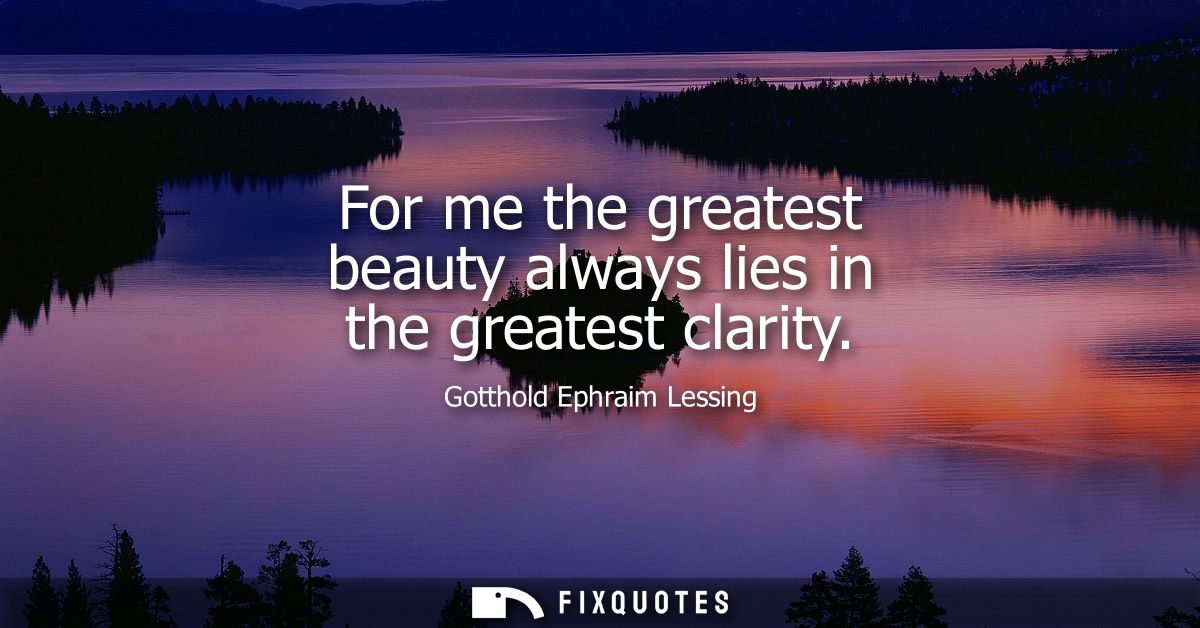
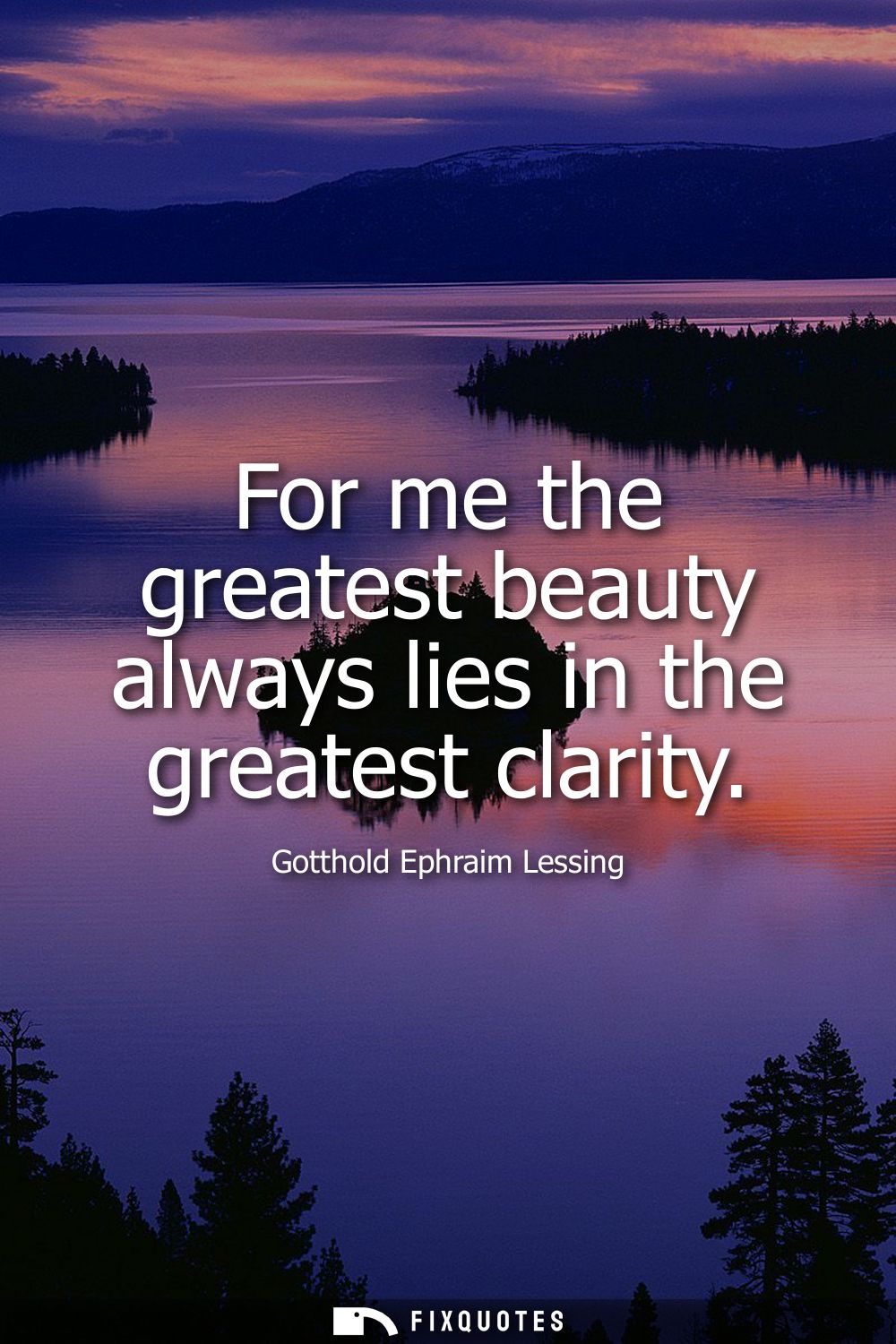
"For me, the greatest beauty always lies in the greatest clarity"
About this Quote
Lessing’s line is a manifesto disguised as a preference. In an 18th-century culture still intoxicated by baroque flourish and courtly performance, “greatest clarity” is a pointed rebuke: beauty isn’t the ornamental fog that flatters power; it’s the moment an idea becomes legible. Coming from a critic at the heart of the German Enlightenment, the claim isn’t merely aesthetic. It’s political in the period’s quieter way. Clarity implies public reason, the kind that can be shared, argued with, corrected. Mystery can be a luxury; obscurity can be a tactic.
The sentence also plays defense against the prestige of difficulty. Lessing is telling you that the highest art doesn’t require a priesthood of interpreters. That’s not anti-intellectualism; it’s an insistence that intelligence includes being understood. “Greatest” matters twice here: he isn’t praising plainness or simplification, but the hard-won lucidity that comes after complexity has been wrestled into form. The subtext is craft, discipline, and ethical accountability: if you can’t say what you mean, maybe you don’t mean much.
Lessing’s broader work, especially his arguments about the limits and strengths of different arts (and his battles against dogma in theater and theology), makes the line feel like a program for modern criticism. Beauty, for him, is not a decorative bonus. It’s what happens when form stops showing off and starts revealing.
The sentence also plays defense against the prestige of difficulty. Lessing is telling you that the highest art doesn’t require a priesthood of interpreters. That’s not anti-intellectualism; it’s an insistence that intelligence includes being understood. “Greatest” matters twice here: he isn’t praising plainness or simplification, but the hard-won lucidity that comes after complexity has been wrestled into form. The subtext is craft, discipline, and ethical accountability: if you can’t say what you mean, maybe you don’t mean much.
Lessing’s broader work, especially his arguments about the limits and strengths of different arts (and his battles against dogma in theater and theology), makes the line feel like a program for modern criticism. Beauty, for him, is not a decorative bonus. It’s what happens when form stops showing off and starts revealing.
Quote Details
| Topic | Wisdom |
|---|---|
| Source | Help us find the source |
| Cite |
Citation Formats
APA Style (7th ed.)
Lessing, Gotthold Ephraim. (2026, February 16). For me, the greatest beauty always lies in the greatest clarity. FixQuotes. https://fixquotes.com/quotes/for-me-the-greatest-beauty-always-lies-in-the-143983/
Chicago Style
Lessing, Gotthold Ephraim. "For me, the greatest beauty always lies in the greatest clarity." FixQuotes. February 16, 2026. https://fixquotes.com/quotes/for-me-the-greatest-beauty-always-lies-in-the-143983/.
MLA Style (9th ed.)
"For me, the greatest beauty always lies in the greatest clarity." FixQuotes, 16 Feb. 2026, https://fixquotes.com/quotes/for-me-the-greatest-beauty-always-lies-in-the-143983/. Accessed 14 Mar. 2026.
More Quotes by Gotthold
Add to List