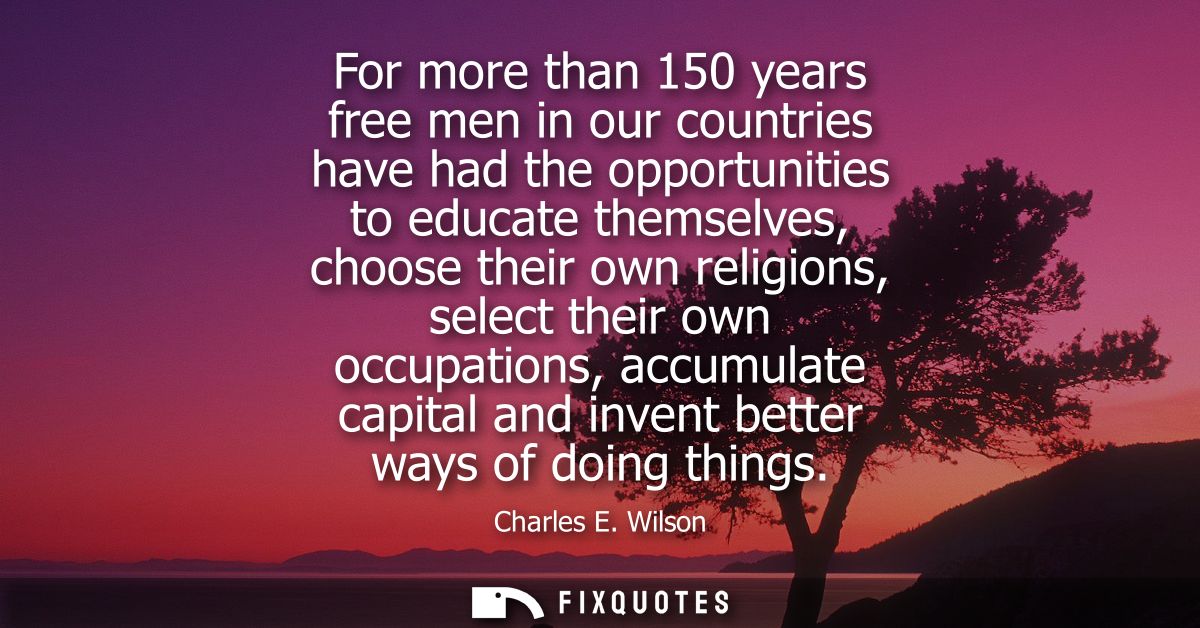
"For more than 150 years free men in our countries have had the opportunities to educate themselves, choose their own religions, select their own occupations, accumulate capital and invent better ways of doing things"
About this Quote
The subtext is selective. “Free men” is doing a lot of work, quietly narrowing the cast to those already positioned to benefit from these liberties. The list treats “accumulate capital” as coequal with “choose their own religions,” a rhetorical move that elevates property rights into the same sacred category as conscience. It’s a subtle defense against redistribution and regulation: if capital accumulation is part of the freedom package, then constraints on capital start to look like constraints on freedom itself.
Context matters because Wilson wasn’t a philosopher; he was an industrial executive (and famously, a Defense Secretary) speaking from the mid-century peak of American managerial confidence. This is the era when corporate leaders sold the public on the idea that private enterprise was not merely efficient but virtuous, the engine of both national security and everyday prosperity. The line “invent better ways of doing things” nods to innovation, but it also naturalizes hierarchy: the people who “invent” and “accumulate” are cast as society’s protagonists, while labor, collective bargaining, and the state recede into the background as if they’re incidental rather than structural.
Quote Details
| Topic | Freedom |
|---|---|
| Source | Help us find the source |
| Cite |
Citation Formats
APA Style (7th ed.)
Wilson, Charles E. (2026, January 17). For more than 150 years free men in our countries have had the opportunities to educate themselves, choose their own religions, select their own occupations, accumulate capital and invent better ways of doing things. FixQuotes. https://fixquotes.com/quotes/for-more-than-150-years-free-men-in-our-countries-40591/
Chicago Style
Wilson, Charles E. "For more than 150 years free men in our countries have had the opportunities to educate themselves, choose their own religions, select their own occupations, accumulate capital and invent better ways of doing things." FixQuotes. January 17, 2026. https://fixquotes.com/quotes/for-more-than-150-years-free-men-in-our-countries-40591/.
MLA Style (9th ed.)
"For more than 150 years free men in our countries have had the opportunities to educate themselves, choose their own religions, select their own occupations, accumulate capital and invent better ways of doing things." FixQuotes, 17 Jan. 2026, https://fixquotes.com/quotes/for-more-than-150-years-free-men-in-our-countries-40591/. Accessed 19 Feb. 2026.