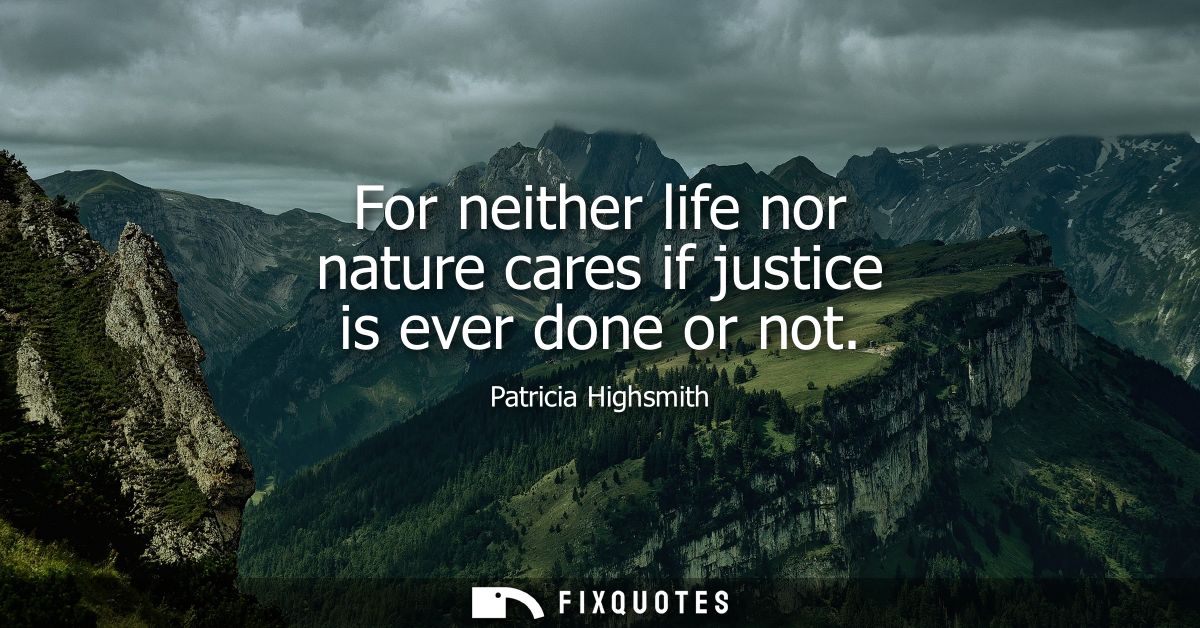
"For neither life nor nature cares if justice is ever done or not"
About this Quote
Cold comfort is the point: Highsmith strips away the cozy superstition that the world keeps moral books. "Neither life nor nature" is a double barrel. Life is the social mess we narrate into meaning; nature is the indifferent machinery underneath it. By pairing them, she closes the usual escape hatches. If injustice happens, you cannot appeal to fate, karma, God-in-the-ecosystem, or history's eventual arc. Nothing out there is invested.
The line is doing more than nihilism. Highsmith is a crime novelist famous for making readers inhabit the predator's calm. The intent here is to short-circuit the reader's craving for narrative restitution: the murderer caught, the innocent vindicated, the universe restored. Her books often refuse that catharsis, not as a gimmick but as an accusation. We want justice to be inevitable because it absolves us of responsibility. If nature doesn't care, then justice isn't a cosmic outcome; it's a human project, fragile and optional.
Subtext: morality is not a law of physics, it's a local custom enforced - when it is enforced at all - by institutions and people who get tired, corrupt, afraid, or bought. "Cares" is the scalpel word. Justice isn't denied; it's rendered irrelevant to the world's operating system. That indifference is what makes Highsmith's suspense so queasy: evil doesn't need grand motives, only opportunity and a little nerve.
Contextually, it's postwar modern disillusion filtered through psychological realism: a century that watched systems fail and still kept demanding neat endings. Highsmith answers with a chill reminder that the ending is on us, not the universe.
The line is doing more than nihilism. Highsmith is a crime novelist famous for making readers inhabit the predator's calm. The intent here is to short-circuit the reader's craving for narrative restitution: the murderer caught, the innocent vindicated, the universe restored. Her books often refuse that catharsis, not as a gimmick but as an accusation. We want justice to be inevitable because it absolves us of responsibility. If nature doesn't care, then justice isn't a cosmic outcome; it's a human project, fragile and optional.
Subtext: morality is not a law of physics, it's a local custom enforced - when it is enforced at all - by institutions and people who get tired, corrupt, afraid, or bought. "Cares" is the scalpel word. Justice isn't denied; it's rendered irrelevant to the world's operating system. That indifference is what makes Highsmith's suspense so queasy: evil doesn't need grand motives, only opportunity and a little nerve.
Contextually, it's postwar modern disillusion filtered through psychological realism: a century that watched systems fail and still kept demanding neat endings. Highsmith answers with a chill reminder that the ending is on us, not the universe.
Quote Details
| Topic | Justice |
|---|---|
| Source | Help us find the source |
More Quotes by Patricia
Add to List