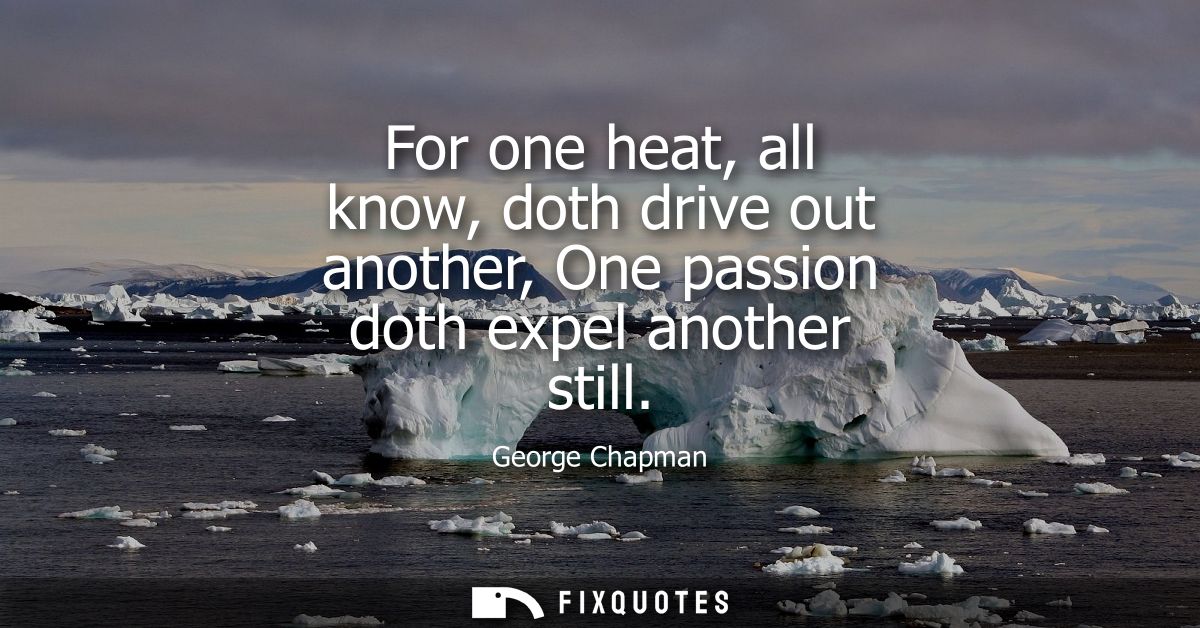
"For one heat, all know, doth drive out another, one passion doth expel another still"
About this Quote
The intent is pragmatic, almost medicinal. Early modern audiences would have recognized the humoral logic underneath: “heat” isn’t only metaphor but temperament, a physical state tied to lust, anger, ambition, grief. Chapman borrows that pseudo-science to make a sharp psychological claim: people don’t stop wanting; they redirect wanting. That’s both consoling and bleak. Consoling because heartbreak has a cure that doesn’t require moral purity - just time and a new fixation. Bleak because it implies we’re not masters of our inner life so much as subjects of competing appetites.
The subtext is about control and self-deception. “All know” pretends this is common wisdom, which doubles as social pressure: if you’re still stuck, you’re refusing the obvious remedy. Chapman also slyly suggests that what we call constancy may be inertia, and what we call recovery may be substitution.
In a culture obsessed with rhetoric and self-fashioning, the line lands as both advice and indictment: the self is not a stable core but a sequence of takeovers.
Quote Details
| Topic | Love |
|---|---|
| Source | Help us find the source |
| Cite |
Citation Formats
APA Style (7th ed.)
Chapman, George. (2026, February 17). For one heat, all know, doth drive out another, one passion doth expel another still. FixQuotes. https://fixquotes.com/quotes/for-one-heat-all-know-doth-drive-out-another-one-101204/
Chicago Style
Chapman, George. "For one heat, all know, doth drive out another, one passion doth expel another still." FixQuotes. February 17, 2026. https://fixquotes.com/quotes/for-one-heat-all-know-doth-drive-out-another-one-101204/.
MLA Style (9th ed.)
"For one heat, all know, doth drive out another, one passion doth expel another still." FixQuotes, 17 Feb. 2026, https://fixquotes.com/quotes/for-one-heat-all-know-doth-drive-out-another-one-101204/. Accessed 13 Mar. 2026.