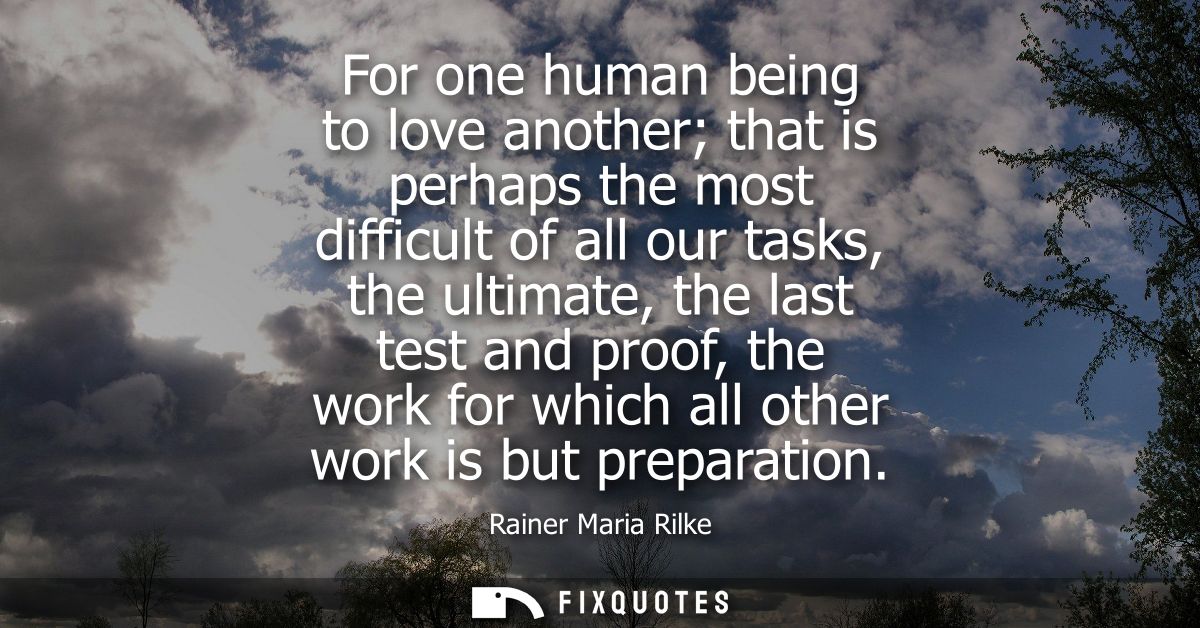
"For one human being to love another; that is perhaps the most difficult of all our tasks, the ultimate, the last test and proof, the work for which all other work is but preparation"
About this Quote
Love, in Rilke's hands, is not a soft landing. It is a discipline severe enough to make everything else in life feel like training drills. The line’s force comes from its refusal to treat romance as an instinct or a lucky accident; he frames it as labor, and not the Instagrammable kind. “Task,” “test,” “proof,” “work” - he stacks bureaucratic, almost monastic nouns where we expect tenderness. The subtext is blunt: most people want the feelings, not the assignment. Rilke is calling that bluff.
Context matters. Rilke wrote out of a modernist suspicion of easy sentiment, and out of a personal history of intense, often difficult intimacy. In Letters to a Young Poet, where this idea circulates most famously, he warns against the romantic fusion myth - the notion that two people should dissolve into one. Real love, for him, preserves two solitudes. That’s why it’s hard: it requires patience without possession, devotion without annexation, closeness that doesn’t become control.
The sly pivot is “preparation.” He demotes ambition, art-making, and public achievement into mere warm-ups, implying that the real adult exam is ethical and relational. It’s also a quiet rebuke to the era’s (and ours) cult of productivity: if you can build a career but can’t build a humane bond, you’ve mastered the wrong craft.
Rilke’s intent isn’t to romanticize struggle; it’s to dignify responsibility. Love becomes a practice of attention - the kind that proves, over time, who you are.
Context matters. Rilke wrote out of a modernist suspicion of easy sentiment, and out of a personal history of intense, often difficult intimacy. In Letters to a Young Poet, where this idea circulates most famously, he warns against the romantic fusion myth - the notion that two people should dissolve into one. Real love, for him, preserves two solitudes. That’s why it’s hard: it requires patience without possession, devotion without annexation, closeness that doesn’t become control.
The sly pivot is “preparation.” He demotes ambition, art-making, and public achievement into mere warm-ups, implying that the real adult exam is ethical and relational. It’s also a quiet rebuke to the era’s (and ours) cult of productivity: if you can build a career but can’t build a humane bond, you’ve mastered the wrong craft.
Rilke’s intent isn’t to romanticize struggle; it’s to dignify responsibility. Love becomes a practice of attention - the kind that proves, over time, who you are.
Quote Details
| Topic | Love |
|---|---|
| Source | Rainer Maria Rilke, Letters to a Young Poet (Briefe an einen jungen Dichter). The line is commonly attributed to Rilke in English translations of his collected letters to Franz Xaver Kappus (published posthumously in collections of Rilke's letters). |
More Quotes by Rainer
Add to List