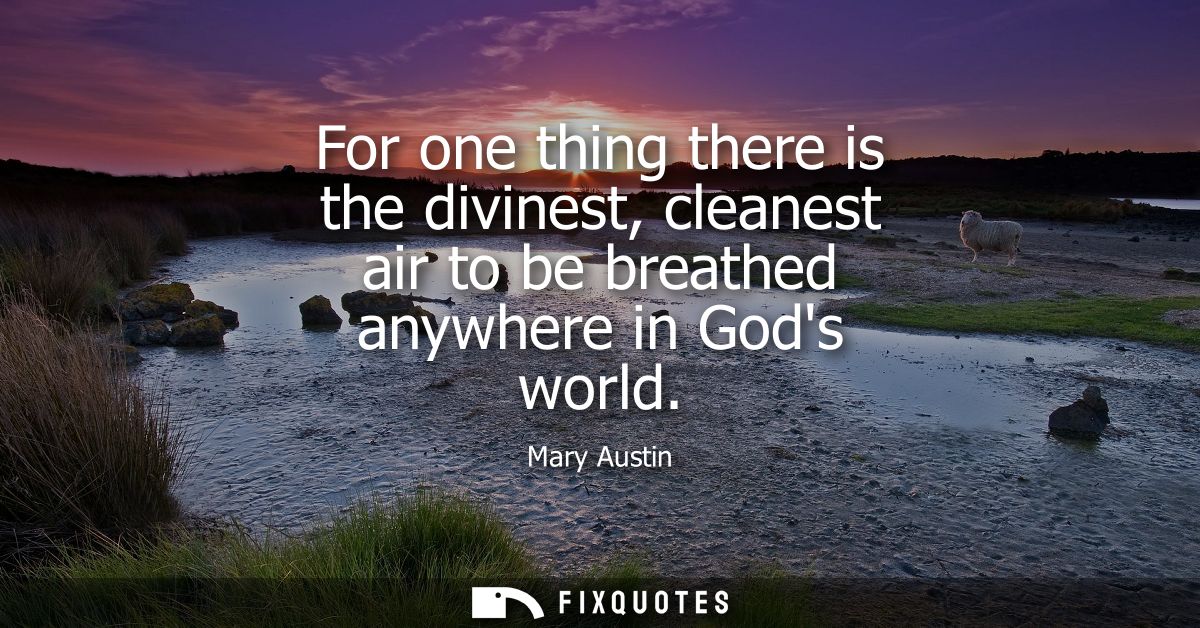
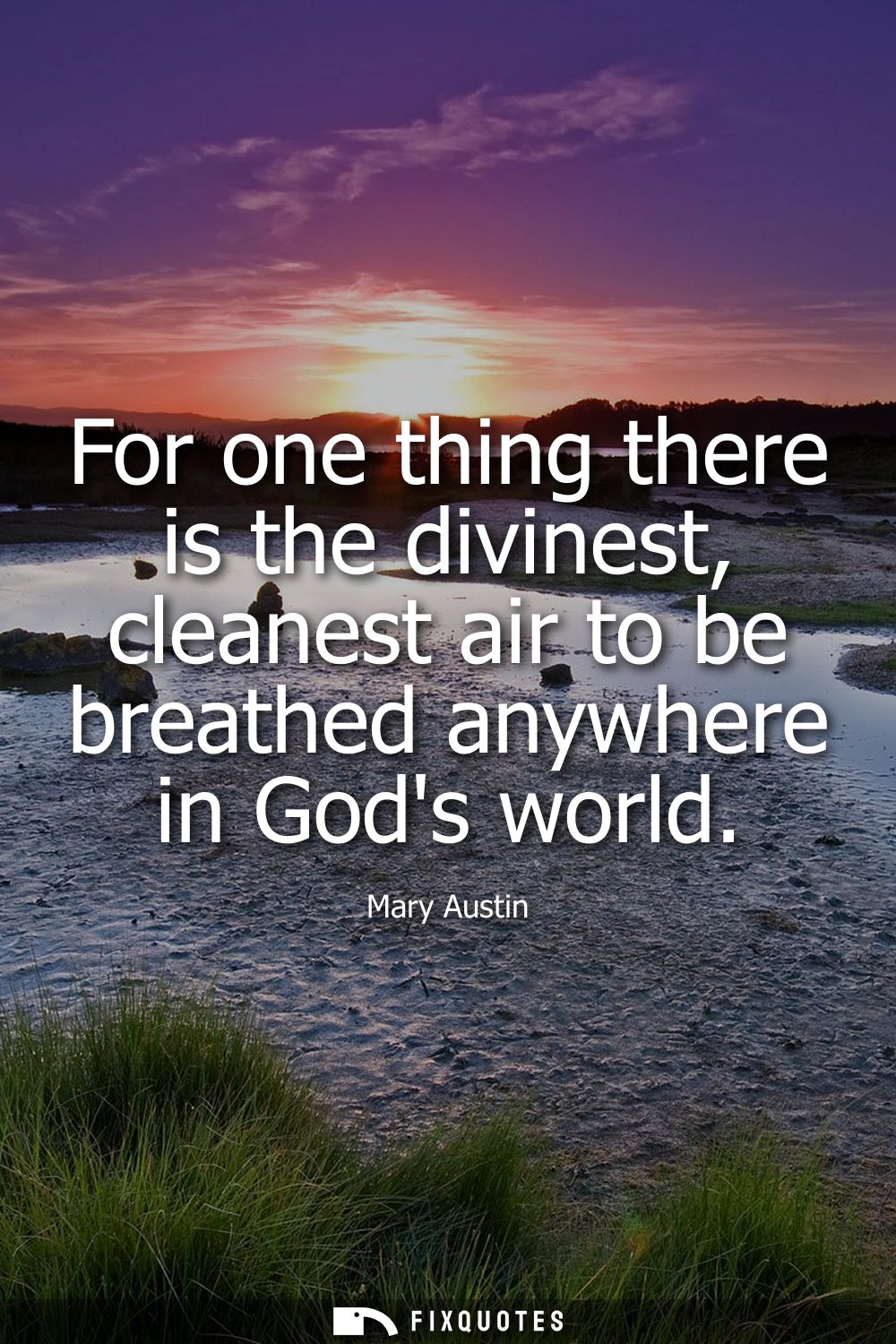
"For one thing there is the divinest, cleanest air to be breathed anywhere in God's world"
About this Quote
Austin was writing out of the early 20th-century American West, when “pure air” carried cultural weight: tuberculosis sanatoriums, back-to-nature movements, and a growing urban disgust with smoke, crowding, and industrial grime. So the sentence isn’t just landscape writing; it’s an argument. The desert becomes a moral and physical corrective, a place where the body is restored and the mind can be scrubbed of modernity.
The religious phrasing - “anywhere in God’s world” - works as both permission and provocation. It folds the claim into a shared vocabulary of reverence, implying that to doubt her is to doubt creation itself. Subtext: the West is not barren; it’s purified. In a period when the desert was often framed as empty, hostile, or useless, Austin flips the script. She makes “nothing” sound like salvation, and does it through the simplest human act: inhaling.
Quote Details
| Topic | Nature |
|---|---|
| Source | Help us find the source |
| Cite |
Citation Formats
APA Style (7th ed.)
Austin, Mary. (2026, January 16). For one thing there is the divinest, cleanest air to be breathed anywhere in God's world. FixQuotes. https://fixquotes.com/quotes/for-one-thing-there-is-the-divinest-cleanest-air-93402/
Chicago Style
Austin, Mary. "For one thing there is the divinest, cleanest air to be breathed anywhere in God's world." FixQuotes. January 16, 2026. https://fixquotes.com/quotes/for-one-thing-there-is-the-divinest-cleanest-air-93402/.
MLA Style (9th ed.)
"For one thing there is the divinest, cleanest air to be breathed anywhere in God's world." FixQuotes, 16 Jan. 2026, https://fixquotes.com/quotes/for-one-thing-there-is-the-divinest-cleanest-air-93402/. Accessed 12 Feb. 2026.