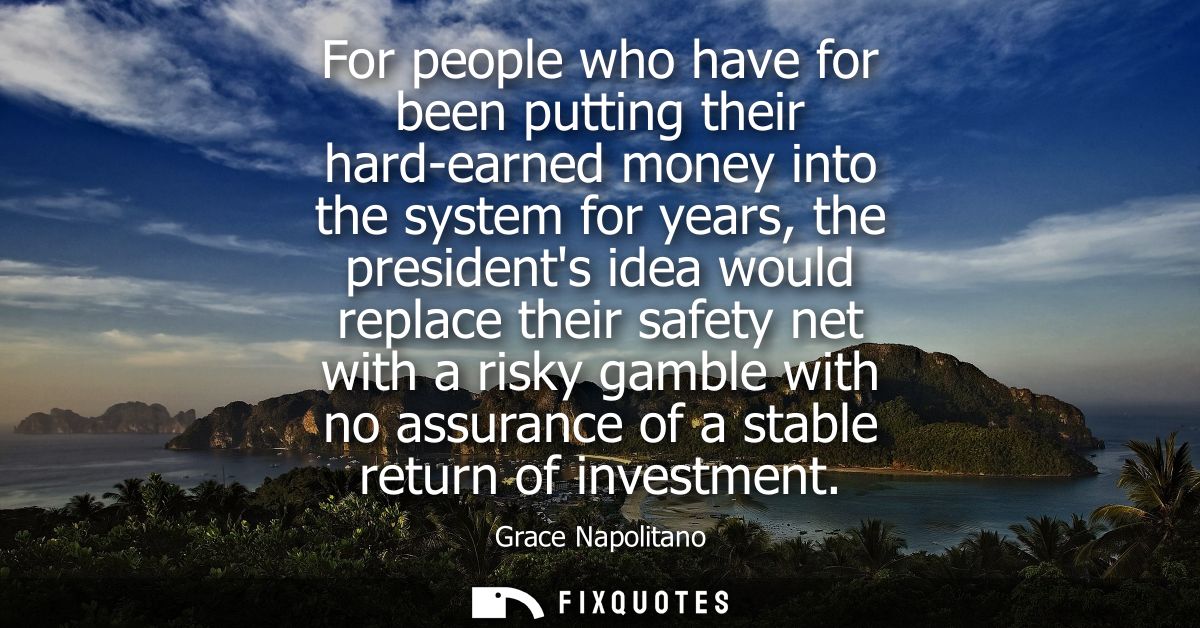
"For people who have for been putting their hard-earned money into the system for years, the president's idea would replace their safety net with a risky gamble with no assurance of a stable return of investment"
About this Quote
The phrasing "hard-earned money" signals an appeal to dignity, not charity. These aren’t passive beneficiaries; they’re contributors who have been paying in "for years", which smuggles in a promise: longevity creates obligation. That’s the subtextual contract she implies the president is breaking. Calling the existing program a "system" also matters. It sounds impersonal, bureaucratic, maybe flawed, but stable. Stability is her primary value, because stability is what retirees and near-retirees actually purchase with payroll taxes: predictability.
She also weaponizes financial vocabulary to rebut market romanticism. "Return on investment" is usually the language of the reformers; Napolitano turns it against them by emphasizing "no assurance" and "stable" in the same breath. The line is calibrated for a specific audience: people close enough to retirement to fear downside risk more than they crave upside potential. Politically, it’s a warning shot at any proposal that shifts responsibility from collective insurance to individual exposure, framing that shift as not just risky, but unfair.
Quote Details
| Topic | Investment |
|---|---|
| Source | Help us find the source |
| Cite |
Citation Formats
APA Style (7th ed.)
Napolitano, Grace. (2026, January 16). For people who have for been putting their hard-earned money into the system for years, the president's idea would replace their safety net with a risky gamble with no assurance of a stable return of investment. FixQuotes. https://fixquotes.com/quotes/for-people-who-have-for-been-putting-their-82453/
Chicago Style
Napolitano, Grace. "For people who have for been putting their hard-earned money into the system for years, the president's idea would replace their safety net with a risky gamble with no assurance of a stable return of investment." FixQuotes. January 16, 2026. https://fixquotes.com/quotes/for-people-who-have-for-been-putting-their-82453/.
MLA Style (9th ed.)
"For people who have for been putting their hard-earned money into the system for years, the president's idea would replace their safety net with a risky gamble with no assurance of a stable return of investment." FixQuotes, 16 Jan. 2026, https://fixquotes.com/quotes/for-people-who-have-for-been-putting-their-82453/. Accessed 6 Apr. 2026.