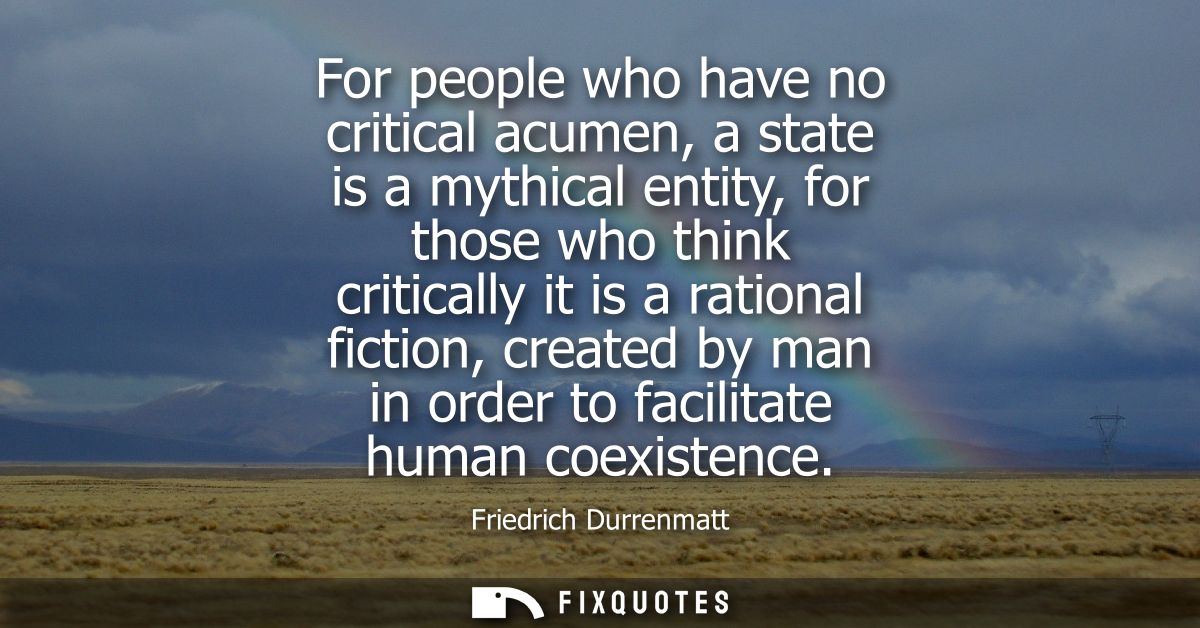
"For people who have no critical acumen, a state is a mythical entity, for those who think critically, it is a rational fiction, created by man in order to facilitate human coexistence"
About this Quote
Then comes the colder formulation: the state as “rational fiction.” Durrenmatt isn’t dismissing it as a lie; he’s naming it as a collective story we agree to act as if it’s real because it solves practical problems. Money is a rational fiction. Borders are a rational fiction. Law is a rational fiction. They function precisely because we stop noticing how invented they are. The line “created by man” drags the state back down to human scale, where it becomes criticizable, revisable, and, crucially, blameworthy.
The subtext is aimed at modern Europe’s nervous mid-century aftermath, when states had recently proven they could industrialize both welfare and horror. A Swiss dramatist watching authoritarian mythmaking on one side and technocratic managerialism on the other, Durrenmatt insists on a third posture: lucid participation. Coexistence requires coordination, but coordination without skepticism curdles into worship. His intent is less to weaken the state than to deny it the alibi of inevitability.
Quote Details
| Topic | Reason & Logic |
|---|---|
| Source | Help us find the source |
| Cite |
Citation Formats
APA Style (7th ed.)
Durrenmatt, Friedrich. (2026, February 19). For people who have no critical acumen, a state is a mythical entity, for those who think critically, it is a rational fiction, created by man in order to facilitate human coexistence. FixQuotes. https://fixquotes.com/quotes/for-people-who-have-no-critical-acumen-a-state-is-47502/
Chicago Style
Durrenmatt, Friedrich. "For people who have no critical acumen, a state is a mythical entity, for those who think critically, it is a rational fiction, created by man in order to facilitate human coexistence." FixQuotes. February 19, 2026. https://fixquotes.com/quotes/for-people-who-have-no-critical-acumen-a-state-is-47502/.
MLA Style (9th ed.)
"For people who have no critical acumen, a state is a mythical entity, for those who think critically, it is a rational fiction, created by man in order to facilitate human coexistence." FixQuotes, 19 Feb. 2026, https://fixquotes.com/quotes/for-people-who-have-no-critical-acumen-a-state-is-47502/. Accessed 30 Mar. 2026.