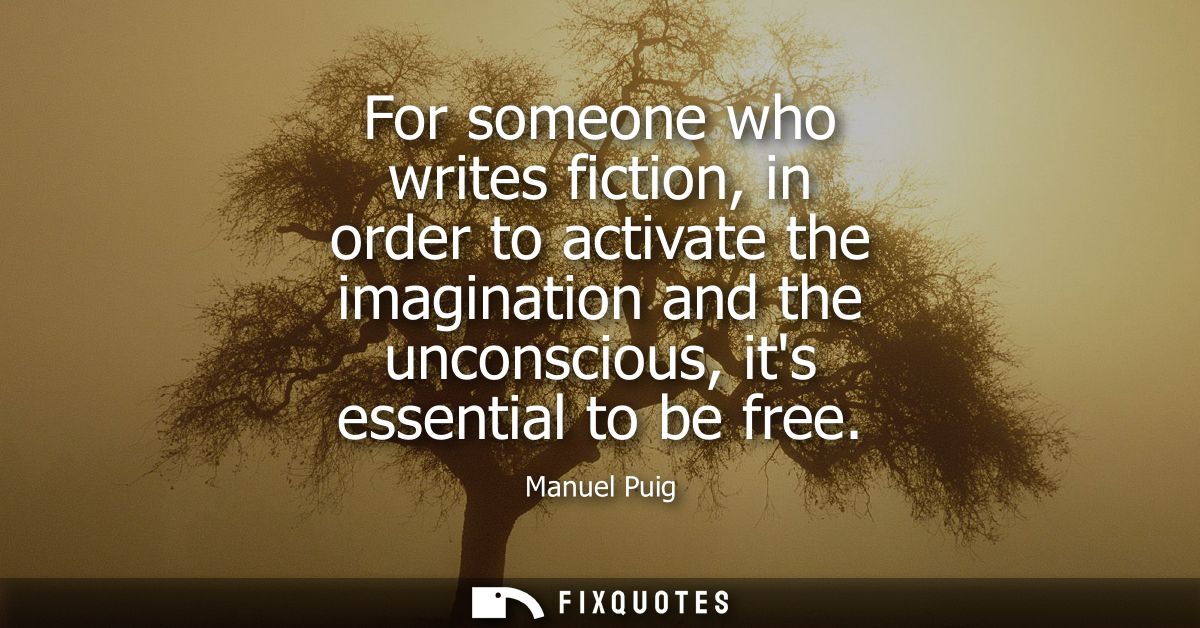
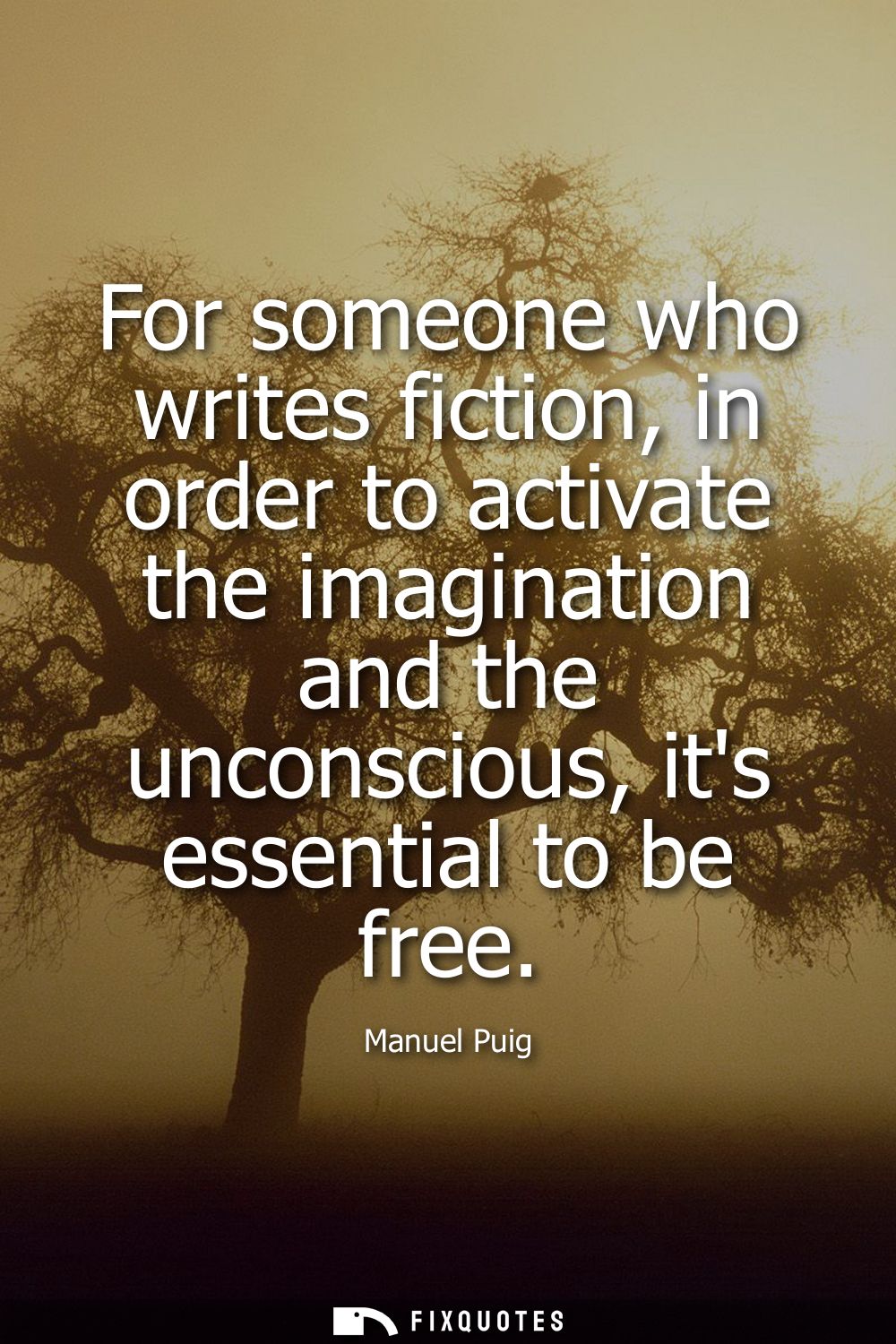
"For someone who writes fiction, in order to activate the imagination and the unconscious, it's essential to be free"
About this Quote
Puig’s career makes the line sharper. An Argentine novelist whose work mixed pop melodrama, gossip, film dialogue, and high-literary ambition, he built narratives out of voices that “serious” culture often dismissed: women’s talk, queer desire, mass entertainment. In Latin America under authoritarian pressure - and for a gay writer navigating public scrutiny - “freedom” isn’t abstract. It’s the difference between a novel that risks contamination by the low, the feminine, the taboo, and one that retreats into safe allegory.
The subtext is a quiet rebuke to the myth of the writer as pure willpower. Puig implies the unconscious is not a pet; it’s a wild collaborator. Fiction works when you can let it speak without immediately translating it into socially acceptable language. Freedom, in that sense, is an aesthetic condition before it’s a political one - though for Puig, the two were never cleanly separable.
Quote Details
| Topic | Writing |
|---|---|
| Source | Help us find the source |
| Cite |
Citation Formats
APA Style (7th ed.)
Puig, Manuel. (2026, January 15). For someone who writes fiction, in order to activate the imagination and the unconscious, it's essential to be free. FixQuotes. https://fixquotes.com/quotes/for-someone-who-writes-fiction-in-order-to-155494/
Chicago Style
Puig, Manuel. "For someone who writes fiction, in order to activate the imagination and the unconscious, it's essential to be free." FixQuotes. January 15, 2026. https://fixquotes.com/quotes/for-someone-who-writes-fiction-in-order-to-155494/.
MLA Style (9th ed.)
"For someone who writes fiction, in order to activate the imagination and the unconscious, it's essential to be free." FixQuotes, 15 Jan. 2026, https://fixquotes.com/quotes/for-someone-who-writes-fiction-in-order-to-155494/. Accessed 31 Mar. 2026.