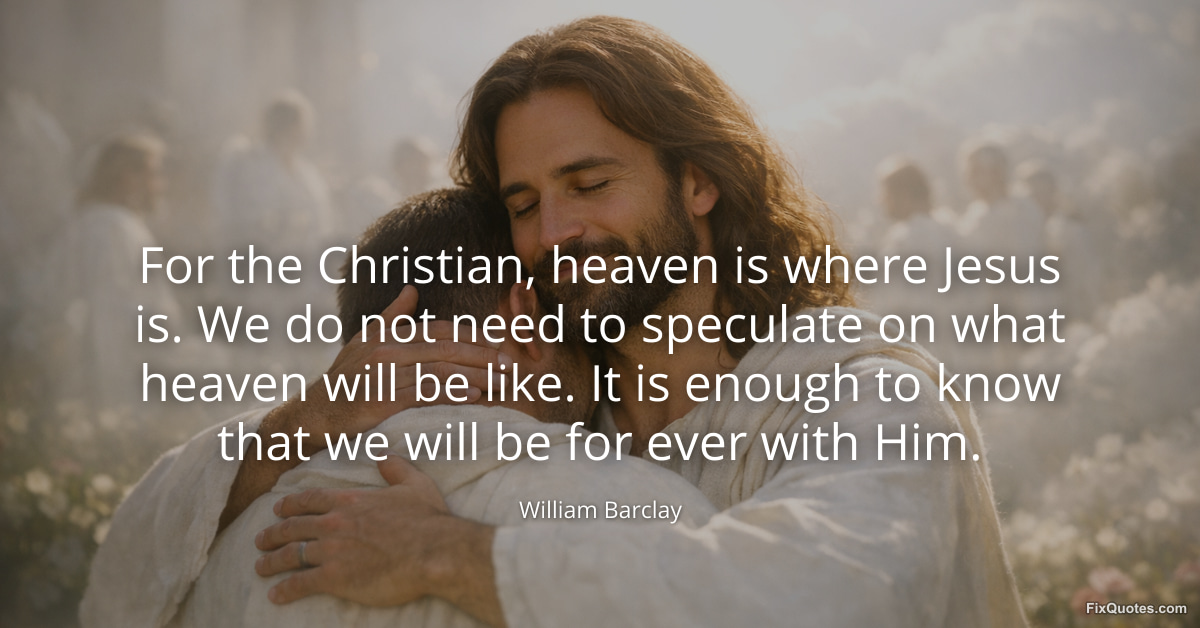
"For the Christian, heaven is where Jesus is. We do not need to speculate on what heaven will be like. It is enough to know that we will be for ever with Him"
About this Quote
The subtext is pastoral and corrective. If heaven is defined by proximity to Jesus, then the anxious questions that haunt ordinary believers - Will I recognize people? Will I be bored? Will I be judged? - are reframed as distractions, even mild temptations: attempts to control what cannot be controlled. “It is enough” is the rhetorical pressure point. It’s not merely comfort; it’s an instruction in spiritual discipline, teaching readers to accept not-knowing as part of trust.
Barclay’s context matters. Writing in a 20th-century Protestant world marked by war, rising secular confidence, and a growing suspicion of religious literalism, he offers a version of afterlife belief that can survive modern skepticism. Heaven becomes less a disputed geography and more an ethical and emotional orientation: if being “for ever with Him” is the goal, the present life is quietly judged by whether it trains desire toward that communion rather than toward spiritual consumerism.
Quote Details
| Topic | Faith |
|---|---|
| Source | Verified source: The Gospel of John (Daily Study Bible): Volume 1 (William Barclay, 1955)
Evidence: Here is a great truth put in the simplest way; for the Christian, heaven is where Jesus is. We do not need to speculate on what heaven will be like. It is enough to know that we will be for ever with him. (Chapter 14 section: "THE PROMISE OF GLORY (John 14:1-3)"). This wording appears verbatim in Barclay's commentary on John 14:1–3 (section heading "THE PROMISE OF GLORY") in his Daily Study Bible series. Many quote sites cite this as "The Gospel of John" with a generic year (often 1964), but the Daily Study Bible John volumes were first issued earlier by The Saint Andrew Press (Vol. 1 first edition September 1955; Vol. 2 first edition September 1955 per the revised-edition front matter mirrored online, with later editions in 1956 and a revised edition copyright 1975). The online StudyLight page is a transcription of Barclay's Daily Study Bible commentary and includes the quote in-context immediately after the sentence "Where I am, there you will also be." Other candidates (1) Daily Moments, Pause to Reflect (Abi May, 2016) compilation97.9% ... For the Christian , heaven is where Jesus is . We do not need to speculate on what heaven will be like . It is en... |
| Cite |
Citation Formats
APA Style (7th ed.)
Barclay, William. (2026, February 20). For the Christian, heaven is where Jesus is. We do not need to speculate on what heaven will be like. It is enough to know that we will be for ever with Him. FixQuotes. https://fixquotes.com/quotes/for-the-christian-heaven-is-where-jesus-is-we-do-151629/
Chicago Style
Barclay, William. "For the Christian, heaven is where Jesus is. We do not need to speculate on what heaven will be like. It is enough to know that we will be for ever with Him." FixQuotes. February 20, 2026. https://fixquotes.com/quotes/for-the-christian-heaven-is-where-jesus-is-we-do-151629/.
MLA Style (9th ed.)
"For the Christian, heaven is where Jesus is. We do not need to speculate on what heaven will be like. It is enough to know that we will be for ever with Him." FixQuotes, 20 Feb. 2026, https://fixquotes.com/quotes/for-the-christian-heaven-is-where-jesus-is-we-do-151629/. Accessed 3 Apr. 2026.