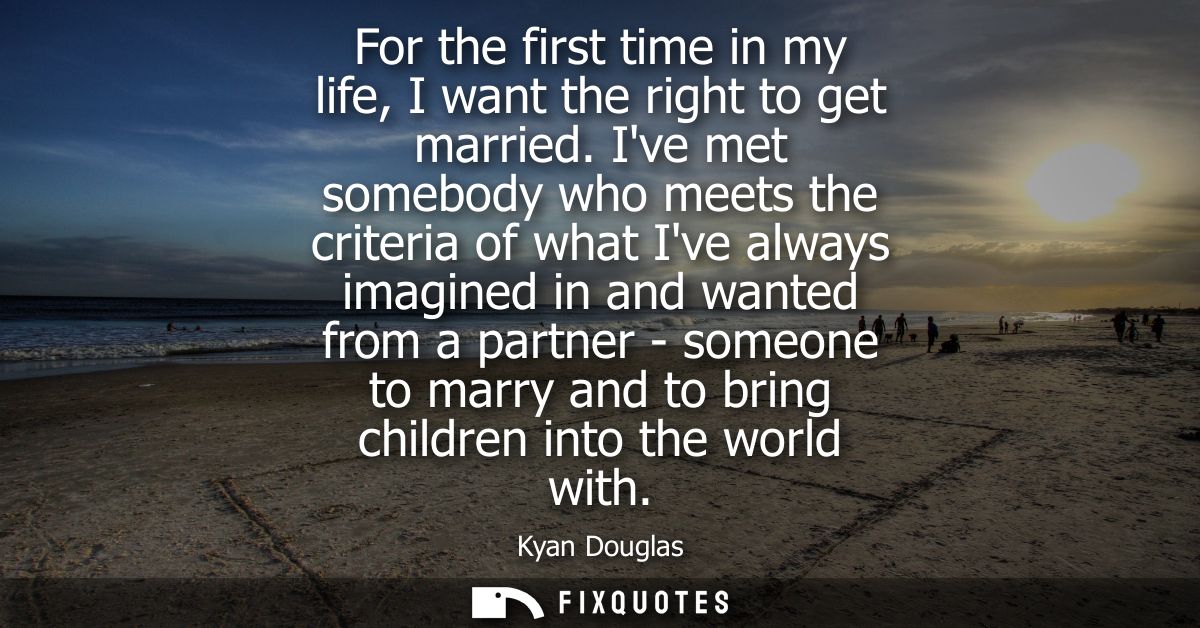
"For the first time in my life, I want the right to get married. I've met somebody who meets the criteria of what I've always imagined in and wanted from a partner - someone to marry and to bring children into the world with"
About this Quote
"I want the right to get married" is doing double duty. It's personal (a private decision) and political (a demand for equal access). That word "right" signals a history of gatekeeping: the implied knowledge that for many LGBTQ people, marriage has been a moving target, denied in law, argued over in culture, then granted unevenly. Douglas isn't begging for validation; he's asserting entitlement, a subtle but potent shift from pleading to claiming.
Then he drops "criteria", an almost clinical term that keeps sentimentality at bay. It's a pragmatic kind of romance: partnership as a standard met, not a fairy tale bestowed. The final pivot - "to bring children into the world with" - broadens the stake from couplehood to legacy. In a culture that still polices who gets to be seen as "family", he's not just asking to marry; he's insisting his future can look ordinary on purpose.
Quote Details
| Topic | Marriage |
|---|---|
| Source | Help us find the source |
| Cite |
Citation Formats
APA Style (7th ed.)
Douglas, Kyan. (2026, January 16). For the first time in my life, I want the right to get married. I've met somebody who meets the criteria of what I've always imagined in and wanted from a partner - someone to marry and to bring children into the world with. FixQuotes. https://fixquotes.com/quotes/for-the-first-time-in-my-life-i-want-the-right-to-133786/
Chicago Style
Douglas, Kyan. "For the first time in my life, I want the right to get married. I've met somebody who meets the criteria of what I've always imagined in and wanted from a partner - someone to marry and to bring children into the world with." FixQuotes. January 16, 2026. https://fixquotes.com/quotes/for-the-first-time-in-my-life-i-want-the-right-to-133786/.
MLA Style (9th ed.)
"For the first time in my life, I want the right to get married. I've met somebody who meets the criteria of what I've always imagined in and wanted from a partner - someone to marry and to bring children into the world with." FixQuotes, 16 Jan. 2026, https://fixquotes.com/quotes/for-the-first-time-in-my-life-i-want-the-right-to-133786/. Accessed 29 Mar. 2026.