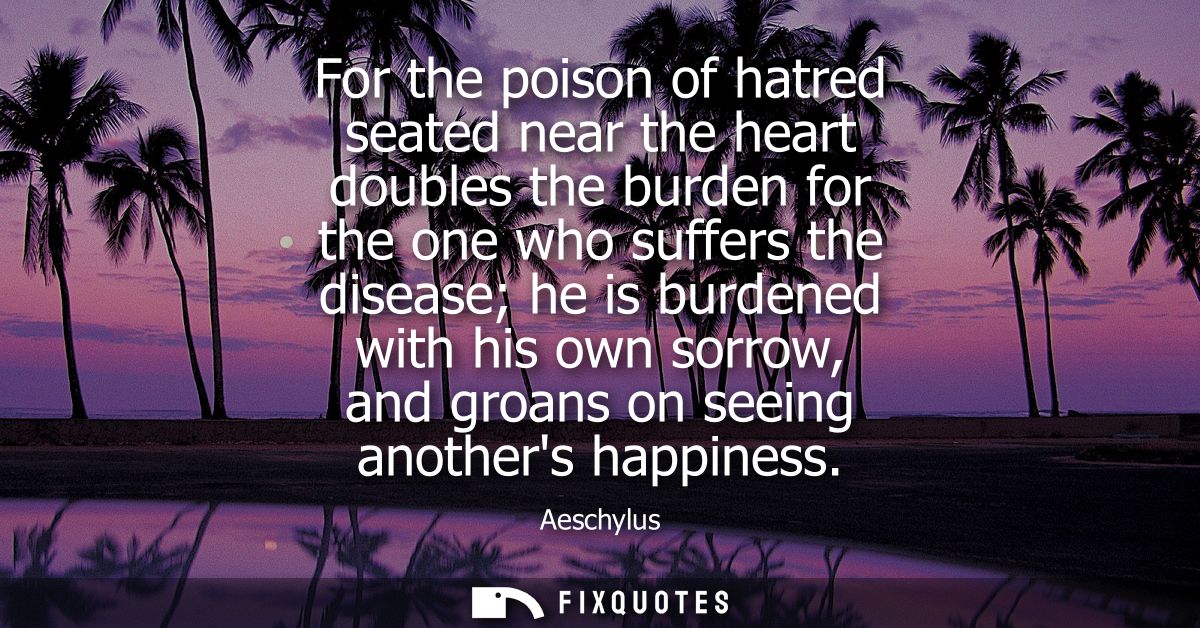
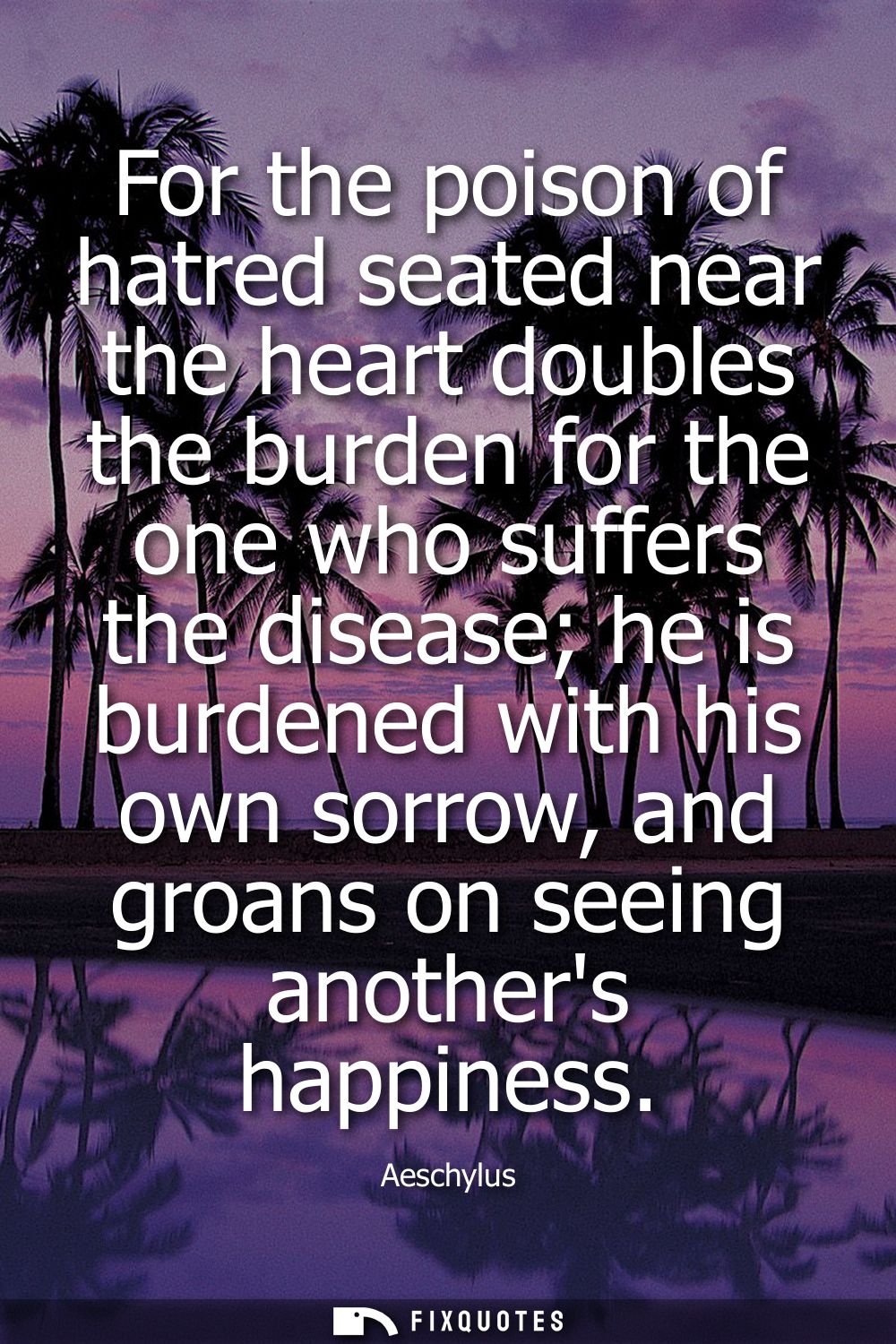
"For the poison of hatred seated near the heart doubles the burden for the one who suffers the disease; he is burdened with his own sorrow, and groans on seeing another's happiness"
About this Quote
The line’s trick is its doubling. Hatred doesn’t merely add pain; it compounds it. First you carry the original wound (the “sorrow” that likely sparked resentment), then you inherit a second, parasitic misery: the inability to tolerate anyone else’s good fortune. That’s a darkly practical definition of envy, but Aeschylus frames it as self-punishment, not moral failure. The hater becomes the primary casualty, lugging around an illness that makes ordinary life - other people laughing, thriving, being loved - feel like an affront.
Subtextually, the quote also reads like political and civic instruction. Aeschylus wrote in a culture where personal vendetta could metastasize into public catastrophe; his plays repeatedly stage how private rage becomes communal ruin. Calling hatred “poison” is a warning about contamination: it spreads inward first, then outward.
Even the phrasing “seated near the heart” suggests choice and habituation. The hatred isn’t a passing flare; it settles in, takes a chair, becomes part of the household. Tragedy’s most brutal insight is that suffering can be addictive - and that the price is losing the capacity to witness happiness without pain.
Quote Details
| Topic | Forgiveness |
|---|---|
| Source | Help us find the source |
| Cite |
Citation Formats
APA Style (7th ed.)
Aeschylus. (2026, January 15). For the poison of hatred seated near the heart doubles the burden for the one who suffers the disease; he is burdened with his own sorrow, and groans on seeing another's happiness. FixQuotes. https://fixquotes.com/quotes/for-the-poison-of-hatred-seated-near-the-heart-36838/
Chicago Style
Aeschylus. "For the poison of hatred seated near the heart doubles the burden for the one who suffers the disease; he is burdened with his own sorrow, and groans on seeing another's happiness." FixQuotes. January 15, 2026. https://fixquotes.com/quotes/for-the-poison-of-hatred-seated-near-the-heart-36838/.
MLA Style (9th ed.)
"For the poison of hatred seated near the heart doubles the burden for the one who suffers the disease; he is burdened with his own sorrow, and groans on seeing another's happiness." FixQuotes, 15 Jan. 2026, https://fixquotes.com/quotes/for-the-poison-of-hatred-seated-near-the-heart-36838/. Accessed 8 Apr. 2026.