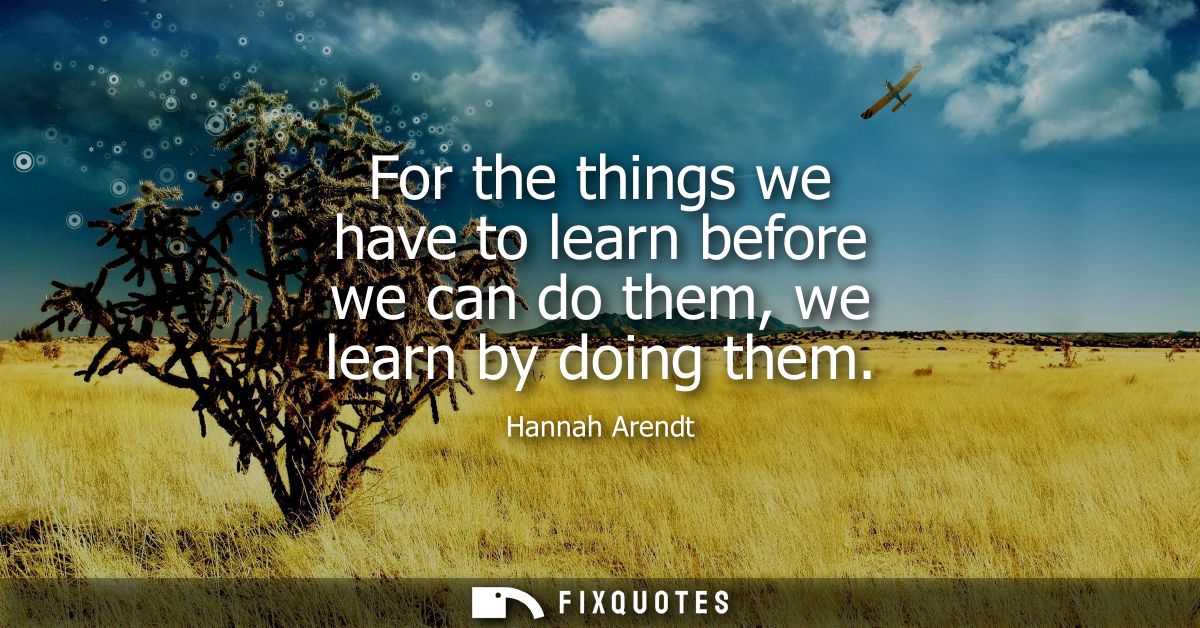
"For the things we have to learn before we can do them, we learn by doing them"
About this Quote
Arendt’s line is a neat little demolition of the fantasy that competence arrives by permission slip. It refuses the comforting order of operations we’re taught to expect: first mastery, then action. Instead, it argues that certain kinds of knowledge only appear inside the mess of practice, when the stakes, the friction, and the consequences make learning unavoidable.
The intent is practical, but the subtext is political. Arendt spent her life thinking about how human beings become capable of judgment and responsibility in a shared world. “Learning by doing” isn’t just a study tip; it’s a theory of how agency forms. You don’t become a citizen, a thinker, or a moral actor by absorbing instructions in private. You become one by entering situations where your choices matter, where you’re forced to weigh competing claims, own outcomes, and revise yourself in public.
Context matters here: Arendt wrote in the shadow of totalitarianism and the bureaucratic alibis that made atrocity feel like routine. Against that, this sentence insists that ethical and political understanding can’t be outsourced to rulebooks. It has to be practiced. The quote works because it turns a paradox into a mandate: stop waiting to be ready. Readiness is the byproduct, not the prerequisite. In an era addicted to credentials and “expertise” as a shield, Arendt offers a bracing counter-logic: responsibility begins at the moment you step in, not the moment you feel qualified.
The intent is practical, but the subtext is political. Arendt spent her life thinking about how human beings become capable of judgment and responsibility in a shared world. “Learning by doing” isn’t just a study tip; it’s a theory of how agency forms. You don’t become a citizen, a thinker, or a moral actor by absorbing instructions in private. You become one by entering situations where your choices matter, where you’re forced to weigh competing claims, own outcomes, and revise yourself in public.
Context matters here: Arendt wrote in the shadow of totalitarianism and the bureaucratic alibis that made atrocity feel like routine. Against that, this sentence insists that ethical and political understanding can’t be outsourced to rulebooks. It has to be practiced. The quote works because it turns a paradox into a mandate: stop waiting to be ready. Readiness is the byproduct, not the prerequisite. In an era addicted to credentials and “expertise” as a shield, Arendt offers a bracing counter-logic: responsibility begins at the moment you step in, not the moment you feel qualified.
Quote Details
| Topic | Learning |
|---|
More Quotes by Hannah
Add to List