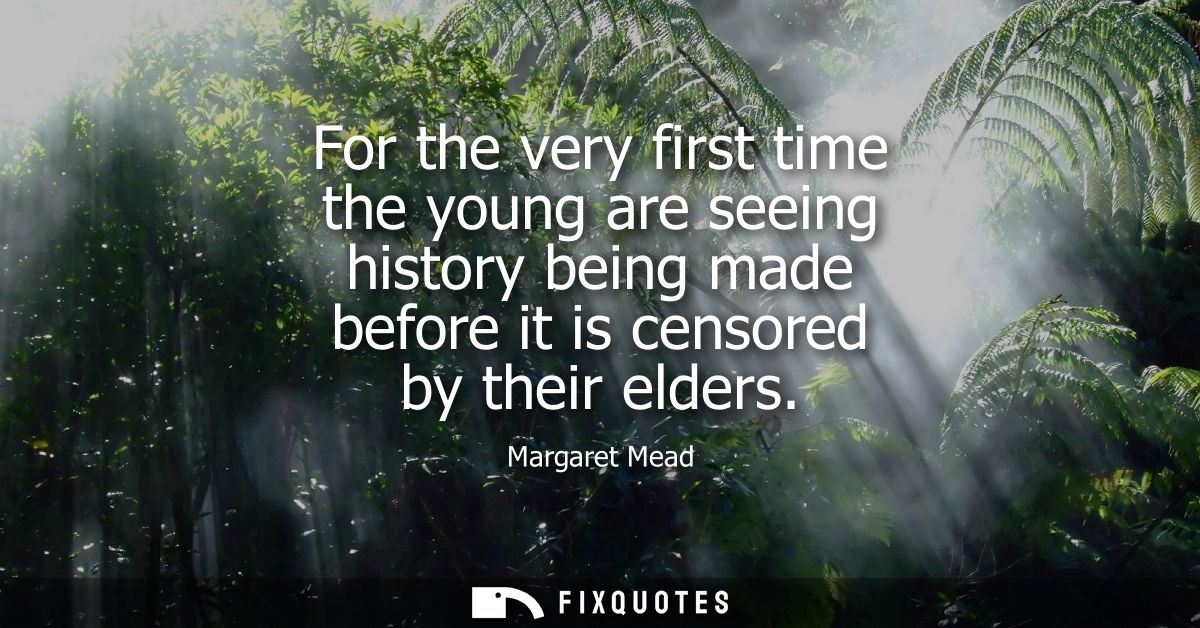
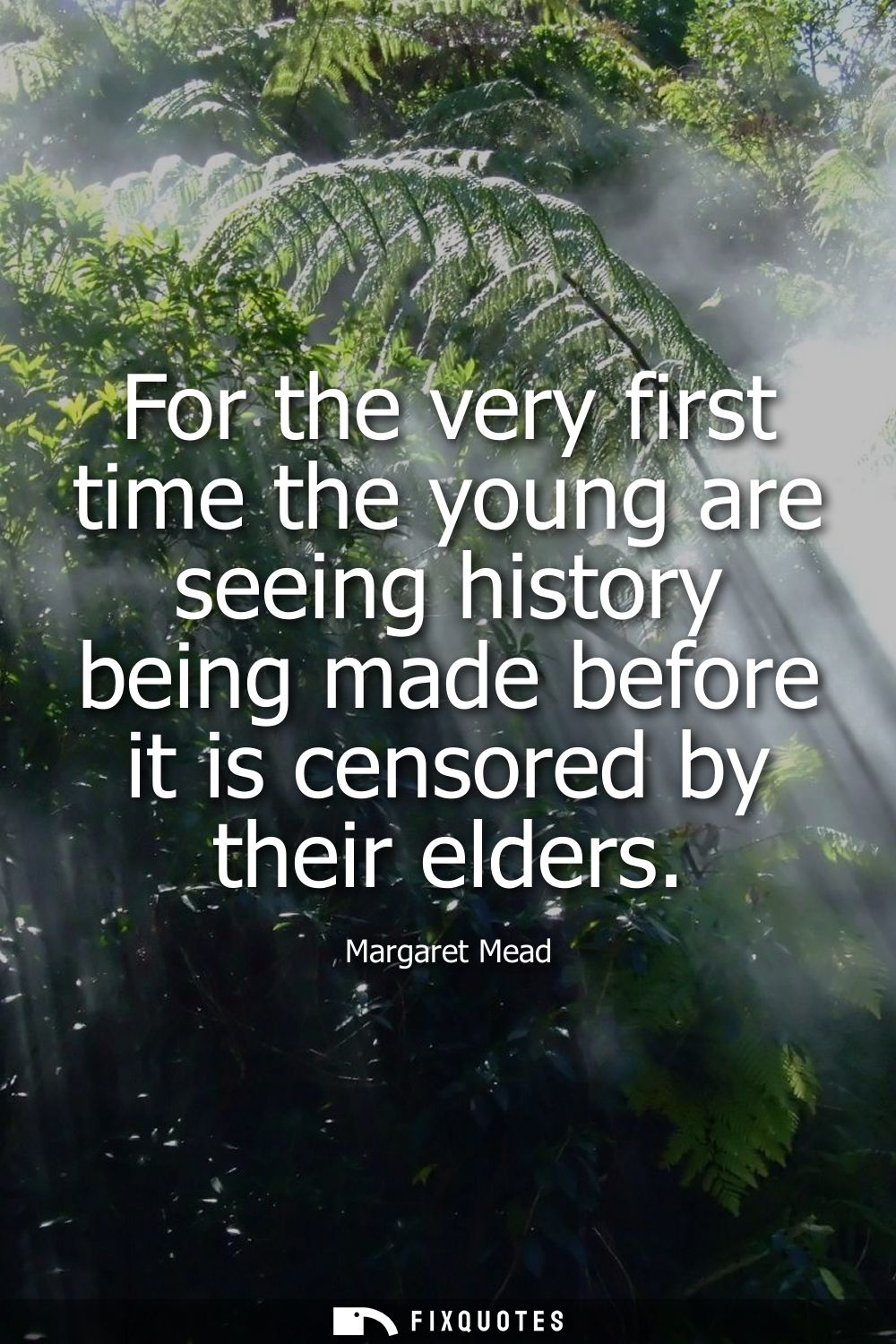
"For the very first time, the young are seeing history being made before it is censored by their elders"
About this Quote
The engine is the word “censored.” Mead isn’t only talking about governments with black markers; she’s pointing at the softer, more pervasive censorship of elders: the editing of chaos into coherence, the sanding down of contradictions into a moral lesson. History, in this view, is less a record than a domestication. By saying young people can watch it “before” that happens, she imagines a raw, first-draft reality escaping the gatekeepers of memory.
Context matters: Mead wrote in an era when mass media, youth movements, and rapid social change were destabilizing old hierarchies. The young weren’t just inheriting culture; they were producing it in public, at speed. Her subtext is both hopeful and anxious. Hopeful because immediacy can puncture pieties and expose hypocrisy; anxious because unfiltered witness can also become unprocessed spectacle. The line’s bite comes from that tension: liberation from elders’ narrative control, paired with the unsettling thought that we might be trading curated myths for a flood of uncurated facts.
Quote Details
| Topic | Youth |
|---|---|
| Source | Help us find the source |
| Cite |
Citation Formats
APA Style (7th ed.)
Mead, Margaret. (2026, February 20). For the very first time, the young are seeing history being made before it is censored by their elders. FixQuotes. https://fixquotes.com/quotes/for-the-very-first-time-the-young-are-seeing-14821/
Chicago Style
Mead, Margaret. "For the very first time, the young are seeing history being made before it is censored by their elders." FixQuotes. February 20, 2026. https://fixquotes.com/quotes/for-the-very-first-time-the-young-are-seeing-14821/.
MLA Style (9th ed.)
"For the very first time, the young are seeing history being made before it is censored by their elders." FixQuotes, 20 Feb. 2026, https://fixquotes.com/quotes/for-the-very-first-time-the-young-are-seeing-14821/. Accessed 5 Apr. 2026.