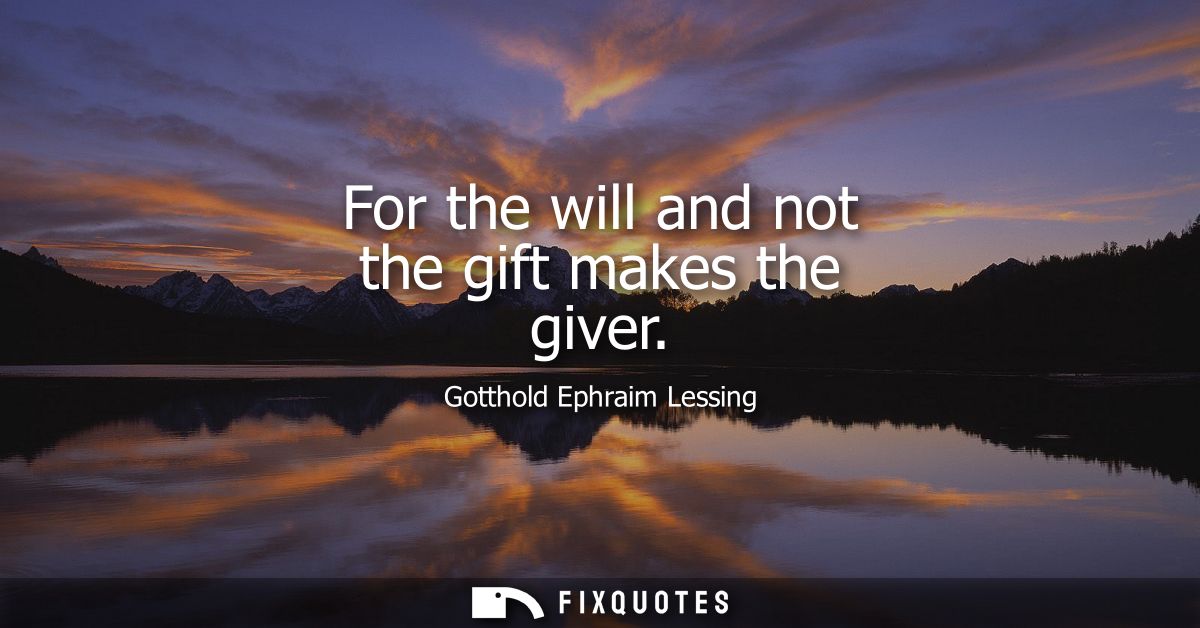
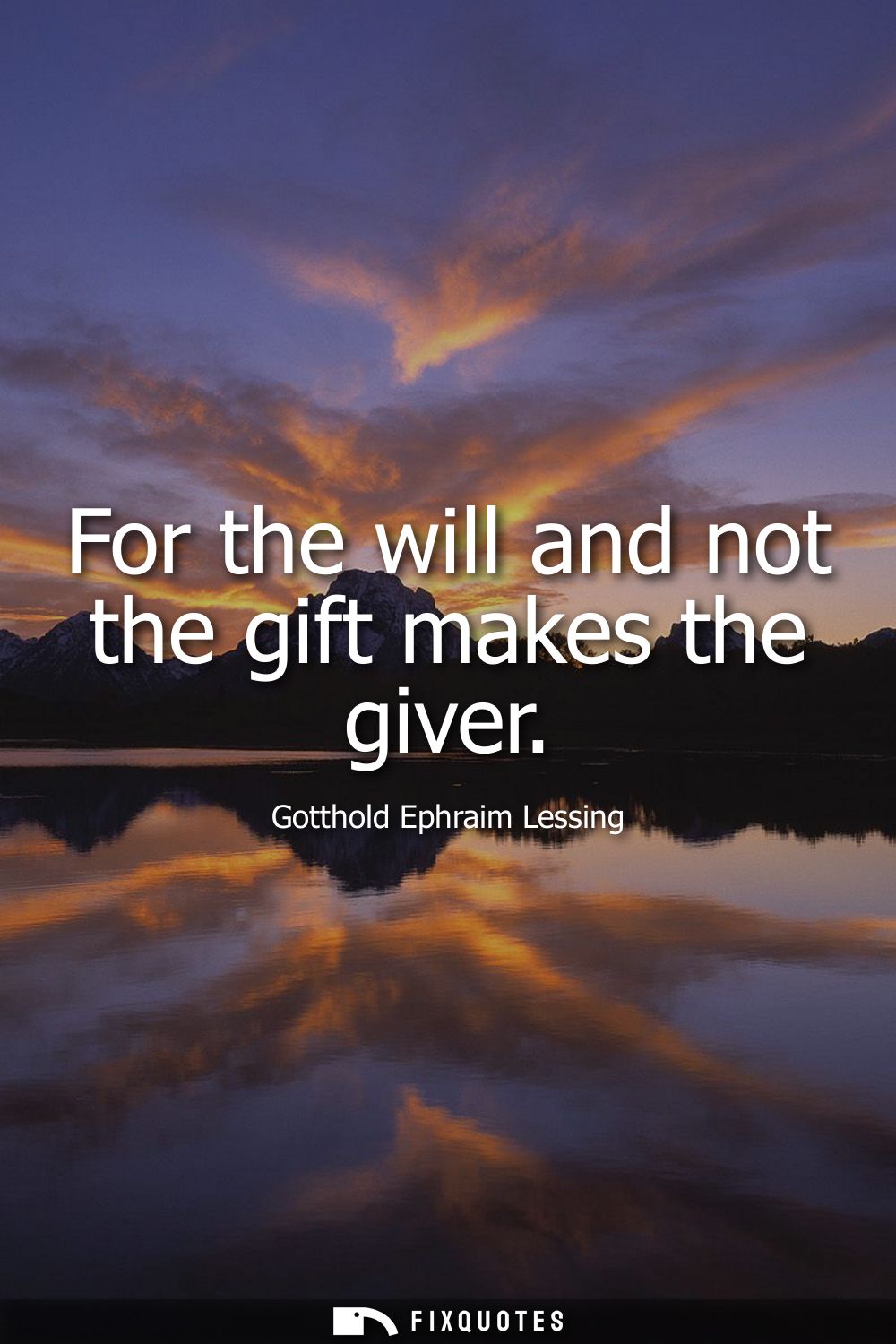
"For the will and not the gift makes the giver"
About this Quote
Lessing cuts straight through the polite theater of generosity: the moral weight of giving doesn’t sit in the object, but in the intention behind it. "Gift" is the visible prop; "will" is the backstage machinery. The line works because it flips what most social economies reward. We tend to measure giving by the size of the check, the rarity of the item, the public splash. Lessing insists the real story is internal, where no applause can reach.
As an Enlightenment critic, he’s also taking a swing at aristocratic virtue-signaling before the phrase existed. In a culture where patronage, charity, and courtly largesse could function as social currency, "gift" is easily counterfeit: it can be compelled, strategic, reputational. "Will" is harder to fake because it implies freedom, moral agency, and a kind of ethical scarcity. You can be rich and ungenerous; you can be poor and still a giver. The line democratizes virtue while quietly accusing the powerful of buying innocence.
There’s also a sharp theological aftertaste. Christian ethics has long privileged the heart over the offering (the widow’s mite logic), and Lessing, who wrestled with religious authority and moral reasoning, translates that inheritance into a secular standard: character is measured by motive, not output.
Read in 2026, it lands as a critique of philanthropic branding and algorithmic charity: the donation that’s optimized for optics may help someone, but it doesn’t necessarily make a giver. Lessing’s punchline is that ethics begins where the receipt ends.
As an Enlightenment critic, he’s also taking a swing at aristocratic virtue-signaling before the phrase existed. In a culture where patronage, charity, and courtly largesse could function as social currency, "gift" is easily counterfeit: it can be compelled, strategic, reputational. "Will" is harder to fake because it implies freedom, moral agency, and a kind of ethical scarcity. You can be rich and ungenerous; you can be poor and still a giver. The line democratizes virtue while quietly accusing the powerful of buying innocence.
There’s also a sharp theological aftertaste. Christian ethics has long privileged the heart over the offering (the widow’s mite logic), and Lessing, who wrestled with religious authority and moral reasoning, translates that inheritance into a secular standard: character is measured by motive, not output.
Read in 2026, it lands as a critique of philanthropic branding and algorithmic charity: the donation that’s optimized for optics may help someone, but it doesn’t necessarily make a giver. Lessing’s punchline is that ethics begins where the receipt ends.
Quote Details
| Topic | Kindness |
|---|---|
| Source | Verified source: Nathan der Weise (Gotthold Ephraim Lessing, 1779)
Evidence: Denn der Wille Und nicht die Gabe macht den Geber. (Act 2, Scene 5 (Fünfter Auftritt)). This line appears in Lessing’s play 'Nathan der Weise' (published 1779). In the German text, it is spoken by the 'Klosterbruder' (Lay Brother) during Act 2, Scene 5. The commonly-circulated English wording ('For the will and not the gift makes the giver') is a translation/variant of this German original, not the original phrasing. In the Project Gutenberg German text, the line occurs in the Act 2 Scene 5 passage beginning around line 902; the quote itself appears at lines ~915–916 in that HTML file. For first-publication bibliographic context, rare-book cataloging describes the first edition as issued in 1779 (by subscription, May 1779). Other candidates (1) Through the Year with Famous Authors (Mabel Patterson, 2022) compilation95.0% ... For the will and not the gift makes the giver . -Lessing . GOTTHOLD EPHRAIM Von Lessing , a famous German poet , ... |
| Cite |
Citation Formats
APA Style (7th ed.)
Lessing, Gotthold Ephraim. (2026, February 20). For the will and not the gift makes the giver. FixQuotes. https://fixquotes.com/quotes/for-the-will-and-not-the-gift-makes-the-giver-143984/
Chicago Style
Lessing, Gotthold Ephraim. "For the will and not the gift makes the giver." FixQuotes. February 20, 2026. https://fixquotes.com/quotes/for-the-will-and-not-the-gift-makes-the-giver-143984/.
MLA Style (9th ed.)
"For the will and not the gift makes the giver." FixQuotes, 20 Feb. 2026, https://fixquotes.com/quotes/for-the-will-and-not-the-gift-makes-the-giver-143984/. Accessed 2 Apr. 2026.
More Quotes by Gotthold
Add to List