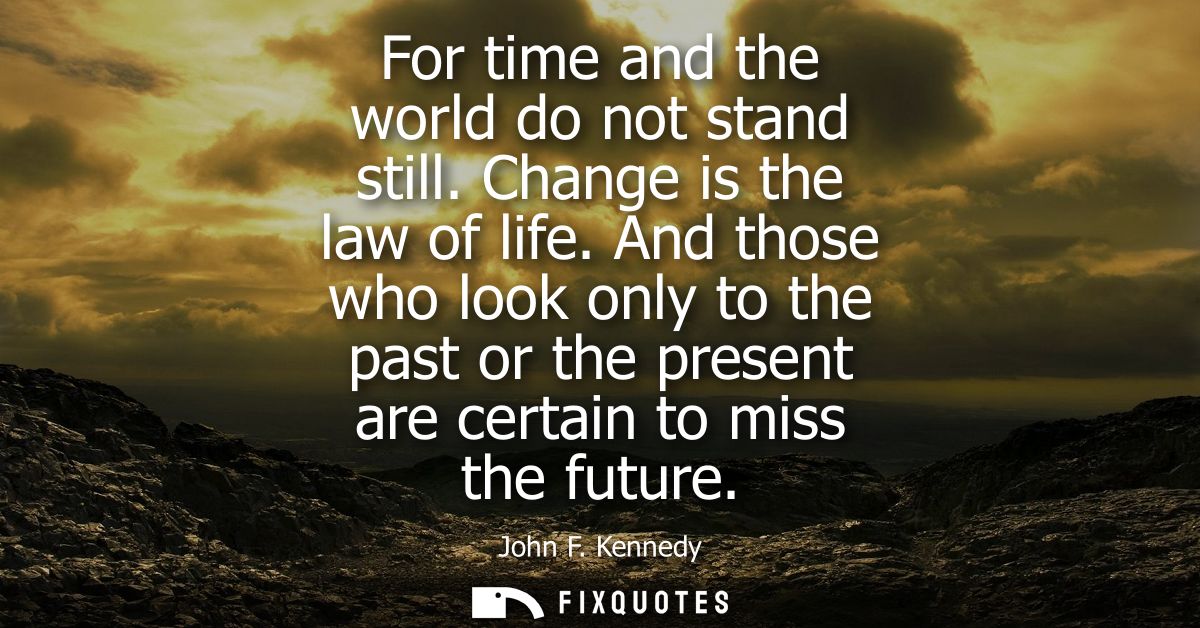
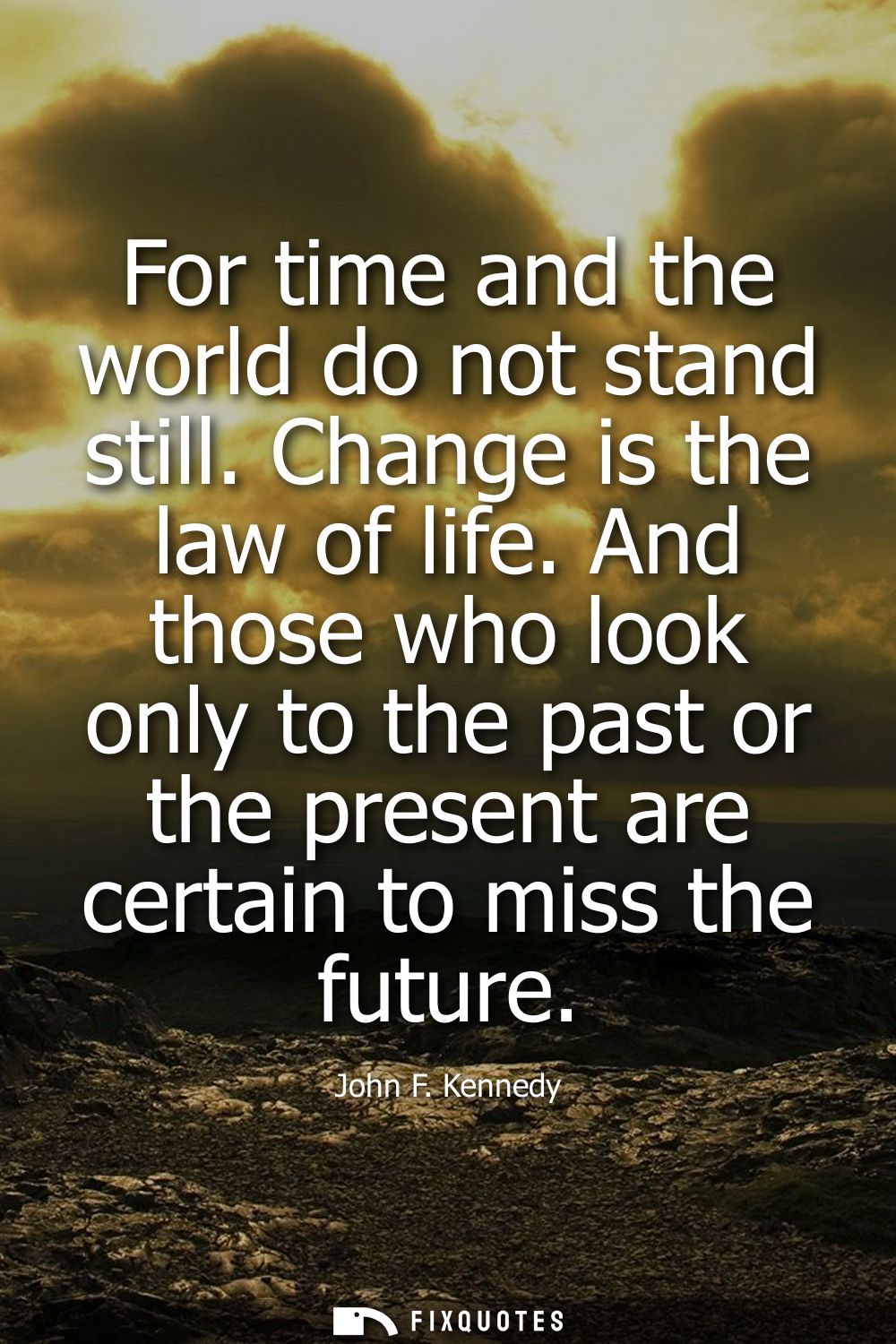
"For time and the world do not stand still. Change is the law of life. And those who look only to the past or the present are certain to miss the future"
About this Quote
The subtext is aimed at two temptations in American politics: nostalgia and complacency. “Those who look only to the past” calls out the reflex to treat yesterday’s victories as permanent entitlements, a quiet jab at tradition-as-strategy. “Or the present” is the sharper cut: even satisfied moderates are indicted. Standing still is recast as a choice to lose.
Context matters. Kennedy is speaking from the early 1960s, when the country was riding postwar confidence into a new kind of anxiety: decolonization abroad, civil rights at home, nuclear brinkmanship overhead, technological competition in the Space Race. His broader “New Frontier” posture depended on making modernization feel patriotic rather than destabilizing. The quote sells that pivot: the future isn’t a distant era, it’s the penalty for political myopia.
Rhetorically, it’s an elegant piece of temporal judo. He makes “the future” sound like a concrete destination that can be “missed,” as if national decline is not a tragedy but a scheduling error. That’s classic Kennedy: urgency without panic, inevitability pressed into aspiration.
Quote Details
| Topic | Change |
|---|---|
| Source | Help us find the source |
| Cite |
Citation Formats
APA Style (7th ed.)
Kennedy, John F. (2026, January 15). For time and the world do not stand still. Change is the law of life. And those who look only to the past or the present are certain to miss the future. FixQuotes. https://fixquotes.com/quotes/for-time-and-the-world-do-not-stand-still-change-24825/
Chicago Style
Kennedy, John F. "For time and the world do not stand still. Change is the law of life. And those who look only to the past or the present are certain to miss the future." FixQuotes. January 15, 2026. https://fixquotes.com/quotes/for-time-and-the-world-do-not-stand-still-change-24825/.
MLA Style (9th ed.)
"For time and the world do not stand still. Change is the law of life. And those who look only to the past or the present are certain to miss the future." FixQuotes, 15 Jan. 2026, https://fixquotes.com/quotes/for-time-and-the-world-do-not-stand-still-change-24825/. Accessed 12 Feb. 2026.