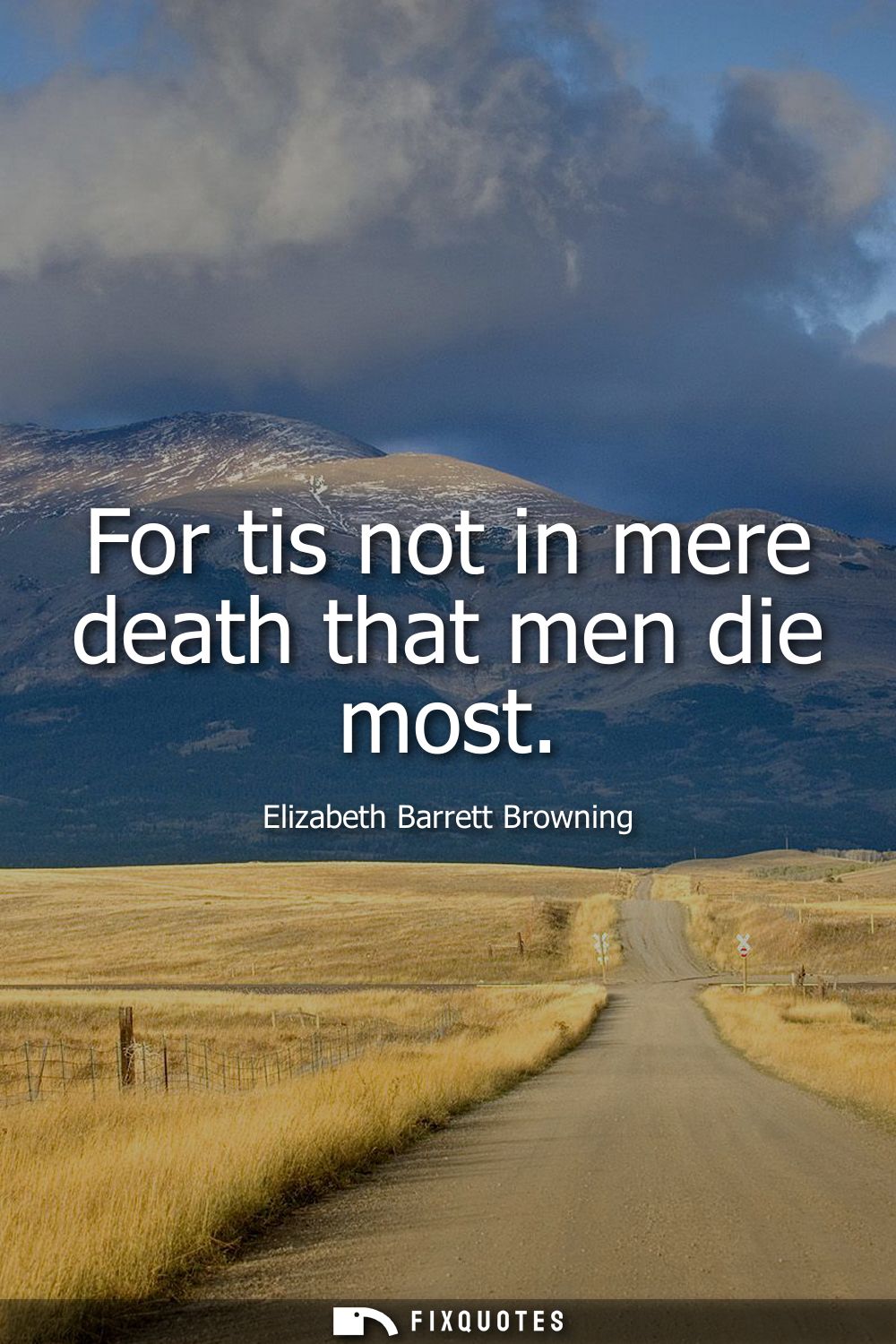
"For tis not in mere death that men die most"
About this Quote
The line lands like a soft indictment: the worst dying isn’t physical, it’s spiritual, social, and slow. Barrett Browning takes the clean finality we attach to death and smudges it, insisting that men “die” in ways that never make it into an obituary. The phrasing matters. “Mere death” is a provocation, demoting the dramatic event everyone fears into something almost bureaucratic. What follows, implied rather than stated, is a ledger of other endings: the death of hope under poverty, the death of conscience under complicity, the death of love under routine, the death of agency under tyranny.
The line’s power is its moral redefinition. By using “men” (in the period sense of humankind), Browning points outward, not inward: she’s less interested in private melancholy than in the public conditions that hollow people out while they still breathe. The archaic “tis” and the inversion (“not in mere death”) give it biblical torque, borrowing the cadence of scripture to make a social argument feel like an ethical truth.
Context sharpens the intent. Browning wrote amid Victorian England’s churn: industrial exploitation, rigid gender roles, and the era’s talent for polishing suffering into respectable silence. Her poetry often presses against that decorum, asking readers to notice what their culture teaches them to overlook. This line works because it refuses the comfort of tragedy as a single moment. It suggests that the real scandal is how easy it is to watch someone vanish in plain sight, and call them alive.
The line’s power is its moral redefinition. By using “men” (in the period sense of humankind), Browning points outward, not inward: she’s less interested in private melancholy than in the public conditions that hollow people out while they still breathe. The archaic “tis” and the inversion (“not in mere death”) give it biblical torque, borrowing the cadence of scripture to make a social argument feel like an ethical truth.
Context sharpens the intent. Browning wrote amid Victorian England’s churn: industrial exploitation, rigid gender roles, and the era’s talent for polishing suffering into respectable silence. Her poetry often presses against that decorum, asking readers to notice what their culture teaches them to overlook. This line works because it refuses the comfort of tragedy as a single moment. It suggests that the real scandal is how easy it is to watch someone vanish in plain sight, and call them alive.
Quote Details
| Topic | Mortality |
|---|---|
| Source | Help us find the source |
| Cite |
Citation Formats
APA Style (7th ed.)
Browning, Elizabeth Barrett. (2026, January 15). For tis not in mere death that men die most. FixQuotes. https://fixquotes.com/quotes/for-tis-not-in-mere-death-that-men-die-most-3414/
Chicago Style
Browning, Elizabeth Barrett. "For tis not in mere death that men die most." FixQuotes. January 15, 2026. https://fixquotes.com/quotes/for-tis-not-in-mere-death-that-men-die-most-3414/.
MLA Style (9th ed.)
"For tis not in mere death that men die most." FixQuotes, 15 Jan. 2026, https://fixquotes.com/quotes/for-tis-not-in-mere-death-that-men-die-most-3414/. Accessed 12 Feb. 2026.
More Quotes by Elizabeth
Add to List