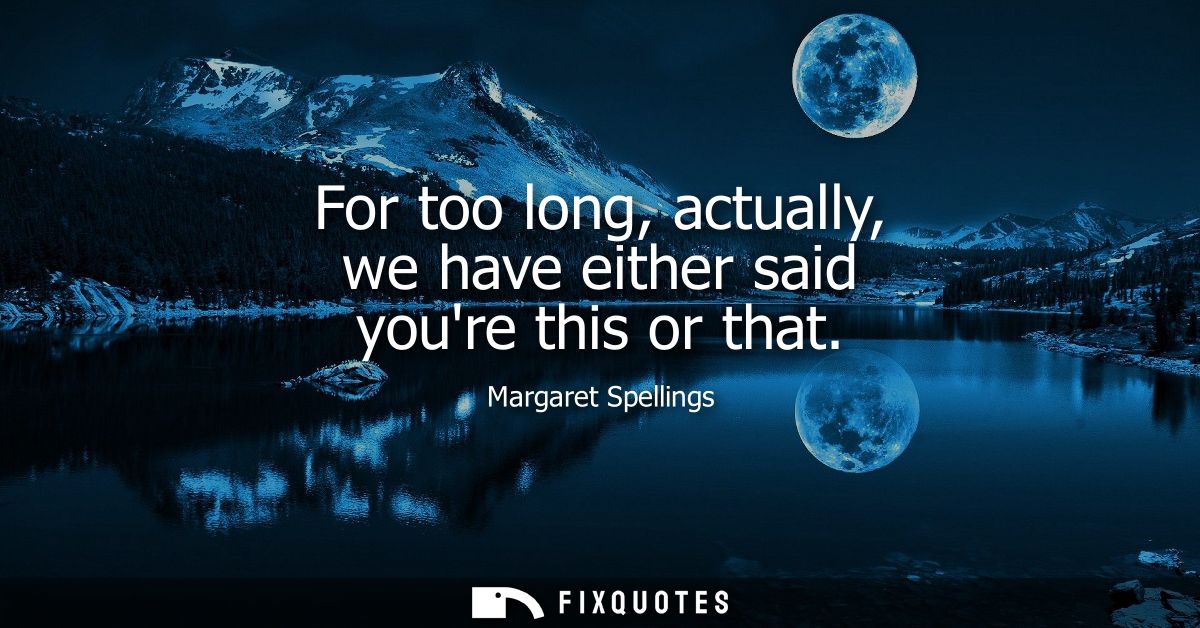
"For too long, actually, we have either said you're this or that"
About this Quote
The line lands like a weary thumb on the scale of American identity politics: we keep sorting people into neat bins, and we’ve been doing it past the point of usefulness. Spellings, a public servant shaped by the education-policy wars of the 2000s, isn’t offering poetry; she’s signaling a governing instinct. The opening, "For too long, actually", is telling. That "actually" is a soft rebuke to whatever orthodoxy she’s pushing against, a little verbal elbow that says: this isn’t just a trend, it’s an entrenched habit we should have outgrown.
The unfinished pair, "this or that", is rhetorically strategic. By refusing to name the categories, she invites the listener to supply their own: partisan labels, racial classifications, learning tracks, "gifted" versus "remedial", even "college-bound" versus "not". That ambiguity broadens the coalition she can speak to while keeping the target safely abstract. It’s a politician’s Swiss Army phrase: widely applicable, hard to fact-check, easy to nod along with.
In context, Spellings’ era emphasized standards, accountability, and measurable outcomes. A critique of rigid labeling doubles as a defense of a more flexible, marketable vision of education and citizenship: people are more than test scores, more than demographics, more than the boxes institutions use to manage them. The subtext is reformist but also managerial. Labels aren’t condemned because they’re cruel; they’re criticized because they’re inefficient, outdated, politically inconvenient - a barrier to mobility, consensus, and the kind of policy story government wants to tell about opportunity.
The unfinished pair, "this or that", is rhetorically strategic. By refusing to name the categories, she invites the listener to supply their own: partisan labels, racial classifications, learning tracks, "gifted" versus "remedial", even "college-bound" versus "not". That ambiguity broadens the coalition she can speak to while keeping the target safely abstract. It’s a politician’s Swiss Army phrase: widely applicable, hard to fact-check, easy to nod along with.
In context, Spellings’ era emphasized standards, accountability, and measurable outcomes. A critique of rigid labeling doubles as a defense of a more flexible, marketable vision of education and citizenship: people are more than test scores, more than demographics, more than the boxes institutions use to manage them. The subtext is reformist but also managerial. Labels aren’t condemned because they’re cruel; they’re criticized because they’re inefficient, outdated, politically inconvenient - a barrier to mobility, consensus, and the kind of policy story government wants to tell about opportunity.
Quote Details
| Topic | Equality |
|---|---|
| Source | Help us find the source |
| Cite |
Citation Formats
APA Style (7th ed.)
Spellings, Margaret. (2026, January 16). For too long, actually, we have either said you're this or that. FixQuotes. https://fixquotes.com/quotes/for-too-long-actually-we-have-either-said-youre-87806/
Chicago Style
Spellings, Margaret. "For too long, actually, we have either said you're this or that." FixQuotes. January 16, 2026. https://fixquotes.com/quotes/for-too-long-actually-we-have-either-said-youre-87806/.
MLA Style (9th ed.)
"For too long, actually, we have either said you're this or that." FixQuotes, 16 Jan. 2026, https://fixquotes.com/quotes/for-too-long-actually-we-have-either-said-youre-87806/. Accessed 21 Mar. 2026.
More Quotes by Margaret
Add to List