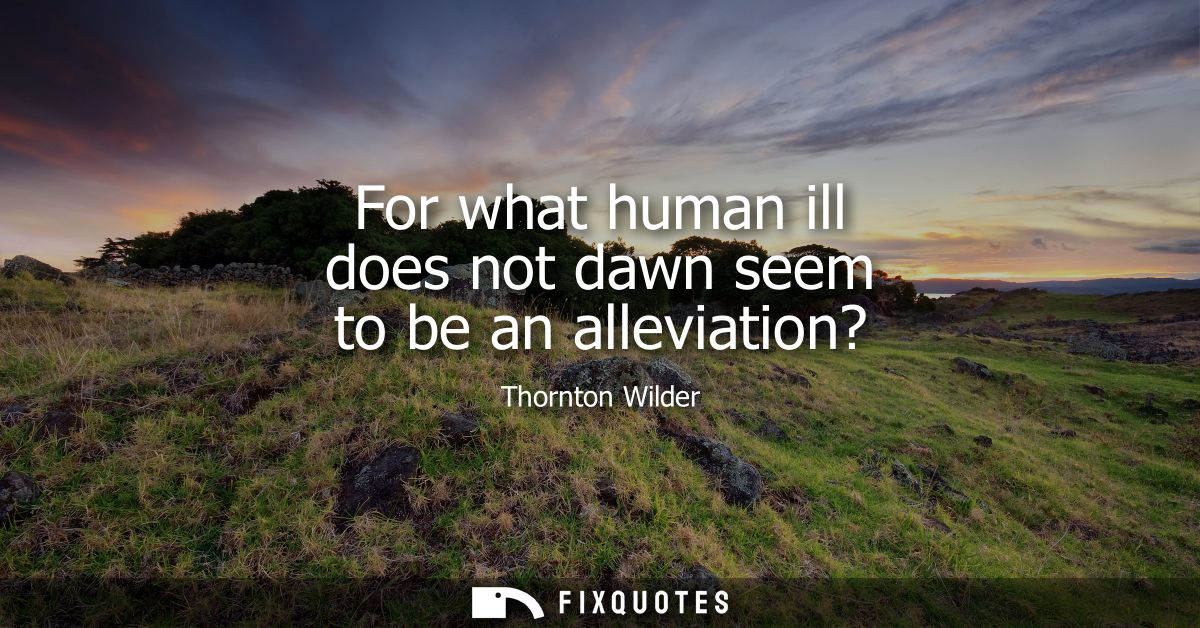
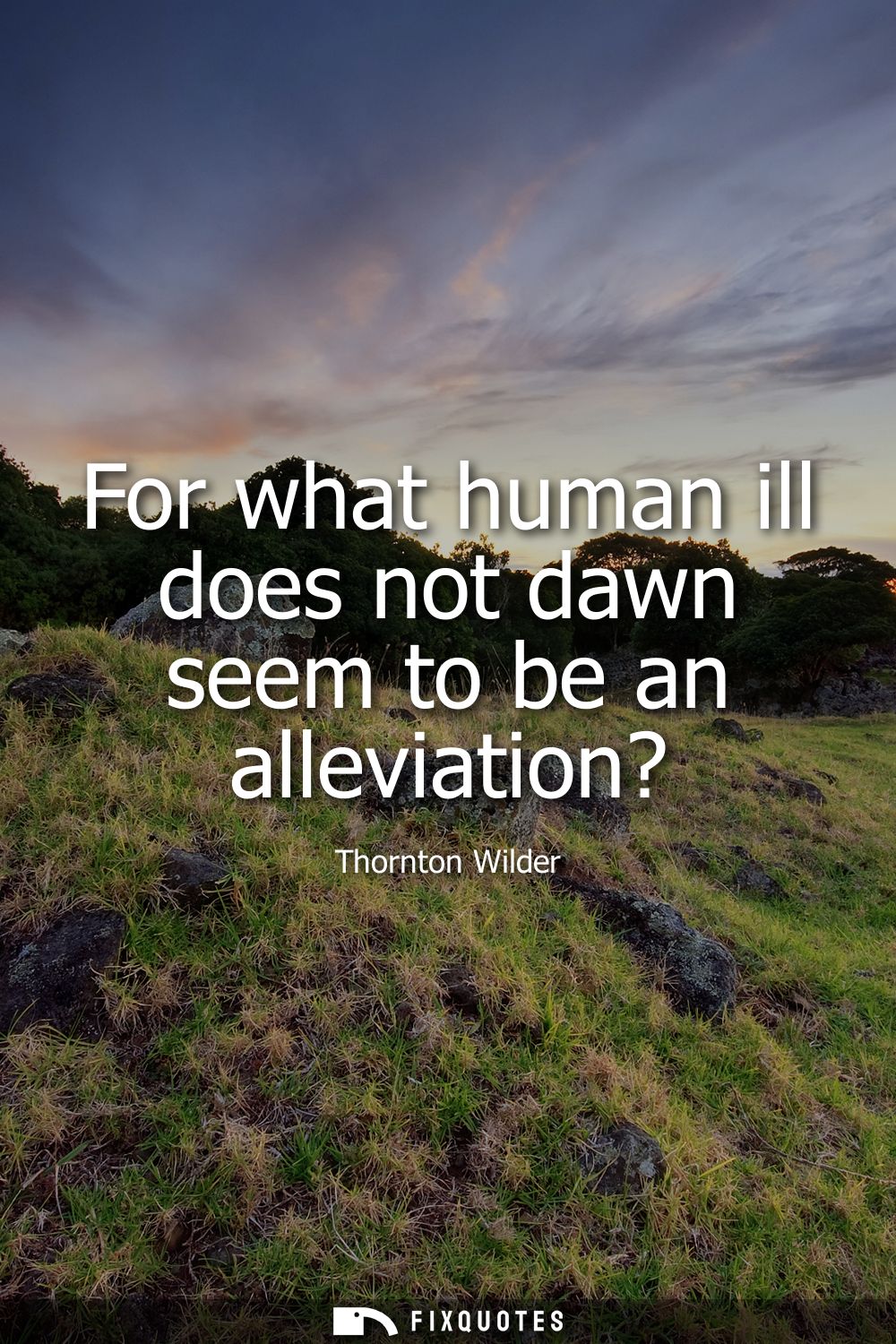
"For what human ill does not dawn seem to be an alleviation?"
About this Quote
Dawn is a daily optical trick that doubles as a moral proposition: if the world can begin again, maybe you can, too. Wilder’s question isn’t really seeking an answer; it’s baiting the reader into noticing how reflexively we reach for morning as medicine. The phrasing matters. “For what human ill” casts suffering in the broadest possible register, from private grief to civic catastrophe, then “dawn” arrives not as a cure but as an “alleviation” - modest, temporary, almost clinical. Wilder avoids the grand lie that pain disappears; he argues for a smaller, more credible mercy: light changes the terms of endurance.
The subtext is both compassionate and slightly skeptical about our dependence on symbolism. We romanticize sunrise because it’s dependable in a way our lives aren’t. The night amplifies anxiety, shame, and dread; it turns problems into omnipresent atmospheres. Morning doesn’t solve them, but it re-scales them. In daylight, the mind regains proportion; the body re-enters routine; other people wake up. Even disaster becomes shareable again, which is its own kind of relief.
Contextually, Wilder wrote in a century trained by war, economic collapse, and mass death to crave any sign of continuity. His work often treats ordinary time as sacred infrastructure: meals, towns, families, the repetitive rituals that keep people from falling through themselves. Dawn, in that sense, is less about hope-as-slogan than hope-as-schedule - a soft reset that keeps the human project moving, one morning at a time.
The subtext is both compassionate and slightly skeptical about our dependence on symbolism. We romanticize sunrise because it’s dependable in a way our lives aren’t. The night amplifies anxiety, shame, and dread; it turns problems into omnipresent atmospheres. Morning doesn’t solve them, but it re-scales them. In daylight, the mind regains proportion; the body re-enters routine; other people wake up. Even disaster becomes shareable again, which is its own kind of relief.
Contextually, Wilder wrote in a century trained by war, economic collapse, and mass death to crave any sign of continuity. His work often treats ordinary time as sacred infrastructure: meals, towns, families, the repetitive rituals that keep people from falling through themselves. Dawn, in that sense, is less about hope-as-slogan than hope-as-schedule - a soft reset that keeps the human project moving, one morning at a time.
Quote Details
| Topic | Good Morning |
|---|---|
| Source | Help us find the source |
| Cite |
Citation Formats
APA Style (7th ed.)
Wilder, Thornton. (2026, January 15). For what human ill does not dawn seem to be an alleviation? FixQuotes. https://fixquotes.com/quotes/for-what-human-ill-does-not-dawn-seem-to-be-an-33576/
Chicago Style
Wilder, Thornton. "For what human ill does not dawn seem to be an alleviation?" FixQuotes. January 15, 2026. https://fixquotes.com/quotes/for-what-human-ill-does-not-dawn-seem-to-be-an-33576/.
MLA Style (9th ed.)
"For what human ill does not dawn seem to be an alleviation?" FixQuotes, 15 Jan. 2026, https://fixquotes.com/quotes/for-what-human-ill-does-not-dawn-seem-to-be-an-33576/. Accessed 27 Mar. 2026.
More Quotes by Thornton
Add to List