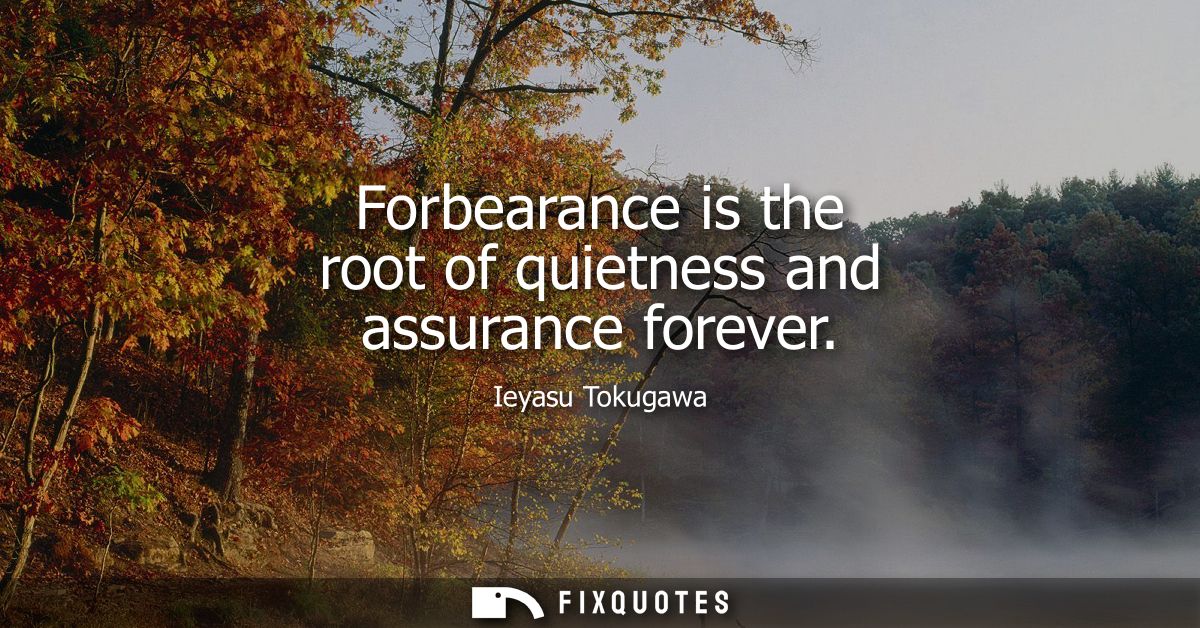
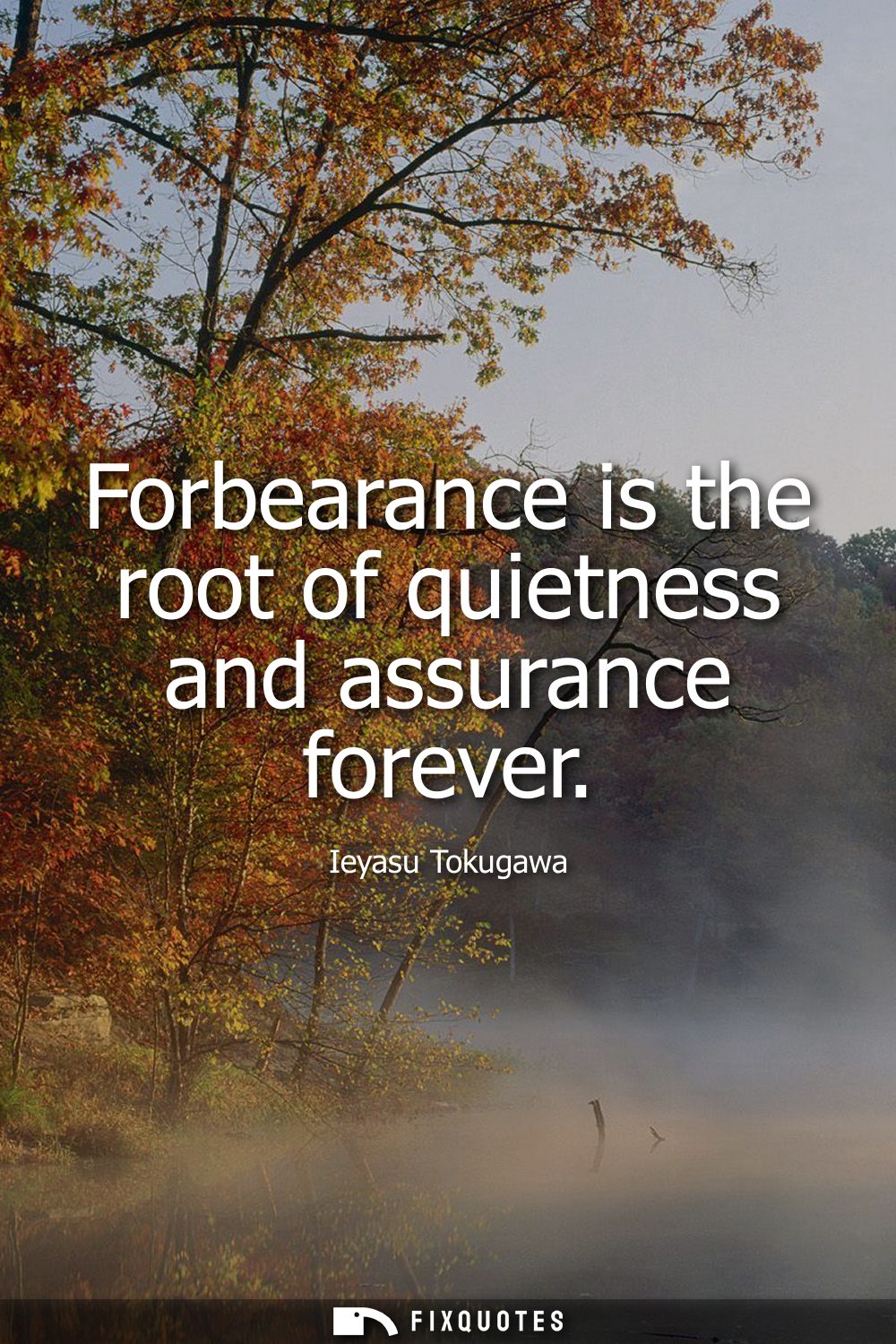
"Forbearance is the root of quietness and assurance forever"
About this Quote
Forbearance sounds like a private virtue, the kind you practice with clenched teeth. In Tokugawa Ieyasu's mouth, it’s statecraft: a strategy for surviving chaos long enough to monopolize peace. The line promises "quietness and assurance forever" not as a spiritual reward, but as an engineered outcome. In an era when "forever" was constantly being interrupted by spear points, that word lands as audacious branding for a new political order.
Ieyasu earned the right to preach restraint because he built power through it. He spent years as a hostage, watched alliances mutate overnight, and learned that impatience is a public vulnerability. "Forbearance" is a discipline of delaying gratification - and delaying revenge - until your rivals exhaust themselves. The subtext is coldly pragmatic: tolerate insult, swallow setbacks, keep your emotions off the battlefield, and you outlast men who confuse impulse with courage.
The elegance of the phrasing matters. Root. Quietness. Assurance. Forever. It reads like a natural law, not a policy memo, which is precisely the point. If patience can be framed as the soil from which stability grows, then obedience and endurance stop feeling like submission and start feeling like participation in order.
Context sharpens the edge: after the Sengoku period’s fragmentation, the Tokugawa shogunate would sell stability as a moral achievement while enforcing it with tight social controls. "Forbearance" becomes a civic requirement. The quote flatters restraint, but it also instructs a population - and a ruling class - to treat peace not as a mood, but as a managed condition.
Ieyasu earned the right to preach restraint because he built power through it. He spent years as a hostage, watched alliances mutate overnight, and learned that impatience is a public vulnerability. "Forbearance" is a discipline of delaying gratification - and delaying revenge - until your rivals exhaust themselves. The subtext is coldly pragmatic: tolerate insult, swallow setbacks, keep your emotions off the battlefield, and you outlast men who confuse impulse with courage.
The elegance of the phrasing matters. Root. Quietness. Assurance. Forever. It reads like a natural law, not a policy memo, which is precisely the point. If patience can be framed as the soil from which stability grows, then obedience and endurance stop feeling like submission and start feeling like participation in order.
Context sharpens the edge: after the Sengoku period’s fragmentation, the Tokugawa shogunate would sell stability as a moral achievement while enforcing it with tight social controls. "Forbearance" becomes a civic requirement. The quote flatters restraint, but it also instructs a population - and a ruling class - to treat peace not as a mood, but as a managed condition.
Quote Details
| Topic | Wisdom |
|---|---|
| Source | Help us find the source |
| Cite |
Citation Formats
APA Style (7th ed.)
Tokugawa, Ieyasu. (2026, January 15). Forbearance is the root of quietness and assurance forever. FixQuotes. https://fixquotes.com/quotes/forbearance-is-the-root-of-quietness-and-142590/
Chicago Style
Tokugawa, Ieyasu. "Forbearance is the root of quietness and assurance forever." FixQuotes. January 15, 2026. https://fixquotes.com/quotes/forbearance-is-the-root-of-quietness-and-142590/.
MLA Style (9th ed.)
"Forbearance is the root of quietness and assurance forever." FixQuotes, 15 Jan. 2026, https://fixquotes.com/quotes/forbearance-is-the-root-of-quietness-and-142590/. Accessed 17 Mar. 2026.
More Quotes by Ieyasu
Add to List