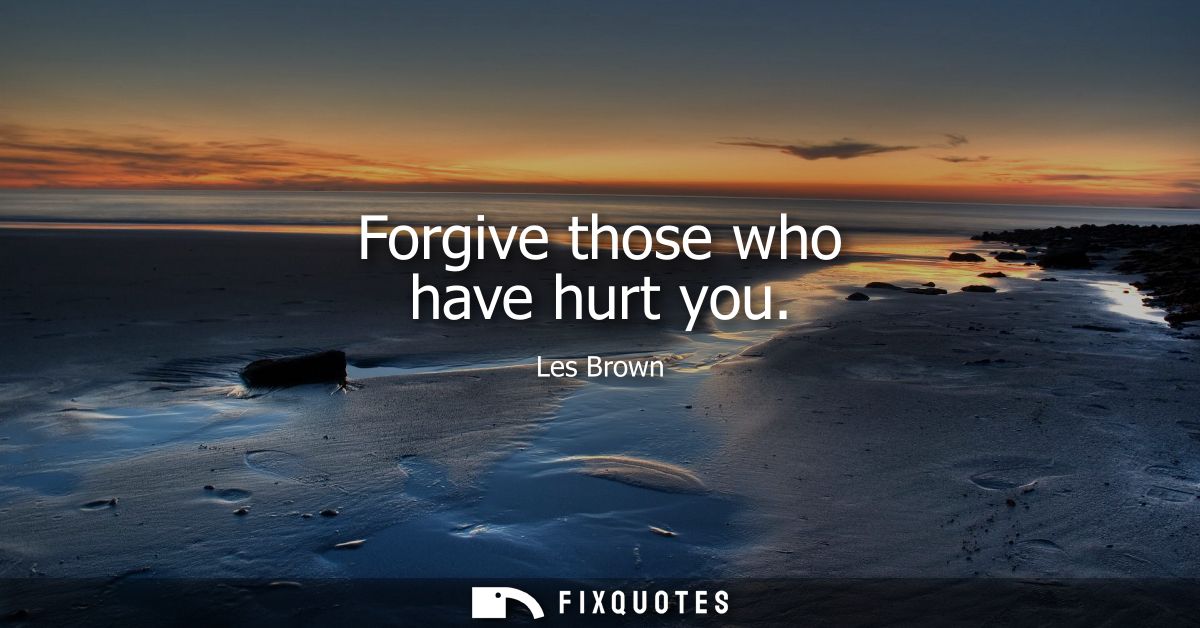
"Forgive those who have hurt you"
About this Quote
“Forgive those who have hurt you” is self-help as a power move: it reframes forgiveness not as a gift to the offender, but as an exit strategy for the injured. Coming from Les Brown - a motivational businessman who built a career on the language of personal agency - the line isn’t theological or sentimental. It’s transactional in the best sense: stop paying emotional interest on a debt someone else ran up.
The intent is pragmatic. Brown’s audience isn’t gathered for moral philosophy; they’re there to be un-stuck. Forgiveness, in this frame, is a tool for momentum. It clears cognitive bandwidth, breaks the loop of replaying betrayal, and makes room for the next choice you can actually control. The subtext is blunt: resentment feels like justice, but it behaves like a cage. You don’t forgive because they deserve it; you forgive because you do.
There’s also a quietly American context here - late-20th-century motivational culture, where inner life gets translated into performance: better habits, better outcomes, better “results.” That can sound reductive, but it’s why the sentence works. It’s short, imperative, and easily rehearsed at the moment you’re tempted to let an old wound steer a new day.
What’s left unsaid is the tension: forgiveness isn’t reconciliation. Brown’s line assumes boundaries can stay intact while bitterness goes. The command is less “make peace with them” than “stop letting them live rent-free in your head.”
The intent is pragmatic. Brown’s audience isn’t gathered for moral philosophy; they’re there to be un-stuck. Forgiveness, in this frame, is a tool for momentum. It clears cognitive bandwidth, breaks the loop of replaying betrayal, and makes room for the next choice you can actually control. The subtext is blunt: resentment feels like justice, but it behaves like a cage. You don’t forgive because they deserve it; you forgive because you do.
There’s also a quietly American context here - late-20th-century motivational culture, where inner life gets translated into performance: better habits, better outcomes, better “results.” That can sound reductive, but it’s why the sentence works. It’s short, imperative, and easily rehearsed at the moment you’re tempted to let an old wound steer a new day.
What’s left unsaid is the tension: forgiveness isn’t reconciliation. Brown’s line assumes boundaries can stay intact while bitterness goes. The command is less “make peace with them” than “stop letting them live rent-free in your head.”
Quote Details
| Topic | Forgiveness |
|---|---|
| Source | Help us find the source |
| Cite |
Citation Formats
APA Style (7th ed.)
Brown, Les. (2026, January 18). Forgive those who have hurt you. FixQuotes. https://fixquotes.com/quotes/forgive-those-who-have-hurt-you-22380/
Chicago Style
Brown, Les. "Forgive those who have hurt you." FixQuotes. January 18, 2026. https://fixquotes.com/quotes/forgive-those-who-have-hurt-you-22380/.
MLA Style (9th ed.)
"Forgive those who have hurt you." FixQuotes, 18 Jan. 2026, https://fixquotes.com/quotes/forgive-those-who-have-hurt-you-22380/. Accessed 31 Mar. 2026.
More Quotes by Les
Add to List