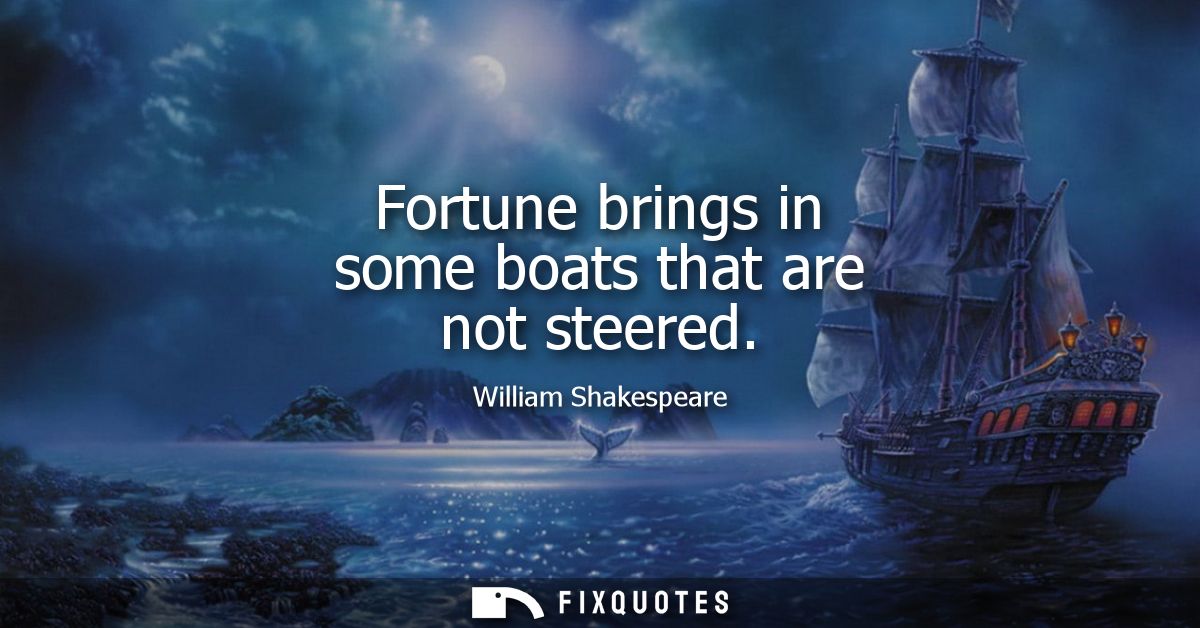
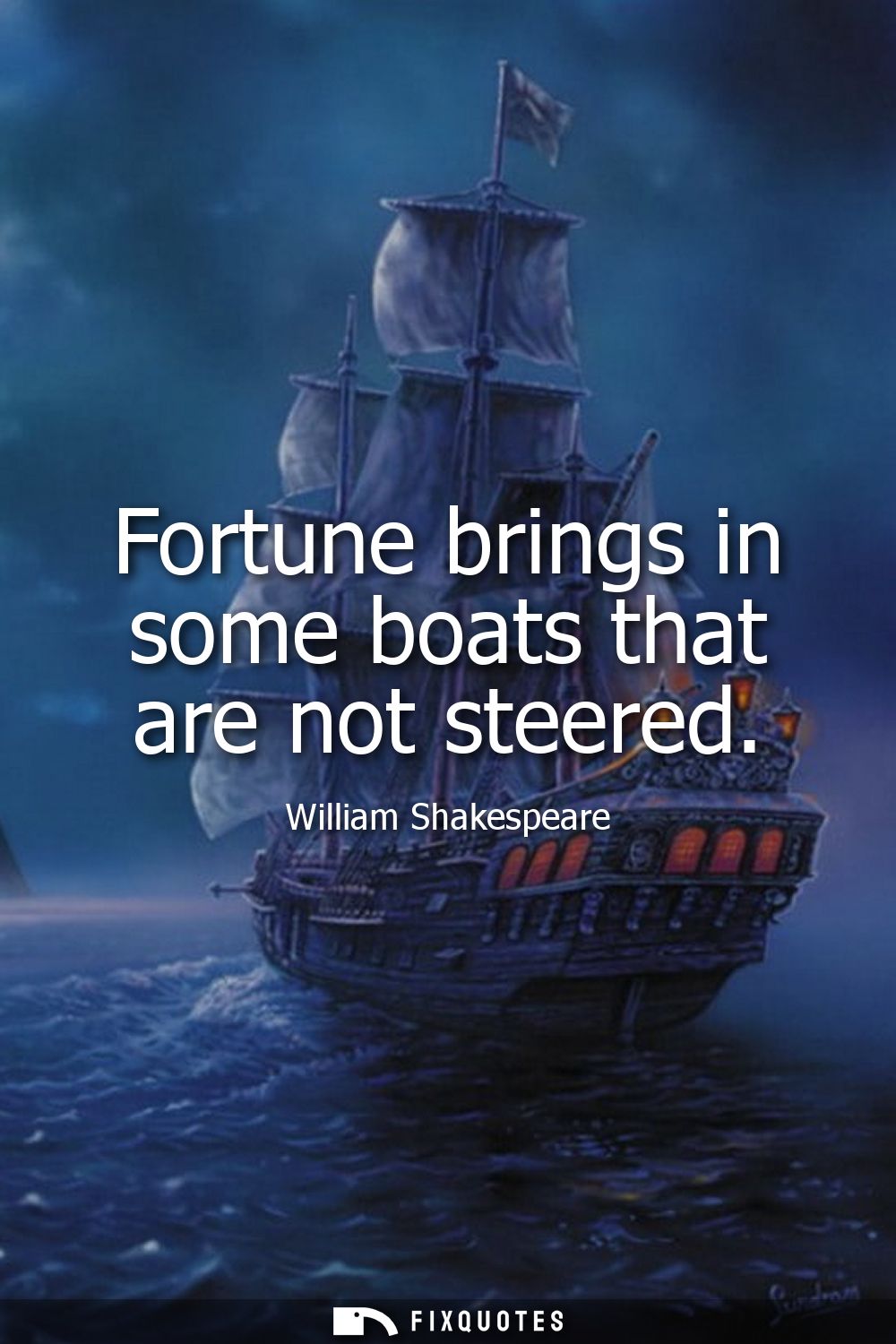
"Fortune brings in some boats that are not steered"
About this Quote
Shakespeare’s line treats luck like a smug harbor master: ships arrive, cargo intact, crews untested, and no one at the helm. “Fortune brings in” makes chance an active force, a stagehand rolling in a prop that looks like destiny. The sting is in the passive phrasing. These boats “are not steered” - not “weren’t steered by me,” not “lost their pilot,” just fundamentally ungoverned. It’s a neat little indictment of how easily people confuse arrival with achievement.
The intent isn’t to praise Fortune’s generosity so much as to sour it. In Shakespeare’s world, success often turns on misdelivery: letters fail to arrive, coincidences engineer reunions, storms redirect plots. Comedy and tragedy share this mechanism. Characters build elaborate narratives about merit and control, while the play keeps reminding you that outcomes are fickle, sometimes accidental, sometimes undeserved. That’s the subtext: the universe is not a moral accountant. It can reward the idle and punish the diligent with the same indifferent elegance.
Contextually, this fits the Elizabethan obsession with Fortune’s wheel, an old idea with a theatrical edge: today’s winner is tomorrow’s spectacle. Shakespeare uses the image of an unsteered boat to puncture human vanity and to foreshadow instability. What comes in without guidance can just as easily drift out, wreck, or be claimed by whoever shows up first. The line works because it’s both consoling and threatening: if you’ve failed, maybe it wasn’t you; if you’ve succeeded, don’t get smug.
The intent isn’t to praise Fortune’s generosity so much as to sour it. In Shakespeare’s world, success often turns on misdelivery: letters fail to arrive, coincidences engineer reunions, storms redirect plots. Comedy and tragedy share this mechanism. Characters build elaborate narratives about merit and control, while the play keeps reminding you that outcomes are fickle, sometimes accidental, sometimes undeserved. That’s the subtext: the universe is not a moral accountant. It can reward the idle and punish the diligent with the same indifferent elegance.
Contextually, this fits the Elizabethan obsession with Fortune’s wheel, an old idea with a theatrical edge: today’s winner is tomorrow’s spectacle. Shakespeare uses the image of an unsteered boat to puncture human vanity and to foreshadow instability. What comes in without guidance can just as easily drift out, wreck, or be claimed by whoever shows up first. The line works because it’s both consoling and threatening: if you’ve failed, maybe it wasn’t you; if you’ve succeeded, don’t get smug.
Quote Details
| Topic | Free Will & Fate |
|---|---|
| Source | Unverified source: Cymbeline (William Shakespeare, 1623)
Evidence: Act 4, Scene 3 (spoken by Pisanio); in the First Folio text it appears as: "Fortune brings in some Boats, that are not steer'd.". This line is from Shakespeare’s play Cymbeline (character: Pisanio), commonly referenced as Act IV, Scene III (often numbered Act 4, Scene 3). The earliest *publicatio... Other candidates (2) William Shakespeare's Cymbeline: A Retelling in Prose (David Bruce, 2016) compilation95.0% ... from the King , or I'll fall in the war . " Let all other doubts be cleared by time . Fortune brings in some boat... William Shakespeare (William Shakespeare) compilation36.7% going to set their coffins side by side and they are going to get tree to recit |
| Featured | This quote was our Quote of the Day on September 27, 2023 |
| Cite |
Citation Formats
APA Style (7th ed.)
Shakespeare, William. (2026, January 11). Fortune brings in some boats that are not steered. FixQuotes. https://fixquotes.com/quotes/fortune-brings-in-some-boats-that-are-not-steered-87123/
Chicago Style
Shakespeare, William. "Fortune brings in some boats that are not steered." FixQuotes. January 11, 2026. https://fixquotes.com/quotes/fortune-brings-in-some-boats-that-are-not-steered-87123/.
MLA Style (9th ed.)
"Fortune brings in some boats that are not steered." FixQuotes, 11 Jan. 2026, https://fixquotes.com/quotes/fortune-brings-in-some-boats-that-are-not-steered-87123/. Accessed 15 Mar. 2026.
More Quotes by William
Add to List